
How do you begin? From the first idea to the first scene
You want to write, but you can't find the beginning? Free writing, clustering and three ways into a scene will take you to your first one.
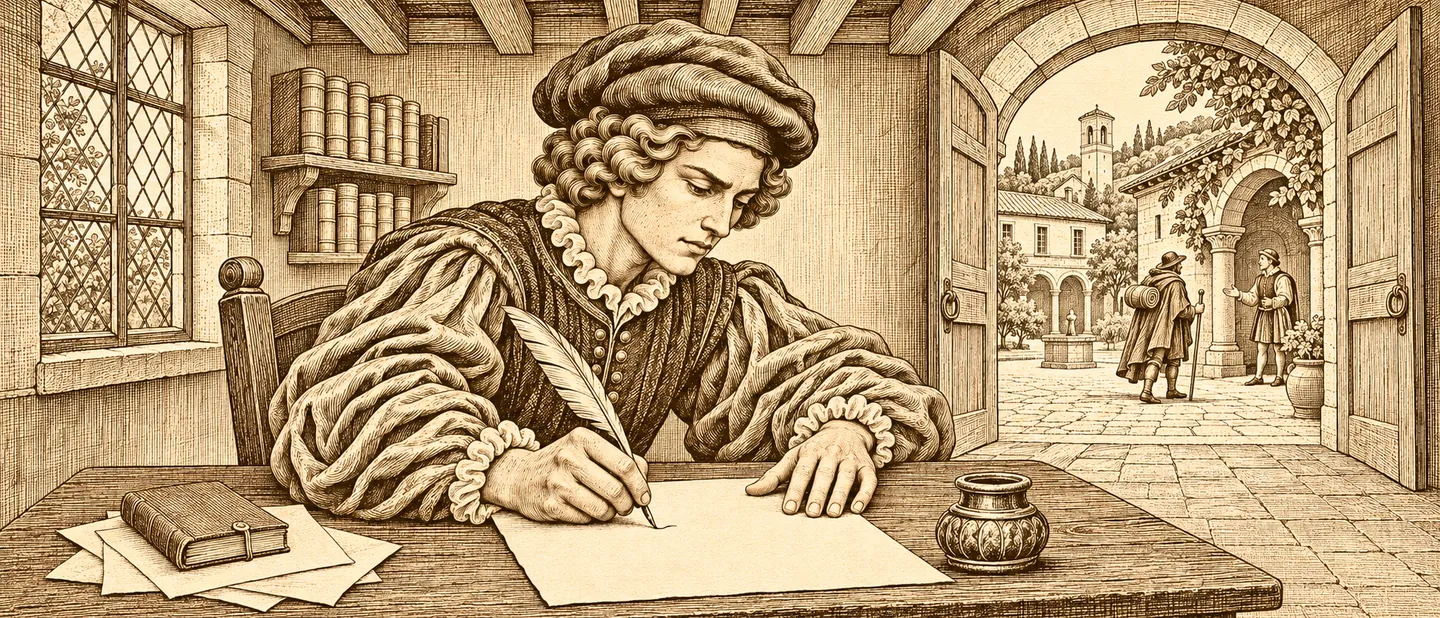
Sometimes a whole story is already in your head. You know the main character, you can see some of the settings, and you may even know how it all ends. And still the first sentence won't come. Sometimes it's the other way round: you want to write, but you have no idea yet what about.
There are simple exercises for both situations. You can start by just writing, gather thoughts in a cluster, or try out different ways into the same scene. Some of what you write this way won't end up in the manuscript. Those pages still help you find out what you want to tell.
Just start writing
If you check every sentence the moment you write it, it's easy to get stuck. As soon as a line is on the page, the questions start: Is this interesting enough? Does it sound good? Have I used that word already?
Free writing helps you stay in drafting mode for a limited time. You write down whatever comes to mind and only decide afterwards what's worth keeping.
A ten-minute exercise
- Set a timer. Ten minutes is manageable to start with.
- Pick a starting point. It can be an object, a memory or a sentence: “She hadn't stood in front of this door for years.”
- Keep writing without going back. Leave spelling mistakes where they are and don't improve anything yet.
- Write your way through a standstill. If nothing comes to mind, write exactly that. Then describe what your character might be seeing, hearing or doing right now.
- Read the text when the time is up. Mark a passage that interests you: an image, a surprising turn of phrase or a question.
Maybe a small scene comes out of it. Maybe you only find a single sentence you'd like to keep working on. Either is enough for the next step.
If complete freedom holds you back rather than helps, narrow the task down: a character is waiting for someone who won't come. Spend five minutes describing what she does. Constraints like this give you something concrete to focus on.
Finding themes with clustering
Some ideas are easier to gather when they sit side by side on one sheet. Clustering, popularised by the American writing teacher Gabriele L. Rico, works well for this: you start from one word and connect it to everything it brings to mind.
All you need is a sheet of paper and a pen. Leave plenty of room around the first word.
How to build a cluster
- Write a word in the middle and circle it. Choose something that's on your mind, such as “homecoming”, “envy” or “the empty house”.
- Note your first associations around it. Circle them too, and connect each new word to the one that sparked it.
- Follow individual thoughts further. “Homecoming” might lead to “station”, that to “farewell”, and that to “a broken promise”.
- Keep unexpected ideas as well. Memories, smells, sentence fragments and contradictions all belong.
- Look for a connection that makes you curious. Pick two or three words and write a few sentences about them.
You don't need neat categories. A cluster is allowed to get messy. What matters is whether you discover something in it that you want to follow up.
You'll find more ways to a theme in the post Finding writing ideas.
From a word to a story
Say the word in the middle is “key”. Several chains of thought grow out of it:
- key → parents' house → sold → last visit
- key → a stranger's flat → mix-up → someone is waiting
- key → drawer → letter → a secret life
Now you can make connections: on a last visit to her parents' house, which has been sold, a woman finds a key. It belongs to a flat her father never told her about.
That gives you a possible starting point. What the woman finds there and what follows is still open.
Ask next: who wants to achieve something here, and what stands in the way? An object becomes a story as soon as it means something to someone and sets something in motion.
Good openings in fiction
In a first draft you can start anywhere. For the version readers will see, a more deliberate choice pays off: at what point should readers first meet your story?
An opening can live on an unusual situation, a distinctive voice, a relationship or a quiet sense that something is off. It has to fit the story and give enough orientation to make people want to keep reading.
The following examples are made up and show different possibilities.
Starting with an action
As Mara put the key in the lock, the light inside went out.
An everyday movement gets an unexpected answer. We are close to the character and wonder who is in the flat.
Action doesn't automatically mean a chase or a fight. Someone setting a second plate on the table although they live alone can spark interest too.
Starting with a voice
My father left me three things: his debts, a useless compass and the request not to tell my mother about any of it.
Here the interest comes from the way the story is told. The choice of things and the final addition reveal an attitude towards the family.
If you start like this, the narrative voice should still be recognisable on the following pages. So don't just check the first sentence, check the paragraph after it too.
Starting with a relationship
“You can stay,” my sister said. She left the suitcase outside the door.
The invitation and the action don't quite match. That reveals a tension between the characters without having to explain their shared past yet.
An opening like this can carry a quiet family story as well. For now it's enough that we want to understand what stands between these people.
How much do you need to explain at the start?
Readers need something to hold on to: Who is experiencing the situation? What is happening right now? Why might it matter to this character?
The full backstory can come later. With every explanation in the first paragraph, check whether it's needed to understand the present moment.
A comparison:
Summary opening:
Mara hadn't been in touch with her father for twelve years. After his death she had returned to her hometown to clear out his house.
Opening with a scene:
Mara pulled open the bottom drawer. Between old bills lay an envelope with her name on it. Underneath it said: “In case you come after all.”
The first version gives a quick overview. The second draws attention to a discovery. Which one fits better depends on how you want to tell the story. Try both and write half a page further with each.
You'll find more on openings, first lines and common mistakes in the Writing Academy article How to Start a Novel: First Line, First Page, First Chapter.
Common difficulties when starting out
You keep revising the first paragraph. Jot down open questions in a short note and write to the end of the scene. With some distance it's easier to judge which opening it needs.
You explain your character's entire life story. Check which information makes their next action understandable. Other background can go where it plays a role.
You raise lots of questions but give little orientation. Mysteries can make readers curious. Still, give them something tangible: a recognisable situation, a place or an immediate concern.
You're waiting for a fully worked-out idea. Write a single encounter or discovery. It often shows which questions you need to answer for further planning.
A writing exercise: three openings for the same story
Take an idea from your cluster and write three short openings of about 100 words each:
- Start with an action.
- Start with a line of dialogue.
- Start with something your main character observes.
Read the versions aloud. Which one shows the character most clearly? Which one creates a concrete expectation? Which one would you yourself like to continue?
Choose one version and finish the scene. Keep the others if there's something in them you might use later.
Putting it into practice with Faustica
Start by creating a separate chapter in Faustica for your writing experiments. There you can write freely and collect different openings. Focus mode helps you concentrate on the text during a short writing session, and the focus timer takes care of the ten minutes from the exercise.
You can develop your cluster on paper or build it directly as a mind map in your project. As soon as a scene grows out of it, move it into the manuscript. Questions for later go into comments at the right place in the text. That way you can keep writing even while some decisions are still open.
Frequently asked questions
Do I have to start with the first chapter?
You can begin with the scene you can already see most clearly. Briefly note what would have to happen before it, and then write that scene first. You can decide later where it ends up in the book.
Do I need a finished plot before I start writing?
That depends on how you work. Some people find it easier to write with a plan, others discover their story while drafting. If you're not sure yet, start with a character, a goal and an obstacle. That's enough to try out a first scene.
When should I revise the opening?
Once you know enough of the story to judge its effect. After a few chapters you often know better what mood and which questions the opening should set up. Look at it again after the first draft, alongside the ending.