
Finding writing ideas: how to discover themes for your novel
The great themes of literature stay the same, what's new is the way you see them. How to find writing ideas in everyday life and turn a passing thought into a novel project.
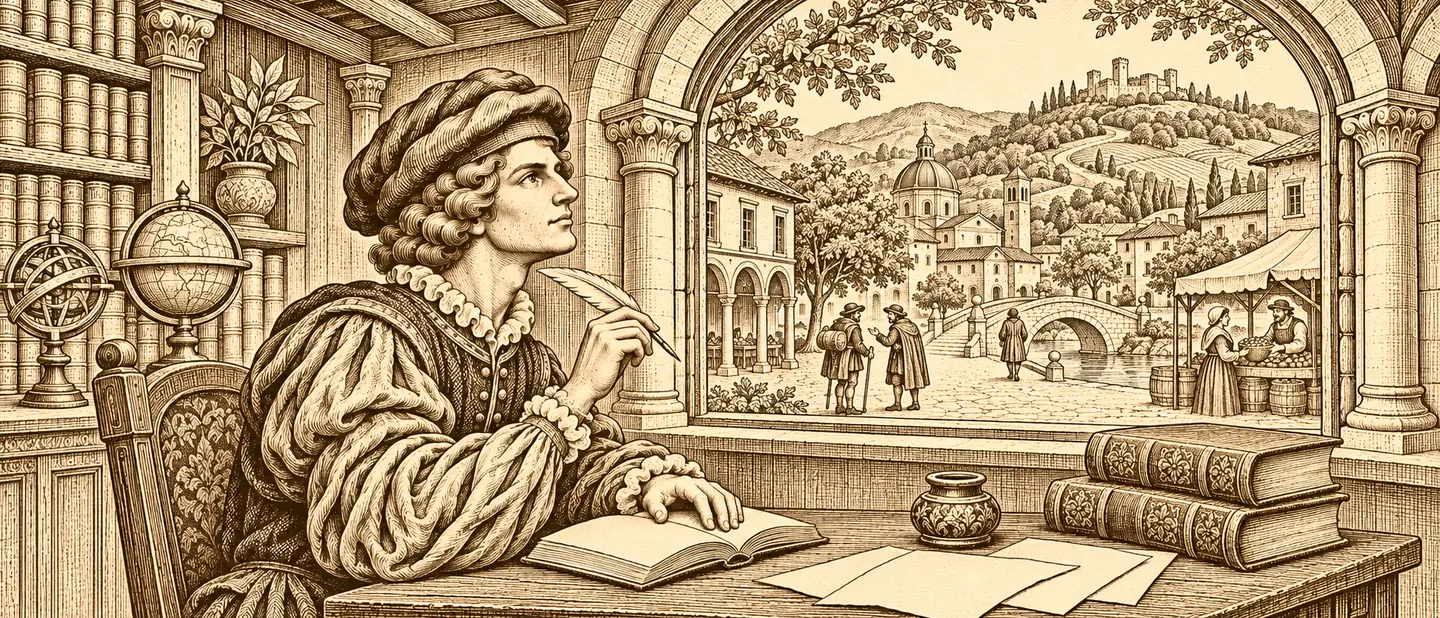
Maybe you know the feeling: you're sitting in front of a blank page, thinking, "Everything has already been written about." That's not entirely wrong. And yet every year books come out that move you as if you had never read anything like them.
So what do you want to write about? This article is about how to find writing ideas, why you don't need to invent a completely new theme, and how a passing thought can become the beginning of a novel.
In short
You don't have to invent a new theme. The great themes of literature, such as love, loss, guilt, power, identity, freedom and homecoming, have been told again and again for centuries. What makes a story special is usually not the theme, but the way you see it: the character, the situation, the detail that you in particular notice. And that material is often closer than you think. In everyday life, in conversations, in memories.
Theme, idea, premise: what's what?
These terms are often mixed up. When you're looking for a story, it helps to keep them apart:
- The theme is the question beneath the surface, for example forgiveness or loyalty. It doesn't yet say anything about what happens.
- The spark is what you come across first: an image, a sentence, a place, a character. It has energy, but often no direction yet.
- The novel idea emerges when a spark meets a character and a problem.
- The premise sums up the story in one or two sentences: who wants what, what stands in the way, and what's at stake?
You don't have to go through these stages in a fixed order. Some stories begin with a theme, others with an image that only reveals much later what it's really about.
Why there are hardly any new themes, and why that's good news
Time and again, people have tried to reduce all stories to a handful of basic patterns. In 1895, the Frenchman Georges Polti described thirty-six dramatic situations. In 2004, Christopher Booker arrived at seven basic plots in his book The Seven Basic Plots. Classifications like these are disputed and are better seen as thinking tools than as laws. But they do show how often the big patterns repeat.
A theme is only the foundation. It describes what the story is about at its core, forgiveness for instance. The story is what gets built on top of it: two sisters who, after twenty years of silence, have to clear out their parents' house together. Or a cook who returns to her former mentor the recipe she once stole from him.
One theme, countless stories. You aren't competing with everything that has ever been written. You're standing in a long tradition and adding your own voice to it.
The timeless themes of literature
- Love and loss: finding, holding on, letting go.
- Guilt and forgiveness: what we do to others and whether we can live with it.
- Power and powerlessness: who decides, who obeys, who fights back.
- Identity: who am I when everything changes?
- Freedom and belonging: breaking away or arriving.
- Coming of age: the moment the world is no longer what you thought it was.
- Good and evil: and the grey area in between.
- Transience: time, age, death and what remains.
The list isn't complete, and many stories combine several of these themes. So don't just ask yourself "What's my theme?", but also "Which of these questions won't let go of me?" A theme that matters to you personally can help you keep going over many months and hundreds of pages.
How to find out which theme matters to you
Sometimes you don't really know what you want to write about. A few questions can help:
- What makes you angry or sad? Strong feelings often show where something really matters to you.
- What do you keep talking about? Topics you come back to again and again usually have a reason.
- Which books and films have stayed with you? See whether they have something in common. Maybe not the genre, but a question they ask.
- What have you already written? If you have old notes, diaries or unfinished texts, they're worth a look. Sometimes the same motifs turn up in very different pieces.
- What don't you understand? You don't need to know the answer. A story often becomes interesting precisely when you're searching for an answer yourself as you write.
Where stories are right in front of you
- Overheard snippets: a sentence from the café can become the first line of your novel.
- Places: an abandoned train station, your grandmother's flat. Places often tell stories on their own.
- Memories: what happened to you as a child that you never fully understood?
- Family stories: the story that gets told at every family gathering, and the one nobody talks about.
- Jobs: every profession has its own rules, conflicts and secrets. What do you know from your working life that others don't?
- Contradictions: the friendly neighbour who never has visitors.
- The news: behind many reports are people nobody writes about any further.
- "What if …?": one of the most versatile questions in your toolbox. Take something familiar and change a single condition.
An observation on its own is usually not yet a story. But observation, theme and a character who wants something: that can be the beginning.
A note if you draw on your own life: if real people become recognisable in your text, that can be delicate not only on a personal level but also legally, because a fictional character can still touch the rights of a real person. The rules differ from country to country. It often helps to disguise characters, mix traits and change places. If you're unsure, get legal advice before you publish.
Retelling the familiar
Not every idea has to come out of nowhere. Many stories come about by shifting something familiar:
- Change the perspective: what does a well-known story look like from the point of view of a minor character or the antagonist?
- Move it in time or place: what happens when an old tale is set in the present, in a small town instead of at a royal court?
- Turn a convention around: the mentor lies, the rescuer is the culprit, the treasure is a curse.
- Combine two things that don't belong together: a profession and a genre, a historical era and a present-day question.
If you deliberately draw on an existing work: ideas and themes as such are generally not protected by copyright, but the concrete expression of a work is. In Germany and the rest of the EU, protection for works whose authors died more than 70 years ago has usually expired. Other countries have their own rules. This is a rough guide, not legal advice. If you want to publish a retelling, it's worth taking a closer look when in doubt.
Can your idea carry a novel?
Not every good spark is enough for a whole novel. Some carry a short story, some a single scene. That's not a flaw. A few questions can help you judge:
- Does someone want something, and does something stand in the way?
- Is there a character readers would want to follow?
- Can the situation change or escalate several times?
- Is there a question that can stay open until the end?
- Are you still interested in the idea after a few weeks?
If you don't have answers to some of these questions yet, that doesn't mean the idea is no good. Often you only find the answers as you keep thinking or start writing. The Writing Academy goes into this in more depth in the article Story ideas: how to find and develop a novel idea.
From spark to story in 5 steps
- Capture the idea straight away. Ideas are fleeting. In Faustica you can collect them in your notes and link them to chapters or compendium entries once they've found their place.
- Name the theme. What is it about beneath the surface? One sentence is enough to start with. It's allowed to change later.
- Find a character who wants something. Create an entry for them in the compendium: what do they want? What holds them back? What do they fear?
- Make connections visible. A mind map can turn loose thoughts into a web in which you spot connections more easily.
- Sketch the arc. In the plot you can note the goal, conflict and outcome for each scene, and in the timeline you can arrange the chronological order. That way you often notice early on where your story still has gaps.
These steps are a suggestion, not a must. If you prefer to just start writing, you can begin with a scene and catch up on the planning later.
An idea collection that actually helps
Many writers end up with more ideas than they could ever use. A few habits help keep them from getting lost:
- One fixed place: notebook, phone or writing software, what matters more than the tool is always using the same place.
- More than a keyword: don't just note the idea, but also what draws you to it. "Old train station" may mean nothing to you six months later, "Old train station where someone waits every evening for a train that no longer runs" probably will.
- Look through them regularly: some ideas fade after a few weeks, others grow stronger. And sometimes two old notes suddenly fit together.
- Ideas can wait: not every spark has to become a novel right away. Some take years until you find the right story for them.
When nothing comes to mind
Sometimes nothing comes. That's normal and not a sign that you can't write. The reasons can vary a lot: tiredness, too much pressure, the expectation that the idea has to be perfect right away.
It often helps to lower the bar. Don't look for the one big idea, but for a small question that interests you. Write down ten bad ideas instead of waiting for a good one. Go for a walk, read something outside your genre, listen to people. Many ideas don't come at the desk but along the way, and some only once you're writing.
If you're not stuck before the idea but in the middle of your text, the Writing Academy has suggestions in the article How to overcome writer's block.
A small exercise for today
Take ten minutes. Pick one of the themes above and a place you've seen this week. Write a scene in which a character is confronted with exactly that theme in that place. Don't judge, don't correct, just write.
If you like, do the same tomorrow with a different theme and the same place. You'll see how differently one and the same place can feel.
Perhaps you'll notice along the way: some stories were already there. You just had to look.
Frequently asked questions
Are there any new themes left to write about?
Truly new themes are rare. What's new is usually the character, the situation and your personal view. That's enough for a story to feel like its own.
How do I find an idea for my novel?
There's no single way. Many people find it helps to observe everyday life consciously, write ideas down straight away and ask themselves: "What if …?"
What's the difference between theme and plot?
The theme is the core, for example forgiveness. The plot is what actually happens. One theme can carry countless different plots.
What if a book with my idea already exists?
That happens a lot and is usually no reason to give up. Two people with the same basic idea will generally still write very different books. It can be worth reading the other book, though, to see what you'd like to do differently.
Can I borrow ideas from other books?
Themes, motifs and basic ideas are generally free to use. What's protected is the concrete expression, such as the text itself, fully developed characters and distinctive plot details. Exactly where the line lies depends on the individual case.
Should I work on several ideas at once?
That depends on the person. Some need a single project to stay on track, others like to switch. If you notice that you keep starting over and nothing gets finished, it can help to deliberately commit to one idea and park the others in your idea collection.
What should I do if nothing comes to mind?
Don't look for the perfect idea, but for a question that occupies you. Many ideas only emerge while writing, not before.
Your story is waiting
From the first note to the finished manuscript: Faustica brings ideas, characters, plot and text together in one place. You can try it free for 30 days with every feature, no account and no payment details required.