
How to write a book: a guide in 10 steps
How do you write a book? A guide in ten steps, from the first idea through characters and plot to the finished manuscript.
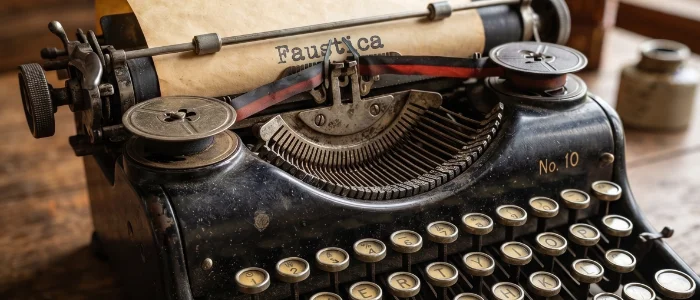
You have an idea. Maybe you've had it for years. A character who drifts through your mind as you fall asleep. A scene you can see in every detail. A sentence that simply belongs in a book. And at some point you type the question into a search engine: how do you actually write a book?
I know that question well. I'm not an author (yet). I have an idea for a book, and I want to write it. Along the way I've read a lot, taken a creative writing course, tried out plenty of things and in the end even built my own writing app. In this article I share what I've learned: ten steps from the first idea to the finished manuscript. Not a secret recipe, but a path you can hold on to.
In short: how to write a book
- Find an idea that won't let go of you.
- Sum up your story in one sentence.
- Get to know your characters.
- Build the world your story takes place in.
- Plan your plot, as closely as you need to.
- Write the first draft without looking back.
- Make writing a habit.
- Revise with some distance.
- Get honest feedback.
- Get your manuscript into shape.
Sounds like a lot? It is. But none of these steps is hard if you take them one at a time. Let's go through them in order.
1. Find an idea that won't let go of you
You don't start with a perfect idea. You start with an idea that won't leave you alone. Writing a book takes months, often years. There will be weeks when nothing moves forward. What carries you through them is genuine interest in your story, not a trend you happen to see in the book market.
Ask yourself three questions:
- Would I want to read this book myself?
- What exactly fascinates me about it: the character, the world or the question behind it?
- Do I still feel like writing it a week from now?
Write ideas down right away, even the half-finished ones. Many stories only come about when two small ideas meet that wouldn't have been enough on their own. A sentence on your phone, a note on the shopping list, everything counts. The only thing that matters is that you can find your notes again later.
2. Sum up your story in one sentence
Before you write hundreds of pages, try a single sentence. It answers three questions: Who wants what? What stands in the way? And what's at stake?
An example: A retired detective wants to solve the one case she failed to crack back then, but the only witness is her own brother.
This sentence doesn't have to be pretty. It's your compass. When you no longer know where things are heading in chapter three, read it again. Does the scene you're working on belong to this story? If not, that's a hint, not a ban. Sometimes you'll also notice that your story has changed. Then write a new sentence.
3. Get to know your characters
Readers rarely follow a plot. They follow characters. That's why it pays to know your protagonists better than the book will ever show.
Helpful questions for every important character:
- What do they want, and what do they really need?
- What are they afraid of?
- What are they hiding, perhaps even from themselves?
- How do they change by the end?
Then there are the small details that get lost so easily. A character reappears after five chapters, and suddenly the question comes up: what color were her eyes? Or how old was her sister? Or is she left-handed? So write down everything you decide about your characters.
I built the Compendium in Faustica for exactly this moment. Every character gets an entry with a photo, roles, tags and sections of your own. The “Ideas” questions in the entry help you think a character further when you don't know what else to tell about them. And under Relationships you see as a graph who is connected to whom: related, hostile, in love.
4. Build the world your story takes place in
Worldbuilding sounds like fantasy, like maps and invented languages. But every story has a world. Even a crime novel set in a small town needs places, habits, clubs and old stories nobody talks about.
A few prompts:
- Places: What does the pub where your characters meet smell like? What can you see from the window?
- Rules: What is normal in your world, what is forbidden, what is unthinkable?
- History: Which events happened before the book and still have an effect?
An honest piece of advice: build only as much as your story needs. Worldbuilding can be great fun and at the same time a very comfortable way of not writing. I speak from experience.
Besides characters and places, the Compendium in Faustica has categories for countries, organizations, items, events, cultures and much more. You can create categories of your own if something is missing. For loose thoughts that don't have a fixed place yet, mind maps are a good fit.
5. Plan your plot, as closely as you need to
This is where opinions differ. Some authors plan every scene before they write the first line. Others just start writing and discover the story along the way. Both are fine. Most end up somewhere in between.
If you want to plan, proven structures help as a framework:
- Three-act structure: Setup, confrontation, resolution. Simple and solid.
- Hero's journey: The character leaves their familiar world, is tested and returns changed.
- 15 beats: A finer division with fixed turning points.
- 7 points: From the starting state through the turning points to the resolution.
None of these structures is a law. They're aids for seeing whether your story sags somewhere or whether the climax comes too early.
It gets tricky as soon as you have several storylines. Then it's easy to lose sight of the fact that a subplot has been silent for seven chapters. In Faustica's plot planner you lay out your storylines and chapters as a grid and fill it with scene cards. The four structure templates above are built in. A tension curve shows you how the tension develops across the book, and Faustica points out storylines that are currently resting.
If your story plays with time, with flashbacks, parallel events or several points of view, a timeline is worth it as well. There you see what happens at the same time and find contradictions before your readers do.
6. Write the first draft without looking back
Now comes the most important step, and the simplest advice for it: the first draft is allowed to be bad. It's even supposed to be. Its only job is to exist.
What helps:
- Don't revise while you write. Anyone who polishes every chapter three times rarely gets past the fifth.
- Mark gaps instead of researching. You don't know what a train looked like in 1910? Write “[research]” in the text, link a note or comment on the passage and keep going.
- Skip scenes. If a scene is stuck, write the next one. You'll close the gap later.
Distractions are the biggest enemy of writing. That's why the editor in Faustica has a focus mode that hides the navigation so only your text remains. For passages you want to revise later, you can attach comments directly to the text.
7. Make writing a habit
Books aren't written on one inspired weekend. They're written on many ordinary days. A little arithmetic: if you write 500 words every day, you'll have around 90,000 words after six months. That's a whole novel.
How writing becomes a habit:
- A fixed time: In the morning before work, during your lunch break, in the evening after dinner. As long as it's regular.
- Small goals: Better 300 words every day than 3,000 on one day a month.
- Writing sprints: 25 minutes of nothing but writing, then a break. It outsmarts the fear of the blank page.
- Make progress visible: It's motivating to see the manuscript grow.
For sprints, Faustica has a focus timer you can set freely. The project statistics show your writing history by day, week and month, and how many days in a row you've kept at it. Only ever compare yourself with yourself, never with other people's numbers.
8. Revise with some distance
When the first draft is done: congratulations. Many people never get that far. And now put it away. A few weeks of distance work wonders. Afterwards you read your text almost like a stranger would, and that's exactly what you need.
Revise in several passes instead of all at once:
- Structure: Is the order right? Are scenes missing, are some superfluous?
- Scenes: Does every scene have a goal? Does something change?
- Characters: Do they all act consistently? Does the protagonist develop?
- Language: Shorten sentences, cut filler words, find your pet words.
A good trick for the last pass: read your text aloud. You'll hear right away where it stumbles.
Pet words in particular are treacherous. Everyone has some, and you hardly notice them yourself. In Faustica, the Repetitions panel shows you which words appear conspicuously often in a chapter or in the whole manuscript and highlights them in the text. With the synonyms you find an alternative straight away, offline and without your text being sent anywhere.
While revising you'll also delete things you might miss later. Faustica automatically saves a version with the first change of the day, and you can restore up to 30 of them. And as a general rule: back up your manuscript regularly in a second place, for example on an external hard drive. No app replaces a backup strategy of your own.
9. Get honest feedback
At some point you're too close to your text to see it objectively. Then you need other eyes. Beta readers don't have to be professionals, but they should like the genre you write in and be allowed to be honest.
Give them specific questions:
- Where were you bored?
- Where were you confused?
- Which character interested you most, and which not at all?
- When did you absolutely want to keep reading?
You don't have to act on every piece of feedback. But if three people stumble over the same passage, it's rarely the people.
For this step, Faustica lets you export your manuscript for editing as a Word file with track changes. Your beta readers work in the program they're used to. You import the revised file back and compare it with your original in the split view.
10. Get your manuscript into shape
What happens next depends on what you have in mind for your book.
For agents and publishers, standard manuscript format is usually expected: a plain, readable layout, typically with a 12-point font, double line spacing and generous margins. On top of that, most ask for a query letter, a synopsis and a sample of the first pages or chapters. Exactly which documents they want is stated by the agents and publishers themselves, and it's worth reading their guidelines carefully beforehand.
For self-publishing you need a cleanly typeset e-book and, if you like, a print-ready file for a paperback.
The export in Faustica creates Word, PDF, e-book (EPUB) and Markdown. There are presets for paperback, manuscript standard format and e-book, and you can add a cover image, a table of contents, page numbers and drop caps.
Frequently asked questions about writing a book
How long does it take to write a book?
That varies a lot. It depends on how much time you have each week, how long your book will be and how much you plan and revise. For a first novel alongside a job and everyday life, one to two years is not unusual. Sticking with it matters more than speed.
How many words does a novel have?
As a rough guide, many novels have between 60,000 and 100,000 words. Depending on the genre this can vary considerably: fantasy often runs longer, some crime novels and romances shorter. For the first draft: write the story as long as it needs to be. You can cut later.
Do I need special writing software?
No. Many books were written in a perfectly ordinary word processor, some even by hand. Writing software won't write your book for you. But it can help you keep track when characters, places, notes and storylines pile up. That's exactly what I built Faustica for. Faustica doesn't do everything, but it keeps everything important about your book in one place.
Do I have to plan everything in advance?
No. Some authors plan a lot, others hardly at all. Try out what suits you. If you keep getting stuck once you start writing, a bit more planning helps. If a finished plan bores you, allow yourself more freedom.
How do I start if I've never written before?
With a scene you can already see. It doesn't have to be the beginning of your book. Write it down as well as you can and see where it takes you. The first step isn't to write a book. The first step is to write a few sentences today.
Finally
I'm also still at the beginning with my own book idea. What I've learned so far: a book doesn't come from the perfect method, but from coming back again and again. Sometimes with 1,000 words, sometimes with a single sentence.
If you're looking for a calm environment where manuscript, characters, plot and notes sit together in one place, give Faustica a try. You can test it free for 30 days with every feature, no payment details required. No AI, no cloud, no subscription. Your writing belongs to you.
Download Faustica for Windows and macOS
And if you'd like to tell me what you're working on right now: I read every message myself.