
The best way to overcome writer’s block is to find out first what is behind it and then choose a method that fits that cause. Often the blank page does not point to a lack of talent but to a concrete problem: you do not know what should happen in the next scene, your expectations of the first draft are too high, the project feels too big, or you simply lack time and energy. Each of these causes has different ways out, and almost all of them start with a very small step.
On this page you will find the most common causes, methods that match them, an example of a stuck scene, and common mistakes and practical tips. This page is no substitute for professional help: if a block comes with lasting exhaustion, low mood or anxiety that reaches beyond writing, talking to a doctor or a counselor makes more sense than any writing technique.
What writer’s block is
Writers speak of writer’s block when they want to write but cannot manage it for a longer stretch of time. It can show up as a blank page, as endlessly rewriting the same paragraph or as escaping into everything else, from research to tidying the desk.
It helps to distinguish between a block and a break. Not every day without new words is a problem. Many stories need time to think, and planning, research and revision are work on the book too. It becomes a block when you feel stuck and do not know how to get moving again.
The most common causes
- The story does not know where to go. You do not know the goal of the next scene, or an earlier mistake in the plot makes the next scene impossible. You often sense this before you can name it.
- Perfectionism. Every sentence has to be good right away. The first draft is measured against the finished book, and every line fails that standard.
- The project is too big. “Write a novel” is not a task you can start on a weeknight. If you see the whole book in front of you every time, you find no way in.
- Fear of judgment. The thought of what others might think of the text is writing along before anyone has even read it.
- Lack of time and energy. Job, family, tiredness: sometimes the cause lies not in the text but in everyday life.
- The spark is gone. The story has developed in a direction that no longer interests you. That is important information, not a weakness.
Methods that fit the cause
When the story does not know where to go
- Go back to where it was still working. The problem often lies not in the scene where you are stuck but one or two scenes earlier: a decision that does not suit the character, or a conflict resolved too early.
- Answer three questions about the scene. What does the character want here, what stands in their way, and how has the situation changed by the end? More on this in the guide to writing scenes.
- Collect possibilities instead of one solution. Write down ten things that could happen next, including absurd ones. The most useful ones are often among the last.
- Skip the scene. Insert a placeholder such as “[here: argument at the inn]” and write the next scene you can see clearly. You can fill in the gaps later.
If the problem runs deeper, look at the whole plot. The guide to developing a plot helps you check whether your turning points and chains of cause and effect hold up.
When your standards are too high
- Allow yourself a bad first draft. The first draft is there to find the story. Good sentences are what revision is for. The guide to revising a manuscript describes how that works.
- Write without looking back. Do not reread what you have written during the same session. If you keep correcting, you do not move forward.
- Freewriting. Set a timer for ten minutes and write without stopping whatever comes to mind about the scene, even in keywords or without proper sentences. The goal is not usable text but movement.
When the project feels too big
- Shrink the task. Not “write chapter 12” but “the first sentence of the scene” or “fifteen minutes on the text.” A small goal you reach carries you further than a big one that paralyzes you.
- Work in fixed time blocks. The Pomodoro Technique, developed by Francesco Cirillo, alternates short work periods with breaks. A fixed frame takes away the decision of whether to write right now.
- Write at set times. A routine, such as half an hour every morning, turns writing into a habit instead of a daily act of willpower.
When energy or motivation is missing
- Take a deliberate break. Set a date on which you will return. A planned break feels different from a project that slowly fizzles out.
- Change something about the setting. A different place, a different time of day, writing by hand: small changes can help you see the familiar with fresh eyes.
- Question the direction. If the story no longer interests you, think about what drew you to it in the first place and whether it has moved away from that. Sometimes the answer is a new twist, sometimes a new project. You will find ideas in the guide to finding story ideas.
An example: stuck before an encounter
The example is a stalled scene from an invented suspense novel: ferrywoman Rika discovers drugs in her childhood friend Hauke’s cargo. He advanced repair costs and wants to keep using her crossings. She wants to quit. Suppose their confrontation has stalled: they talk, but nothing changes.
First check the scene’s purpose: Rika wants him to remove the drugs and let her leave the arrangement. He wants further shipments. If he only evades and she keeps asking, the scene lacks a change.
A possible turn is his aggressive shift in tone: “We’ll find a solution” becomes “You sail when I say.” Rika now knows the familiar friend does not respect her refusal. Fear changes her next move: openly quitting no longer seems safe, so she needs an indirect plan.
Write two sentences first: what does she want at the start, and what does she additionally know or fear at the end? Then work on dialogue. Otherwise, polishing every greeting may repair the wording of a scene whose course remains unresolved.
Common mistakes
- Waiting for inspiration. If you only write when the urge comes by itself, you often write little. Many writers report that motivation tends to arrive during writing rather than before it.
- The wrong method for the cause. A writing timer does not help when the plot does not hold up, and a plot analysis does not help when your energy is gone.
- Endless planning as a substitute. Research and planning feel productive, but they can also be a way of avoiding the page. Set yourself a limit after which you go back to writing.
- Comparing yourself with others. Other writers’ word counts and success stories say little about your path. Comparing yourself with your own progress is more helpful.
- Constantly revising the first draft. If you keep starting over at chapter 1, you rarely reach the middle.
Practical tips
- End every writing session in the middle of a scene whose next steps you know, and jot down a note for the next sentence. That makes it easier to get started the next day.
- Keep a short writing log: when did it go well, when not? Patterns often only become visible after a few weeks.
- Tell someone the stuck scene out loud. While explaining it, you often notice where the gap is.
- Keep a list of scenes you would love to write. When you are stuck in one place, pick one of them.
Using Faustica
In the Editor in Faustica, Focus Mode hides everything except your text, so the chapter tree and tools do not distract you. The focus timer helps you stick to set writing sessions, for example short blocks following the Pomodoro Technique, and a daily goal shows how many words you have already written today. You can deliberately set the daily goal low so that it stays within reach.
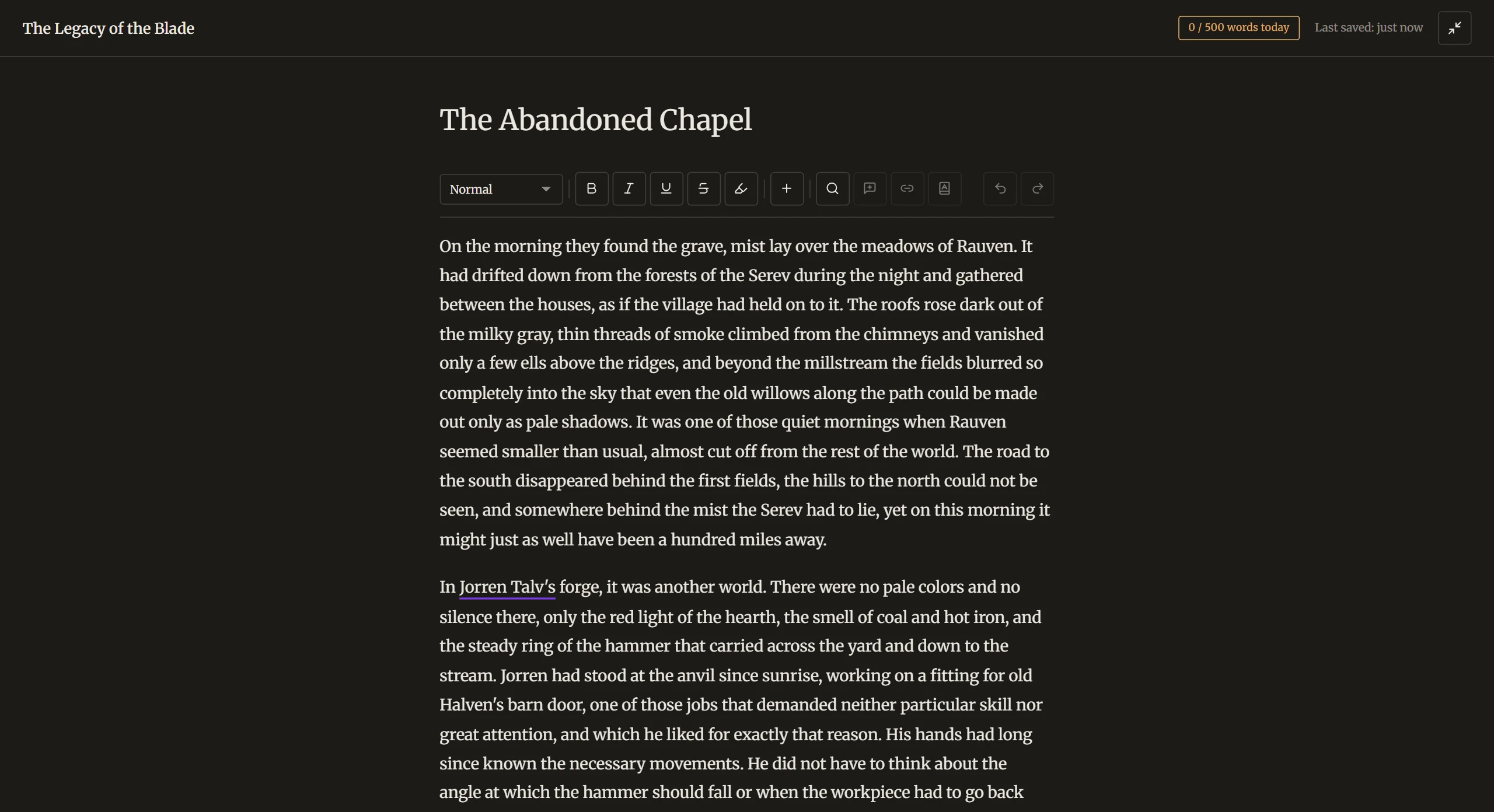
Project Statistics shows your writing history by day, week or month in the writing flow view, along with your streaks and writing time, and the weekday and time of day at which you write most. That can complement a writing log. When a scene is stuck, you can think it through in the Plot Planner with goal, conflict and outcome, or collect ideas in Notes, without touching the text itself.
Frequently asked questions
Is writer’s block real?
Many writers know phases in which writing will not come, even though they want it to. Whether you call it a block or not matters less than the question of what is behind it. Usually you can find a concrete cause to work on.
How long does writer’s block last?
That varies widely, from a few days to longer phases. There is no fixed duration. If a block lasts a long time and comes with exhaustion or low mood that reaches beyond writing, professional support is a better path than more writing techniques.
Should I work on another project while I am blocked?
That can help if you have lost interest in your main project and a new one gets you writing again. But it can also be an escape if the real problem is a difficult scene. In that case, decide when you will return to the main project.
Does it help to write every day?
For many writers a fixed routine helps, because it removes the daily decision of whether to write. It does not have to be daily, though: three fixed sessions a week can be a solid routine too. What matters is that it fits your life.