
You rarely find a story idea all at once. Usually it starts as a seed: an image, a character, a situation or a question that won’t let go of you. It becomes an idea for a novel when you develop it with questions until a conflict appears: Who wants something, what stands in the way, and what is at stake? The most important sources are your own observations and questions, playing with “What if …?” and combining things that don’t belong together. Just as important is capturing ideas the moment they come, so they don’t get lost.
This page covers the step before planning proper: where ideas come from, how to collect them, how to test whether an idea can carry a whole novel, and how to develop it into a premise. What comes after that is described in the guide How to plan a novel.
Seed, idea, premise
These terms are often used interchangeably. For practical work, it helps to tell them apart:
- The seed is the first spark: “extra cargo on a ferry.” It has energy but no direction yet.
- The story idea connects the seed with a character and a problem: a ferrywoman discovers drugs in her childhood friend’s cargo and is threatened when she tries to quit.
- The premise sums up the story in one or two sentences: Who wants what, who or what stands against them, and what is at stake?
Many abandoned manuscripts fail not because of a weak seed but because the seed was never developed into an idea. A fascinating image carries a few pages; a conflict carries a novel.
Where story ideas come from
- “What if …?” Take something familiar and change one condition. What if objects remembered their owners? What if someone woke up speaking a different language every morning? The question immediately produces consequences, and consequences produce plot.
- Combine two things. An idea often becomes interesting when two unrelated elements collide: a profession and a genre, a place and a conflict, a historical period and a present-day question.
- Observe. Conversations, news stories, places, jobs, family histories. The thing itself isn’t the idea; the question it raises is: Why would someone do that? What would have happened if …?
- Start with a character. Some stories grow out of a person you can picture vividly. Then the question is: What is the worst thing that could happen to this character, and what would they do?
- Start from a theme. A question that preoccupies you, such as guilt, memory or loyalty, can form the core. It then needs a situation in which characters live through it instead of debating it.
- Flip a convention. Take a familiar genre situation and turn it around: the messenger is the culprit, the mentor is lying, the treasure is a curse.
Ideas come more often when you expect them. If you note down ideas regularly, you’ll start noticing more of them over time.
Capturing ideas
An idea that isn’t written down is often gone the next day, or paler than it was. That’s why ideas need a fixed home: a notebook, a notes app or a collection in your writing software. The tool matters less than the habit of always using the same place.
When you note an idea, it helps to record not just the idea but also what excites you about it. “Ferry and extra cargo” may no longer remind you what interested you six months later. The note “A ferrywoman helps her childhood friend and discovers drugs in his cargo: how does she resist when the familiar helper suddenly frightens her?” also captures the conflict that draws you to the idea. Open questions in note form are just as useful. They record what hasn’t been decided yet, without forcing you to decide it right away.
Testing whether an idea can carry a novel
Not every good idea is an idea for a novel. Some carry a short story, some a single scene. Five questions help you judge:
- Is there a conflict? Does someone want something, and does something stand in the way? Without conflict, the idea remains a situation.
- Is there a character readers will want to follow? The idea has to affect someone whose path readers care about.
- Can the situation change? A novel needs turning points. Does the idea allow several stages of escalation, or has everything been said after the first twist?
- Does the idea have a question that lasts until the end? A short story answers its question quickly. A novel needs one whose answer can be held off for a long time.
- Does it still interest you after a few weeks? A novel stays with you for a long time. An idea that excites you only briefly will struggle in the middle of the draft.
If an idea fails one of these questions, it isn’t worthless. Often it just lacks a second element, which you might find by combining it with another idea from your collection.
An example: from a seed to a conflict
A first spark might be: “A ferrywoman unknowingly transports drugs.” That promises a discovery, but says little about how she gets into this situation or why she cannot simply leave it. Four questions develop it into a story:
- What does the character want apart from the smuggling? Rika wants to keep her island supplied through winter after the daily ferry service is withdrawn. She organizes additional crossings with her own small boat. Her income depends on the service too.
- How does she become involved? An engine failure leaves her unable to pay for repairs. Her childhood friend Hauke advances the money; in return, she carries his seemingly harmless cargo on the return crossings. Only later does she discover the drugs.
- Why can’t she simply stop? When Rika refuses further shipments, Hauke threatens to destroy her boat and implicate her as the organizer of the smuggling. She trusted him, owes him money and now fears for her livelihood.
- Which decisions of her own can drive the plot? Rika fears Hauke’s aggressive behavior. Rather than confront him openly again, she fakes an engine failure so he transports the cargo himself. An anonymous tip is intended to prompt a check while he has the load. Further planning must establish why he believes the deception and whether she can sustain it despite her fear.
One possible premise: A ferrywoman who unknowingly transported drugs is blackmailed into continuing and tries to expose her blackmailer while he transports the cargo himself.
The smuggling alone was a seed. Rika’s own purpose explains why she accepts Hauke’s offer; personal and financial dependence makes leaving harder. Planning the trap gives her a goal she can actively pursue. Further planning must establish when Hauke becomes suspicious and what consequences Rika’s decisions have for her service and the island. The Snowflake Method example shows how this material can grow into a paragraph and character summaries.
Common mistakes
- Waiting for the perfect idea. Ideas get good through work, not through waiting. An ordinary seed with a strong question can carry more than an original notion without conflict.
- Mistaking the world for the idea. An elaborate world or a clever concept isn’t yet a story. It needs a character who wants something in it.
- Committing too early. If you lock in a plot after the first spark, you often miss the better version. Play through several possibilities.
- Not writing ideas down. “I’ll remember that” rarely works.
- Cramming everything into one novel. Not every good idea belongs in the same book. What has no place here may fit the next one.
Practical tips
- For a single seed, write down ten “What if …?” questions, even silly ones. The fourth or fifth is often the most interesting.
- Collect ideas unsorted for a while before you organize them. A mind map shows connections before any order is fixed.
- For every idea that stays with you, try writing a trial premise. If it doesn’t come together, note what’s missing.
- Keep discarded ideas in a collection of their own.
- If nothing comes at all, a change of scene or a fixed time for jotting down ideas often helps. More on this in Overcoming writer’s block.
Using Faustica
In Faustica you collect ideas on note boards, as many as you need, for example one for ideas, one for research and one for open questions. Each note gets a heading, a color and keywords; you can attach images, PDF documents and external links directly. Notes can be linked to chapters or compendium entries, and linked notes appear in the right-hand column of the editor while you write.
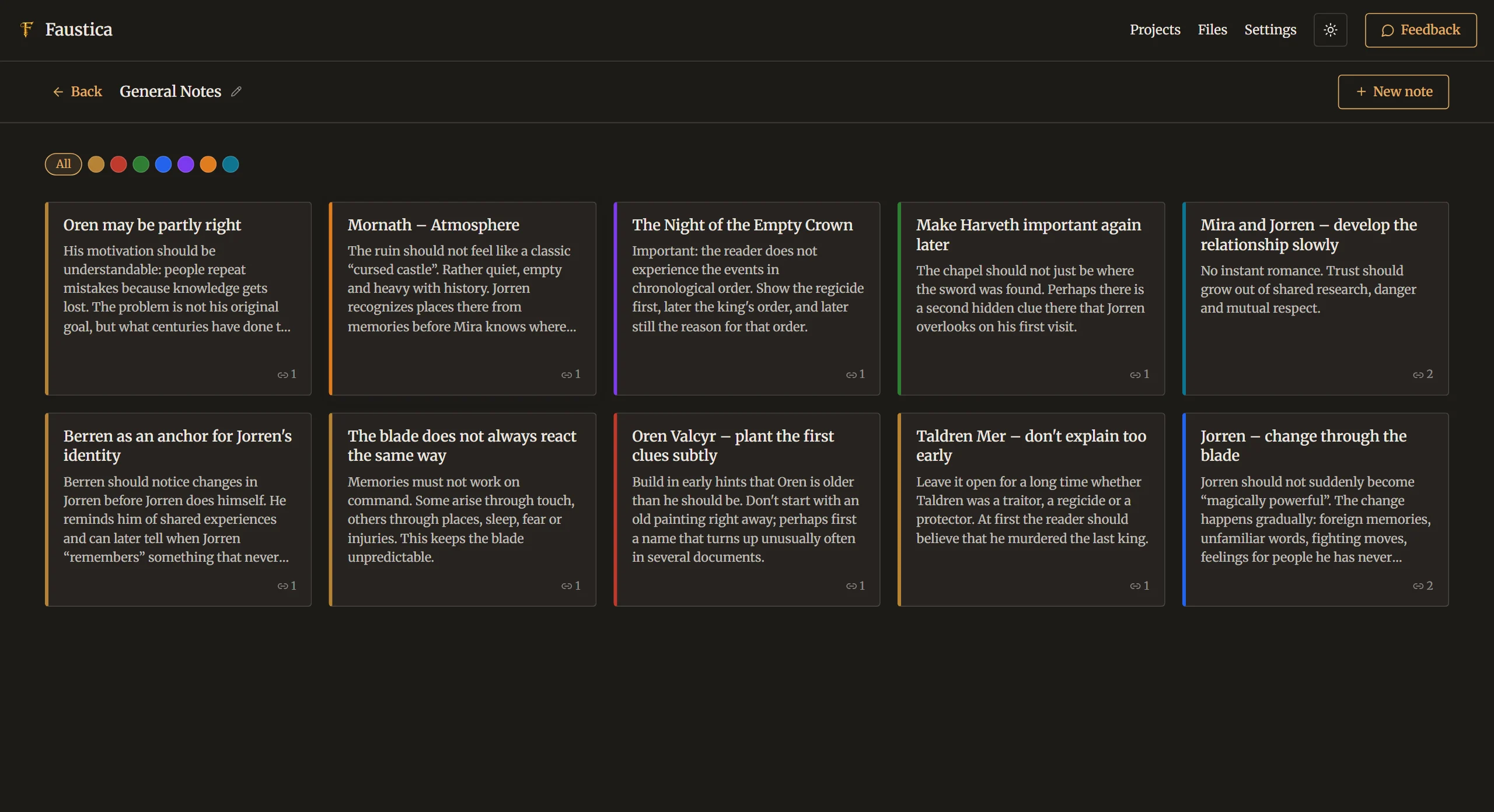
If you prefer to arrange ideas spatially, create a mind map in the same project. Faustica doesn’t develop ideas for you; it gives them a fixed home where you can find them again.
Frequently asked questions
What if my idea doesn’t seem original enough?
Almost every basic idea has been done before in some form. A story usually becomes original through its characters, its perspective and its details, not through the basic idea alone. Ask yourself what only you would see in this idea.
How many ideas should I collect before I start?
There’s no minimum. Many writers keep a collection they return to again and again, but start with the idea that has stayed with them the longest. If you’re torn between several, develop a premise for each and compare them.
Can I borrow ideas from other books or films?
Basic ideas and motifs aren’t protected; the specific way a work expresses them is. Being inspired by a situation or a motif is common practice. Taking over characters, plot sequences or wording is something else. The more you transform the inspiration with questions of your own, the more it becomes your story.
How can I tell whether an idea is enough for a short story but not for a novel?
If the central question can be answered within a single situation and allows no further escalation, that points to a short story. A novel needs several stages of change and usually more than one character with a goal of their own.