
A character constellation is the structure formed by all the important characters in a novel and their relationships to one another: who belongs to which camp, who supports or fights whom, who mirrors whom and where the lines of tension run. It doesn’t show what happens between two individual characters, but how the whole cast is arranged. A well-thought-out constellation makes conflict grow out of the arrangement of the characters itself and gives every character a recognizable place in the whole.
In English-language writing advice, the same idea often goes by other names, such as a character map or character web: a diagram of the cast and its connections. For authors, it’s a planning tool. This page shows typical patterns, a way to build your own constellation and a map of an example cast. How to work out a single relationship between two characters is covered in Character relationships.
Character constellation vs. character relationship
The two terms are related, but they answer different questions:
| Aspect | Character relationship | Character constellation |
|---|---|---|
| Focus | Two characters | All important characters |
| Question | What connects these two, what do they want from each other? | How is the cast arranged, where are the camps and tensions? |
| Result | The history, friction and arc of one pair | A diagram or overview of the whole structure |
| Helps with | Dialogue, key scenes, relationship arcs | Casting, balance, theme, gaps in the cast |
So a constellation is made of relationships, but it’s more than their sum. Only in the big picture can you see whether one side is too powerful, whether two characters have the same job, or whether an important position is missing.
Typical patterns in character constellations
Most constellations can be described with a few basic patterns. They rarely appear in pure form, but they help with planning:
- The axis. Protagonist and antagonist face each other, and everyone else lines up on one side or stands in between. This is the clearest form, especially in adventure and crime novels.
- Camps and groups. Several parties with their own interests, such as families, orders, companies or factions. Tension arises between the groups and within each group.
- The triangle. Three characters, one of whom stands between the other two: in love, in loyalty, in a decision. Triangles almost always create conflict, because every move one character makes affects the other two.
- Mirror and contrast. Characters who face a similar question and answer it differently. They make the story’s theme visible without anyone having to spell it out.
- Center and edge. A few characters in the middle, many on the edge who are connected to only one of the central characters. Useful for checking whether supporting characters are also connected to each other.
A constellation isn’t static, either. Characters switch camps, alliances break, a triangle dissolves. Shifts like these are often turning points in the plot.
How to plan a character constellation in six steps
- Pin down your story’s central question. What is it really about: power, guilt, belonging, memory? The constellation gets stronger when the important characters all take a stance on that question.
- Put the protagonist at the center. Start with them and their antagonist. That axis is the backbone of the constellation.
- Sort the other characters into camps. Who is on whose side, who belongs to no one? Give groups and institutions a place too, if they act as a force in the plot.
- Give every important character a position on the central question. If two characters don’t differ in camp or stance, they probably have the same job. More on this in Main and supporting characters.
- Look for cross-connections and triangles. Which supporting characters have something to do with each other, independently of the protagonist? Where does one character stand between two others?
- Plan the movement. Who switches sides over the course of the story, who loses their place, who joins? Draw the constellation for the beginning and for the end.
An example: the web around Rika
In this invented suspense novel, Rika uses her boat for extra supply runs. Her childhood friend Hauke advances repair costs to draw her unknowingly into drug transport. After discovery, he threatens her. Rika plans a fake engine failure and anonymous tip so he is caught moving the cargo himself. Smaller roles with their own concerns can be arranged around these two central characters.
| Character | Own purpose | Connection to Rika |
|---|---|---|
| Rika | Preserve the crossings and escape Hauke’s blackmail | Her decisions carry the story. |
| Hauke | Secure drug transport | Childhood friend and lender, then an aggressive blackmailer after discovery. |
| Island shopkeeper, possible supporting role | Reliable deliveries for her shop | Needs Rika’s crossings but cannot accept indefinite delays. |
| Person handling the check | Assess the anonymous information | Acts on the tip; does not know Rika as a partner in an agreed operation. |
The Rika – Hauke – shopkeeper triangle connects supplies and dependence: the shopkeeper increases delivery pressure, Hauke appears to provide a solution, and Rika conceals her money problems. That does not make the shopkeeper an enemy; she has a legitimate purpose.
Rika’s anonymous tip leads to Hauke’s check in the established sequence. This does not require an investigator with a personal connection to her.
Common mistakes
- All lines lead to the protagonist. Supporting characters are connected only to the protagonist, not to each other. The cast then looks like stars around a sun, with no life of its own.
- Two characters in the same spot. Same camp, same stance, same job. One of them is usually superfluous.
- One camp is overpowering. If the opposing side consists of one character and the protagonist has ten allies, the pressure is missing. Balance doesn’t mean equal numbers, but comparable weight.
- The constellation doesn’t move. At the end, everyone stands where they stood at the beginning. Sometimes that’s intended; often it means a development is missing.
- Groups without faces. An order or a company only works as a force if at least one character embodies it.
Practical tips
- Draw the constellation by hand or as a mind map: the protagonist in the middle, camps as areas, lines for relationships.
- Label every line with a word. “Friend” or “rival” forces you to clarify what the connection is.
- Next to each character, write their stance on the central question. Where two stances are the same, take a second look.
- Make two maps, one for the beginning and one for the end. The difference is the story.
- When revising, check whether the constellation is as visible in the text as it is in your diagram.
Using Faustica
In Faustica’s Compendium, the relationship graph shows your constellation: characters, places and other elements such as organizations, connected by labeled lines. That way you can see at a glance who is connected to whom and which characters are just hanging on at the edge.
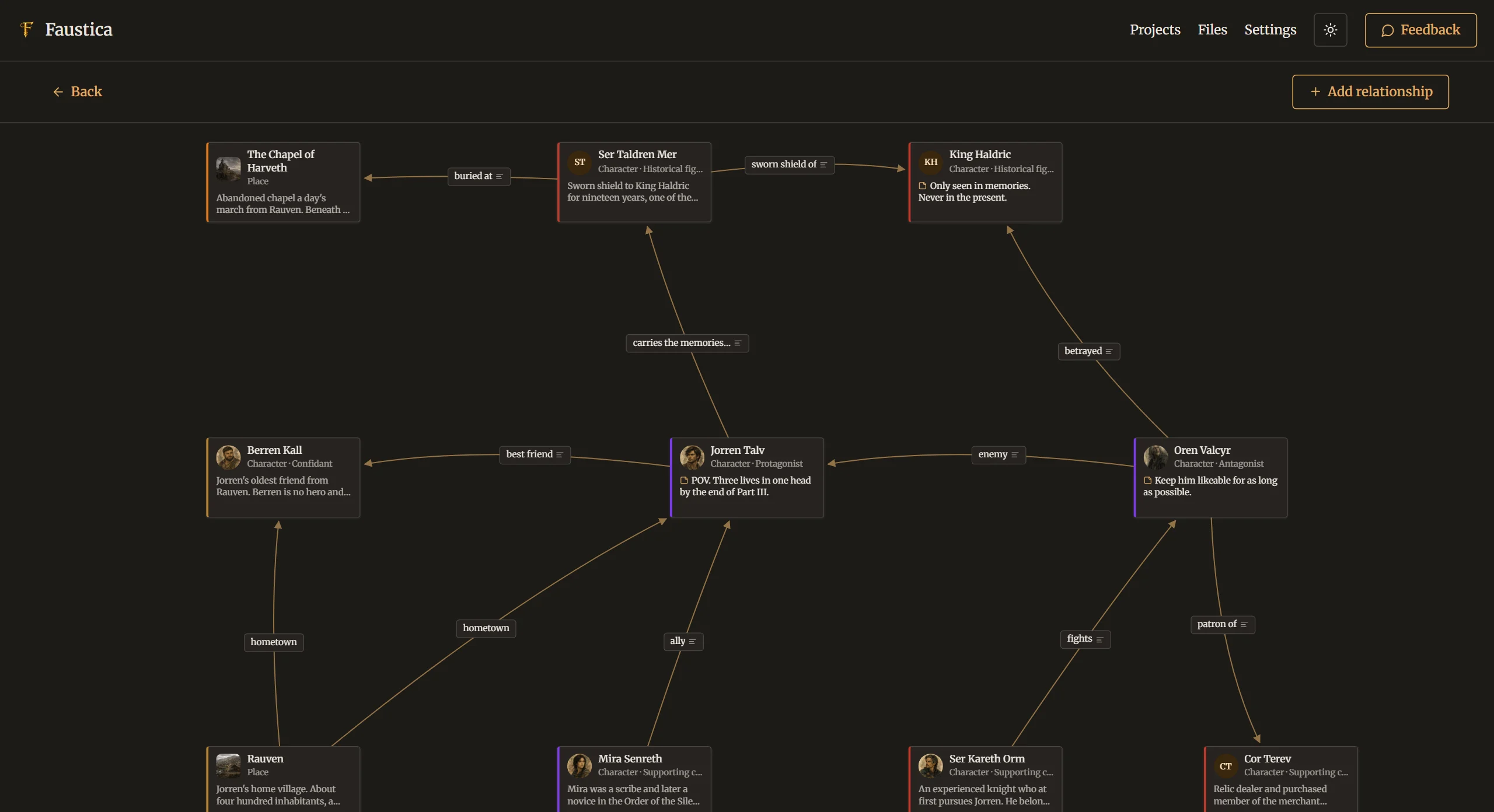
You create custom categories such as “Factions” and custom roles yourself, and you can filter by roles and keywords, for example to see all members of one camp. First drafts of a constellation can be sketched freely in Mind Maps, with colors and shapes for the camps.
Frequently asked questions
How do I map a character constellation?
The usual way is a diagram with the characters as boxes or circles and the relationships as labeled lines, with the protagonist in the middle. Camps or groups can be grouped together as areas. A table with camp, stance and connection to the protagonist is a plainer but easy-to-check alternative.
How many characters belong in a character constellation?
All characters who influence the plot, plus groups that act as a force. Leave out background characters with only one appearance so the picture stays clear. For large casts, one constellation per storyline helps.
When should I plan the character constellation?
A first draft helps as soon as the protagonist and the central conflict are settled. It shows early on whether positions are doubled up or missing. After the first manuscript, a second look pays off, because characters often develop differently than planned while you write.
What does the character constellation have to do with theme?
A lot. When the important characters take different stances on the story’s central question, the cast shows the theme from several sides without anyone having to say it. The constellation then becomes a conversation about the theme, carried out in actions rather than explanations.