
A mind map for your novel is a sketch with a central term in the middle and ideas branching out from it: characters, places, conflicts, scenes, open questions. It is most useful in the early phase, when a story doesn’t have a fixed order yet, and for questions where connections matter more than sequence, such as the relationships between characters, the parts of a world or the sides of an inner conflict. It’s less suited to putting scenes in order; that’s what scene lists are for.
On this page you’ll find where the method comes from, what you can use mind maps for when writing, how to make one, examples from a single novel project and the most common mistakes.
Mind maps, clustering and other sketches
The term “mind map” was popularized above all by the British author Tony Buzan, who spread the technique from the 1970s onward through books and a television series. His mind map is hierarchical: a topic in the middle, main branches with key concepts, and ever finer sub-branches splitting off from them.
In writing classes, a related technique is widespread: clustering, as described by Gabriele L. Rico (Writing the Natural Way, 1983). In clustering, you write down a core word and quickly note every association that comes to mind, without judging, connecting them with lines. It’s less about order than about reaching ideas that don’t surface when you take notes in a straight line.
For novels, many writers mix the two and don’t worry about doing it by the book: first associate freely, then sort, group and connect. What matters is that the sketch shows you what connects to what.
What mind maps are good for when writing a novel
- Collecting ideas. Note ideas around a seed before you decide which story it will become. More on this in Finding and developing a story idea.
- Characters and relationships. Who belongs with whom, who stands against whom, who knows what? The guide on character constellations goes into this in depth.
- World and places. Regions, cities, buildings, organizations and how they connect, especially in fantasy and science fiction.
- The big arc. Parts, chapters or turning points as branches, before every scene is settled.
- Themes and inner conflicts. A question in the middle, with the different answers or forces as branches.
- Solving problems. When a scene or turning point doesn’t work, write the problem in the middle and collect possibilities.
How to make a mind map for your novel
- Choose a question for the center. Not “My novel” but something specific: “The world of …,” “Who knows what?”, “How could the finale end?” One map per question stays clearer than one for everything.
- Collect first, organize later. For a while, write down everything that occurs to you without judging it. Contradictions and wild ideas are allowed on the canvas too.
- Form groups. Sort the ideas into main branches: characters, places, factions, parts of the plot. Colors and shapes help distinguish kinds of elements.
- Connect what belongs together. This is where the sketch shows its value: wherever a connection appears that you hadn’t seen before, there is often an idea for the plot.
- Mark the gaps. Branches without sub-branches, elements without connections and questions without answers are to-do items. Note them instead of filling them in right away.
- Carry over what’s settled. When an order emerges from the map, transfer it to a scene list. The map stays on as a store of ideas.
An example: mapping Rika’s conflict
Rika is the ferrywoman in an invented suspense novel: her childhood friend Hauke advances repair costs and uses her crossings for drug transport without her knowledge. When she discovers this and tries to quit, he threatens her. A mind map centered on “Rika: supplies and dependence” can collect people, objects and open questions before fixing a scene order.
- Purpose: additional crossings, income, reliable deliveries.
- People: Rika; Hauke as childhood friend, lender and blackmailer; an island shopkeeper; people Rika avoids out of fear after the threat.
- Objects: repair invoice, cargo, phone containing Hauke’s messages.
- Conflicts: trust versus suspicion; accepting help versus retaining control; island supplies versus financial dependence.
- Open questions: How does Rika discover the drugs? What does she hide from the shopkeeper? Why does Hauke collect the last load himself?
- Possible scenes: repair negotiation, discovery, refusal, anonymous tip, handover.
A connection between “repair invoice” and “control” recalls Rika’s initial wish to solve the debt alone. Linking “shopkeeper” and “reliable deliveries” gives a supporting character her own purpose. Connections can generate scenes; the map does not establish that every scene belongs in the novel.
Common mistakes
- One map for everything. If characters, places, plot and themes all land on one canvas, it quickly becomes unreadable. Better to have several maps, each with one question.
- Organizing too early. Building hierarchies while you’re still collecting slows down association. Collect first, then sort.
- Mistaking the map for the plan. A mind map shows connections, but no sequence and no chain of cause and effect. For the plot, you also need a scene list.
- Lines without meaning. If everything is connected to everything, no connection tells you anything. Only connect what truly belongs together.
- Tending maps instead of writing. A mind map can become a way of avoiding the work, too. It’s a tool for the story, not a substitute for it.
Practical tips
- Settle on fixed colors for kinds of elements, such as one for characters, one for places and one for factions, and stick with them.
- Put questions on the canvas as nodes of their own, with a question mark. They show where work is still waiting.
- Use a map when you’re stuck: write the problem in the middle and collect ten possibilities before you choose one.
- When a map has served its purpose, keep it. Old maps show you later which possibilities you discarded.
Using Faustica
In Faustica you can create as many Mind Maps per project as you like, for example for the world, the story arc, turning points or characters. You place nodes freely on the canvas, connect them and style them with colors and shapes, just like in the examples above.
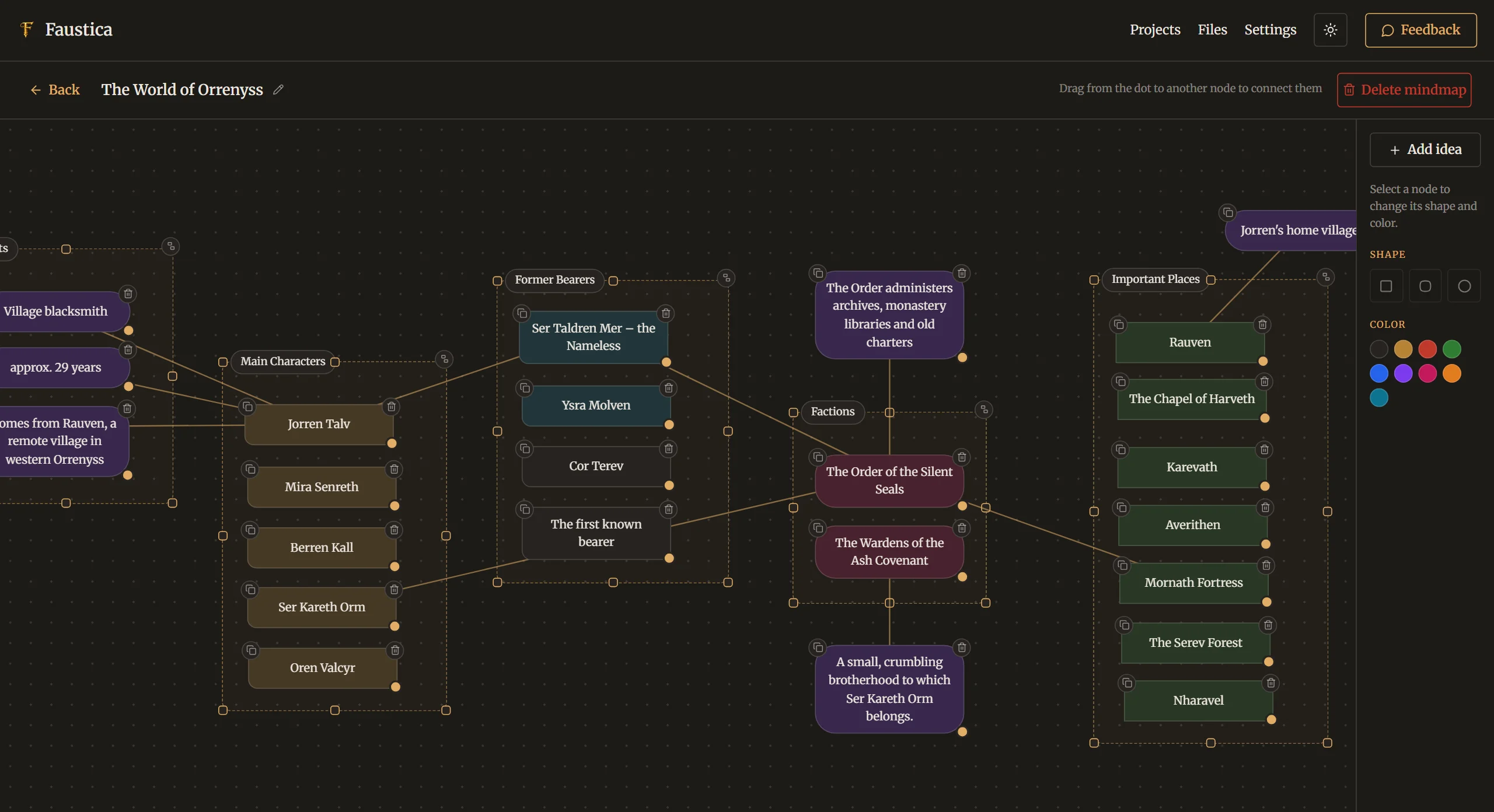
The mind maps live in the same project as your manuscript. Whatever comes out of them, you carry over as scenes into the Plot Planner or record in more detail in Notes. The mind maps themselves are a free sketching space: they don’t generate scenes or structure automatically.
Frequently asked questions
Are mind maps only for the planning phase?
No. They help most at the beginning, when nothing is organized yet. But they can also be useful in the middle of a draft or during revision, for example to think through a stuck chapter or to check which characters are connected.
Should I draw mind maps on paper or on the computer?
Both have advantages. Paper is fast and free, works well for clustering and doesn’t distract. On the computer you can move nodes, change colors and keep the maps with the project, which makes it easier to keep track in long novel projects.
What’s the difference between a mind map and plot planning?
A mind map shows what connects, but not in what order things happen. Plot planning sets out scenes, turning points and their sequence. The mind map is often the step before: the connections that emerge there become cause and effect in the plot.
How many mind maps do I need for a novel?
As many as you have questions. Some writers need just one collection of ideas; others create separate maps for the world, the characters, the plot and the finale. More important than the number is that each map answers a clear question.