
Developing characters for a novel means inventing people who want something and act to get it. Eye color, favorite food or a full résumé won’t bring a character to life. What does is a set of understandable desires, reasons, obstacles and choices. A blind spot can add inner friction on top of that. Then there is a way of speaking that belongs only to them, and the question of how they change over the course of the story.
On this page you’ll find what a character who can carry a story is made of, how to develop one in six steps, and what that looks like with example characters. The focus is on inventing and deepening characters. How to keep track of a large cast later on is covered in the blog post How to organize your novel’s characters.
What makes a character feel alive
When readers say a character “feels real,” they rarely mean they know a lot about them. They mean they understand why the character does what they do, and they still want to know what the character will do next. Both come from the inside of a character, not from their description.
The most important building blocks are:
- Goal. What does the character want to achieve, protect or prevent in this story? A goal makes them active and gives the plot a direction.
- Motivation. Why do they want it? Only the reason makes a goal understandable. Two characters can want the same thing and still be completely different people, because they want it for different reasons.
- Conflict. Who or what stands in the way of the goal? It can be another character, a community, a circumstance or a second, contradictory need inside the character.
- Flaw or false belief. A weakness, a gap in knowledge or a mistaken conviction the character clings to. It is why the road is hard, and often the core of their development.
- Voice. The way the character speaks, thinks and perceives the world. You can recognize a well-voiced character even when their name isn’t mentioned.
- Change. What is different at the end? Many protagonists are transformed. Others stay true to their convictions and change the world around them instead. What matters is that their stance becomes visible under pressure.
Looks, background and backstory aren’t unimportant. But they are raw material from which these building blocks grow, not a substitute for them.
How to develop characters in six steps
These steps work for protagonists as well as for important supporting characters and antagonists. For small roles, the first two are often enough.
- Start with a situation, not a profile. Picture the character in a specific moment where they have to act. What do they do? That scene will tell you more about who they are than any list of traits.
- Give them a concrete goal for this story. “Be happy” isn’t a goal you can measure progress against. “Get Hauke to collect the next load himself” is. The more tangible the goal, the easier it is to find scenes for it.
- Ask why, at least twice. Why do they want this? And why does that matter so much to them? The second answer usually leads to what really drives the character: fear, guilt, loyalty, curiosity, pride.
- Examine their beliefs. What does the character believe about themselves or the world, and what challenges that belief? For a change arc, you can pick a false belief that makes sense given their experience. For a flat (steadfast) arc, a sound conviction is put to the test instead.
- Put something real in their way. Resistance should hit exactly where the character is weak. A character who trusts no one has to rely on others. A character who needs control loses it.
- Find their voice and set the direction of change. Write a few lines that only this character would say. Then note where they stand at the beginning and where at the end, even if the path between them still shifts. You’ll find more on this in Character arcs.
If you want to record your answers, a character profile helps. Fill it in only after you’ve seen the character in motion, though, not as the very first step.
An example: revealing character through decisions
In this invented suspense novel, ferrywoman Rika maintains additional island supply runs. Hauke, her childhood friend, advances repair costs and has her transport drugs without her knowledge. After discovery, he becomes aggressive and threatens her.
- Goal: Break Hauke’s power without warning him of her plan.
- Motivation: Be safe and keep her service out of his control.
- Strength: Knowledge of her boat and deliveries; she can give a credible technical explanation.
- Vulnerability: Money problems and trust in an old friend have made her dependent.
- Inner conflict: She is afraid but must speak to him again to fake the failure.
- Change: Rather than wait for fear to vanish, she develops a strategy of her own.
A possible teaching scene distinguishes a trait from action: after his threat, Rika holds the phone and puts it down again. She knows what she wants to say but fears his voice. Only later does she report the supposed fault. Her boat knowledge stays the same; what she uses it for changes.
She sends an anonymous tip so Hauke is caught transporting the cargo himself. Nor is Rika automatically free of fear or financially rescued at the end. The Snowflake Method provides the plot overview.
Common mistakes
- Traits instead of actions. “She is brave and kind” says very little. Only when the character acts bravely under pressure do readers believe it.
- A character without resistance. Even a competent or morally steady protagonist needs challenges that cost something. An inner false belief is one option; outer conflicts or competing obligations are others.
- Motivation of convenience. When a character does something only because the plot needs it at that point, readers notice. Check every important decision to see whether it comes from the character.
- Everyone sounds the same. If you could strip the dialogue tags and no one could tell who is speaking, your characters lack a voice.
- Too much backstory at once. The fully worked-out childhood belongs in your notes. On the page it works best in small doses, where it explains what the character does.
- Supporting characters without a goal of their own. Even a small role feels more alive when it wants something for itself. A shopkeeper waiting for Rika’s deliveries wants to fill her shelves before the weekend, not just support the protagonist.
Practical tips
- Write a test scene that doesn’t have to end up in the novel: the character on the morning of an ordinary day. It reveals their voice before the plot takes over.
- Phrase your protagonist’s false belief as a sentence they would say themselves. Then you’ll notice while writing when that belief is being tested.
- Ask every important character: what would they do in the key scene if I, the author, didn’t step in?
- Let characters disagree. Different goals in the face of the same events create conflict all by themselves. How to plan those connections is covered in Character relationships.
- Revise your character after the first draft. Often you only know at the end what they should have believed at the beginning.
Using Faustica
In Faustica’s Compendium you create every character as an entry, with an image, a role, keywords and custom sections. You decide on fields such as goal, motivation, false belief or arc yourself instead of filling in a rigid form. You pick roles such as “Protagonist” or “Mentor,” create custom roles like “Historical figure” yourself, and can filter by role.
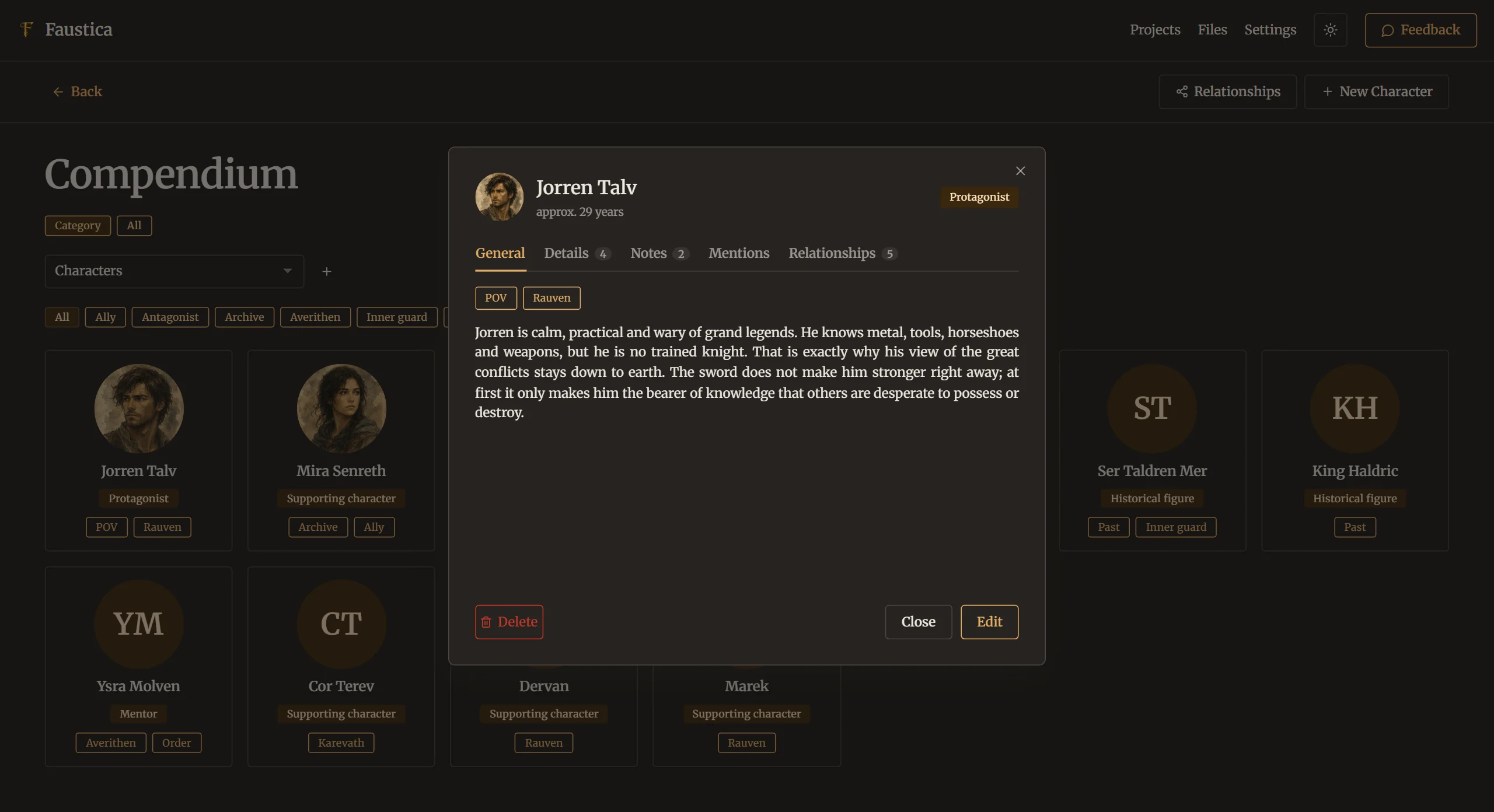
Besides the details, an entry’s reading view shows your notes, the places in the manuscript where the character is mentioned, and their relationships. The relationship graph shows how your characters are connected, with labeled lines such as “best friend” or “enemy.” In the Plot Planner you can assign the characters involved to each scene and follow where a character appears.
Frequently asked questions
How much do I need to know about a character before I start writing?
Less than you might think. A goal, a motivation, a false belief and an idea of how the character talks are enough to begin with. You’ll discover a lot while writing, and it’s easier to deepen a character than to break up a picture you fixed too early.
What is the difference between goal and motivation?
The goal is what the character wants; the motivation is why. Rika wants Hauke to transport the cargo himself because she wants to escape his blackmail and fears him. The goal drives the plot; the motivation makes it understandable.
Does every character in a novel have to change?
No. Both protagonists and supporting characters can stay largely the same. In that case the story shows how their stance is tested or how they change others. A steady supporting character can help readers see how much the protagonist changes.
How do I develop characters if I write without an outline?
Then you develop them in the first draft and check afterwards. Read your text with the questions on this page in mind: does the character have an understandable drive, is their stance put to the test, do they sound unmistakable? Whatever is missing, you add during revision.