
To write character relationships, work out for each important pair what connects them, what each one wants from the other and where they rub against each other. A relationship comes alive when it has a history, when the pressure of the plot puts it to the test, and when it changes as a result. You show it best through what characters do for each other, demand of each other or keep from each other, not through sentences like “They were best friends.”
This page deals with the single relationship between two characters: what it’s made of, how to build it and how to make it visible in scenes. How all the characters in a novel form a larger structure together is covered in Character constellations.
What a character relationship is made of
A relationship is more than a label like “friend” or “enemy.” When you’re working on a novel, a few questions help, and you can answer them for every important pair:
- Connection. What binds the two together: family, history, a shared goal, a debt, a dependency?
- What they want from each other. What does one character want from the other, and vice versa? It’s rarely symmetrical. That very difference makes the relationship interesting.
- Balance of power. Who knows more, who has more to lose, who can hurt the other? Power can shift over the course of the story.
- Point of friction. Where do the two disagree: in values, goals, memories? Without friction, there’s little to tell about them.
- History. What has already happened between them before the story begins? A shared past gives every line between them weight.
- Direction. Do the two grow closer over the course of the plot, drift apart, or is their bond tested and confirmed?
Not every relationship needs all the answers. But for the relationship between your protagonist and their most important counterpart, it’s worth thinking through every question.
Types of relationships
Relationships in a novel can be roughly sorted by their basic stance: allied (friendship, love, loyalty, camaraderie), opposed (rivalry, enmity, pursuit) and ambivalent (family with old wounds, dependency, admiration mixed with envy). The ambivalent ones create the most tension, along with those that switch categories over the course of the story: a pursuer becomes an ally, a friend becomes a traitor.
Relationships with groups and places count too. A character who has left an order stands in a relationship to that order, and it shapes what they do. A character who has never left their home village carries it with them everywhere.
How to build a character relationship in six steps
- Choose the pairs that carry the story. Not every combination of characters needs a fully developed relationship. Start with your protagonist and their two to four most important counterparts.
- Clarify what each side wants. For each pair, write down: what does A want from B? What does B want from A? If both want the same thing, look for the difference in the why.
- Invent a concrete moment from their past. Not “They’ve known each other since childhood,” but a specific experience both of them can refer back to. Moments like that can be picked up later in dialogue.
- Define the point of friction. Where does the relationship come under pressure once the plot picks up speed? Friction that comes from the characters’ goals works best, not friction from misunderstandings.
- Plan the key scenes of the relationship. When is the relationship tested, when does it change, when does it show what it’s really worth? Three to five scenes like that give an important relationship an arc of its own.
- Find signs instead of explanations. A ritual, a recurring line, a small gesture. Signs like these make the relationship tangible and can later, in altered form, show that something has shifted.
Showing relationships in scenes
The most important rule is old but effective: don’t state a relationship, show it. A few ways to do that:
- Actions under pressure. What someone risks for another person says more than any declaration of love.
- What goes unsaid. Characters who know each other well don’t have to explain everything. Gaps in dialogue show familiarity or distrust. More on this in Writing dialogue.
- Rituals and repetition. A saying, a song, a habit only these two share.
- Other people’s reactions. How supporting characters react to the pair shows how it looks from the outside.
An example: Rika and Hauke understand help differently
This example examines ferrywoman Rika and her childhood friend Hauke in an invented suspense novel. He advances repair costs; she carries his supposedly harmless cargo in return. When she discovers drugs and refuses further crossings, he becomes aggressive. The relationship changes as apparent help becomes a claim on her obedience.
A possible exchange:
“You said you were helping me,” Rika said.
“And your boat runs again.”
“The crates are coming off.”
Hauke stepped closer. “You don’t decide when this ends.”
Rika appeals to trust; Hauke speaks of performance and obedience. Moving closer changes the familiar relationship’s meaning. She now faces more than a repair debt: she is afraid of him.
Her later deception uses shared knowledge. Hauke knows about the real engine failure, so another fault may seem plausible. The draft must establish whether this works. Their relationship both exposes her to harm and helps make resistance possible.
Common mistakes
- Relationships by assertion. The narration assures us that two characters are close, but no scene shows it.
- Conflict from misunderstandings. A quarrel that one honest sentence could resolve feels contrived. Friction from genuine, incompatible desires is stronger.
- The relationship stands still. Two characters behave toward each other on page 300 exactly as they did on page 10, even though they’ve survived dangers together.
- Everything revolves around the protagonist. Supporting characters have no relationships with each other. Yet that’s often exactly where life comes in.
- Sudden love. A romance that begins without any scenes preparing it rarely convinces. Attraction needs reasons too.
Practical tips
- For each important pair, write one line that only these two would say to each other.
- Give a relationship a sign that appears at the beginning and at the end. The difference tells the relationship’s arc.
- For every key scene, check how the relationship between the characters involved has shifted by the end of the scene.
- Let allies argue about the how, even if they share the same goal.
- Keep track of relationships where you’ll find them again while writing, and update them when they change.
Using Faustica
In Faustica’s Compendium you record relationships in the relationship graph as labeled lines, such as “best friend,” “ally” or “fights.” You can connect not only characters but also places and other elements, for example a character with the order they’ve left.
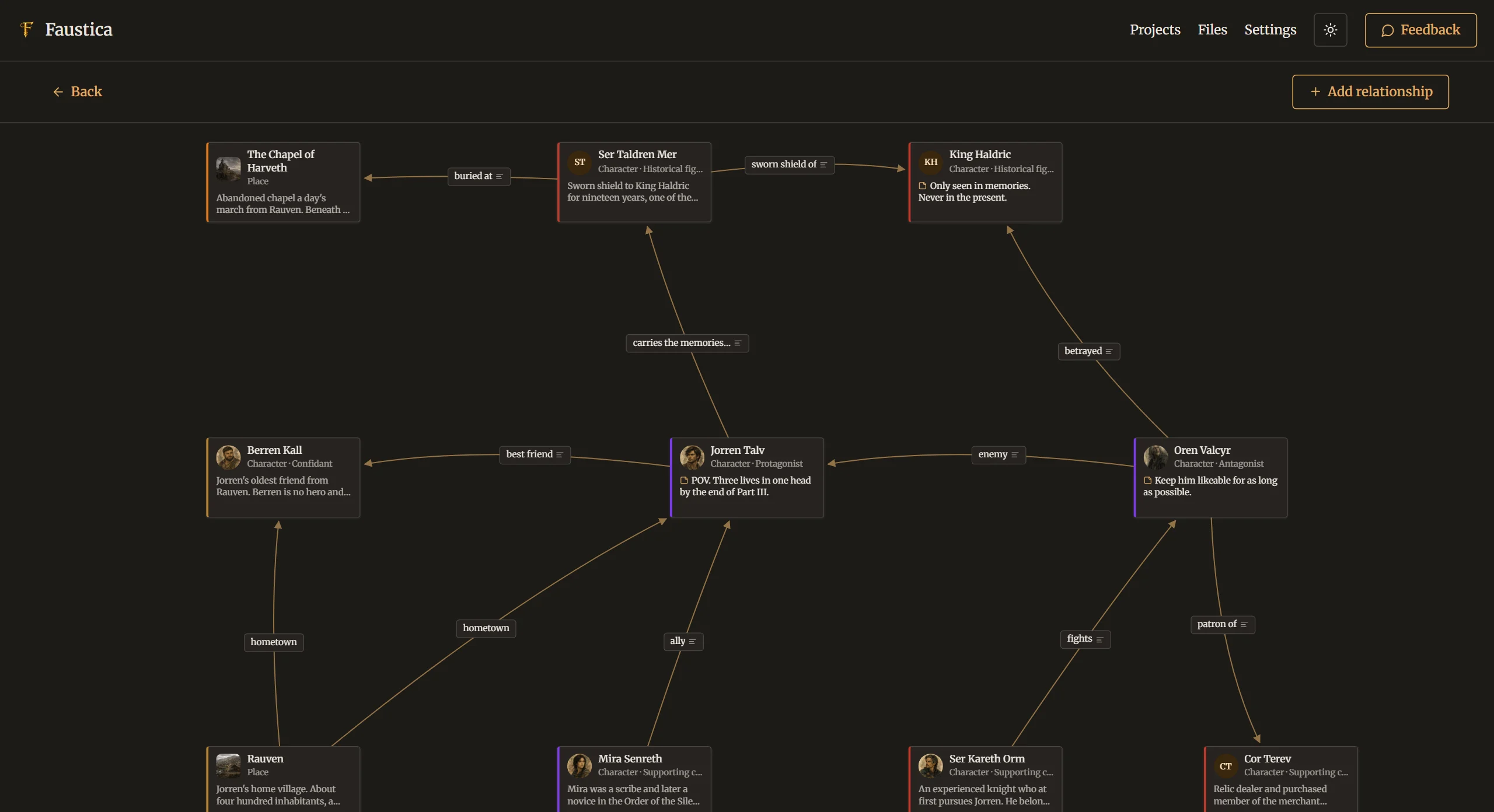
An entry’s reading view shows the character’s relationships together with their details and mentions in the manuscript. If you want to sketch relationships freely first, you can use a mind map. In the Plot Planner you assign the characters involved to each scene, which makes it easy to find a relationship’s key scenes again.
Frequently asked questions
How many relationships should I develop?
Develop your protagonist’s relationships with their most important counterparts thoroughly; usually that’s two to four. For other pairs, a label and a sentence are often enough. You only need more depth where the relationship affects the plot.
How do I show a relationship without explaining it?
Through actions, rituals and what characters don’t need to say to each other. A character who puts bread in front of the other without being asked shows familiarity. One who bolts the door against the other shows distrust. Readers infer more from that than an explanation could tell them.
What is the difference between character relationships and a character constellation?
A character relationship is the connection between two specific characters. The character constellation is the structure of all characters and their relationships to one another, the big picture. The constellation shows who stands on which side; the single relationship shows what happens between two people.
Should every relationship have conflict?
Not every one needs open conflict, but almost every one benefits from a difference. Even in a close friendship, the two don’t want the same thing in everything. Completely conflict-free relationships can serve as a resting point, but they rarely carry a plot.