
To write a believable antagonist, treat them like a second protagonist: they need a goal of their own, a motive that makes sense from their point of view, the means to pursue it, and a reason why their path crosses the protagonist’s. What makes them threatening isn’t cruelty but the fact that they act, plan and strike the protagonist where they are vulnerable. The strongest antagonist is one readers partly understand and still want to see stopped.
This page shows the different forms an opposing force can take, how to build an antagonist in six steps and what that looks like through Hauke, Rika’s antagonist. How to develop characters in general is covered in How to develop characters.
Antagonist, villain, opposing force
The antagonist is the character whose goals most directly oppose the protagonist’s. They don’t have to be a villain. A professional rival, a mother trying to protect her child, or a detective hunting a likable thief are all antagonists without being evil. Conversely, not every villain is the main opponent: some are just another character’s instrument.
Besides characters, other forces can create resistance: nature, a society and its rules, or the protagonist’s own fears. Many novels combine several of these forces. A character as the opponent has one advantage, though: they can plan, react and speak. That lets you show the conflict in scenes instead of only describing it.
It also helps to distinguish between the main antagonist and their henchmen. The main antagonist embodies the central conflict and often appears less often than you’d think. Henchmen bring the pressure into individual scenes, but have smaller motives of their own.
What makes an antagonist believable
- A goal they actively pursue. An antagonist who just waits for the protagonist is part of the scenery. They should have a plan that would keep running even without the protagonist.
- An understandable motive. From their point of view, they’re right, or at least have good reasons. That doesn’t mean readers should agree with them. It means readers understand how they arrive at what they do.
- Competence. They’re superior to the protagonist in something: knowledge, power, money, patience. An opponent who is easily beaten cheapens the victory.
- A connection to the protagonist. The strongest conflict arises when the antagonist mirrors a side of the protagonist or offers exactly what the protagonist secretly wants.
- Limits. Even a powerful opponent has to be vulnerable. Otherwise the protagonist can only win by chance.
How to write an antagonist in six steps
- Start with their goal, not their deeds. What do they want to achieve? Phrase it the way they would say it themselves. “Rule the world” is rarely useful; “prevent my family’s knowledge from being lost” is more like it.
- Ask about the wound behind it. What experience, fear or conviction drives them? This is often where readers come to understand them.
- Define their means and limits. What can they do, what can’t they, and what are they willing to do? The line they cross reveals their character more clearly than any description.
- Connect them to the protagonist. What do they have in common, what do they offer the protagonist, what do they know about them? The more personal the connection, the more is at stake for both. How mirroring like this relates to the character arc is shown in Character arcs.
- Plan their path through the story. Note what they do in each part of the novel, even if it doesn’t appear on the page. Their moves create turning points for the protagonist. A separate storyline helps, as described in Planning subplots.
- Decide when and how they become visible. An antagonist can appear openly from the start or work in the background for a long time. Both work, as long as their presence is felt before they take the stage.
An example: Hauke’s help becomes a threat
In this invented suspense novel, ferrywoman Rika organizes extra supply runs for her island. Her childhood friend Hauke advances repair costs and uses her return crossings for drug shipments without her knowledge. After discovery, Rika refuses further transport. Hauke responds aggressively and threatens her: the familiar helper becomes her antagonist.
| Question | Hauke’s characterization |
|---|---|
| Concrete goal | Keep Rika transporting his drug cargo. |
| Possible motive | Money and influence; retain a route secured through financing her repair. |
| Methods | Apparent help first, then debt, blackmail and aggressive threats. |
| Boundary crossed | After discovery, he refuses to respect Rika’s no and makes her afraid. |
| Counterforce | Her knowledge of the boat and deliveries enables the fake engine failure and anonymous tip. |
A motive need not justify him. Shared history explains Rika’s trust without excusing deception or threats. In a possible scene, he initially speaks of “our agreement.” When she refuses further crossings, familiarity becomes an order. That shift reveals that his helpfulness depended on her compliance.
Common mistakes
- Evil because the plot needs it. The antagonist does bad things with no recognizable reason. For each of their deeds, ask what they want to achieve with it.
- The villain’s monologue before the end. At the decisive moment, the opponent explains their whole plan. It’s better if readers have already worked out the motive from their actions.
- Suddenly stupid. An opponent who acts cleverly throughout the book makes a beginner’s mistake in the finale. The protagonist should win through their own strength or insight, not through the antagonist’s carelessness.
- Too much sympathy. Sometimes an antagonist becomes so understandable that their wrongdoing blurs. The line they cross has to stay tangible.
- Absent and without consequences. The opponent disappears for a hundred pages without their plan moving forward. Their moves should be felt even when they’re not on stage.
Practical tips
- Write a scene from the antagonist’s point of view, even if it never makes it into the book. If you can’t defend them in it, they’re still missing a motive.
- Give them a trait readers can like: humor, loyalty, learning, care. It makes them human and less predictable.
- Let them know something about the protagonist that the protagonist would rather have kept hidden. Knowledge is often more threatening than violence.
- Keep track of their relationships with other characters, including their henchmen. More on this in Character relationships.
- After the draft, check whether each of the protagonist’s major turning points is at least partly triggered by a decision of the antagonist.
Using Faustica
In Faustica’s Compendium you create the antagonist as a character with a role of their own and give them custom sections, such as “Public face,” “Truth” and “Motive,” as in the example. Besides the details, the reading view shows their mentions in the manuscript and their relationships, for example to henchmen or former allies.
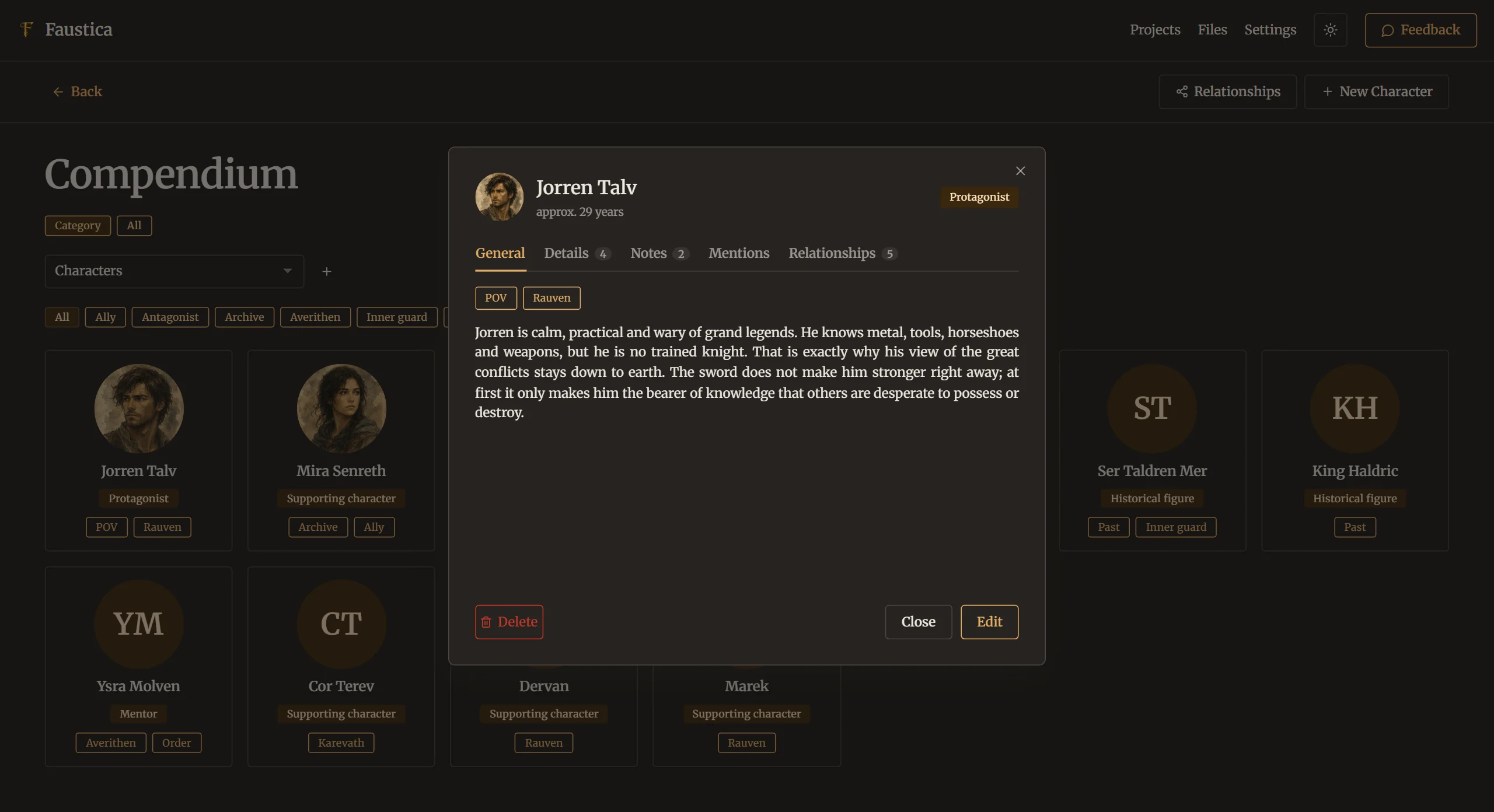
In the Plot Planner you can set up the antagonist’s plans as a storyline of their own. Hints point out storylines that have been dormant for a long time and characters who haven’t appeared for a while. If you’d like to collect loose ideas about your antagonist first, you can use a separate board in Notes.
Frequently asked questions
What is the difference between an antagonist and a villain?
The antagonist is the character whose goals oppose the protagonist’s. A villain is a morally reprehensible character. Often the two coincide, but an antagonist can also be likable or in the right, and a villain can play a minor role.
Does every novel need an antagonist?
Every story needs resistance, but not necessarily an opposing character. In some novels the resistance comes from nature, society or the protagonist themselves. A character as the opponent does, however, make the conflict easier to show in scenes.
How often should the antagonist appear?
There’s no fixed rule. More important than the number of appearances is that their influence stays tangible in the story, through henchmen, the consequences of their plans or clues. An antagonist who rarely appears can feel more threatening that way than one who is constantly present.
Can the antagonist win in the end?
Yes. A victory for the antagonist can carry a tragedy or close one installment of a series in which the larger conflict remains open. What matters is that the ending follows from the characters’ choices and doesn’t feel arbitrary.