
A character profile (sometimes called a character sheet) is a short worksheet where you collect the key facts about a character in your novel: name, role and appearance, but above all goal, motivation, conflict, flaw and arc. It serves as a memory aid while you write and as a test of whether a character can already carry the story. A good profile is brief. It answers the questions that matter for your story and leaves out everything else.
On this page you’ll find a complete character profile template to copy, a filled-in example and advice on which fields really matter and when a profile turns into a trap.
What a character profile is good for
A profile does three jobs. First, it keeps things consistent: eye color, age, the father’s name or the scar on the left hand are recorded in one place instead of somewhere in chapter three. In long novels and series, that’s the most common reason to keep one at all.
Second, it forces you to think. If you can’t fill in the field “What does the character want?”, you notice early that the character lacks a drive. That is worth more than any complete list.
Third, it helps with revision. With the profile next to the manuscript, you can check whether the character behaves the way you set them up and whether their arc actually happens on the page.
What a profile can’t do: it can’t bring a character to life. That happens through actions and decisions in the text. How to get there is described in How to develop characters.
The template to copy
The template below is divided into four blocks. Copy the tables into your writing program or write the fields on an index card. For supporting characters, the blocks “Basics” and “Drive” are usually enough. The template is also available as a printable PDF · Download Word file.
Block 1: Basics
| Field | What goes here |
|---|---|
| Name | Full name, plus nicknames and who uses them. |
| Role | Protagonist, antagonist, supporting character, mentor, confidant, love interest. |
| Age | Exact or approximate. Important if the story spans years. |
| Occupation or position | What they do all day. It shapes their vocabulary, their hands, the way they see the world. |
| Background | Place, family, social class, as far as it matters for the story. |
| Appearance | Two or three features that actually appear in the text. Not a full physical description. |
Block 2: Drive
| Field | What goes here |
|---|---|
| Goal | What does the character want to achieve, protect or prevent in this story? Concrete and checkable. |
| Motivation | Why do they want it? The answer to the second “why.” |
| Conflict | Who or what stands in the way of the goal, outside and inside? |
| Flaw or false belief | What does the character wrongly believe or not know how to do, and why does that get in their way? |
| Stakes | What do they lose if they fail? |
Block 3: Inner life and voice
| Field | What goes here |
|---|---|
| Strengths | What are they better at than others? At least one strength the plot will need. |
| Contradiction | A trait that doesn’t fit the rest. Contradictions make characters believable. |
| Secret | What do they know that others don’t, or what are they hiding? |
| Voice | How do they talk? Sentence length, favorite words, what they would never say. |
| Signature line | A line only this character would say this way. |
Block 4: In the story
| Field | What goes here |
|---|---|
| Relationships | The three to five most important connections to other characters, each with a word on the kind of relationship. |
| Arc | Where does the character stand at the beginning, where at the end? In one sentence. |
| Turning point | The moment their stance changes. |
| First appearance | The chapter or scene where they’re introduced. |
| Open questions | What you don’t know about the character yet. This field isn’t a flaw; it’s a to-do list. |
Example: a short profile that shapes a scene
The example is Rika, a ferrywoman in an invented suspense novel. Her childhood friend Hauke advances repair costs and has her carry drugs without her knowledge. When she tries to quit, he threatens her. Afraid, she devises a trap: a fake engine failure will make him move the cargo himself, and an anonymous tip will prompt a check. This plot gives the profile concrete foundations.
| Field | Rika |
|---|---|
| Role | Protagonist, ferrywoman with her own small boat |
| Goal | Preserve the service; after discovery, escape Hauke’s blackmail. |
| Motivation | Earn her living and remain needed by her island. |
| Strength | Practical knowledge of the boat and deliveries. |
| Vulnerability | Money problems and trust in her childhood friend. |
| Conflict | Hauke reacts aggressively to her refusal; she is afraid. |
| Voice, possible wording | “I’ll manage” hides how little room she has. |
| Change | Act against Hauke while still feeling fear. |
| Open question | How can she make the second, fake engine failure believable? |
A profile does not supply a new history just because a field is empty. Age, family status and dramatic childhood events are not established and need not be invented for every scene.
Calling Hauke depends on her technical knowledge, fear and his response. Eye color and favorite food do not yet change that decision.
Which fields really matter
If you only want to fill in five fields, make it these: goal, motivation, conflict, flaw or false belief, arc. They’re a useful starting point for a change arc. For a steadfast character, write down their central conviction instead of a false belief, and instead of a change, how that conviction is tested. Everything else supports consistency and can grow as you write.
For supporting characters, role, goal and one relationship to the protagonist are often enough. An antagonist, on the other hand, needs almost as much attention as the protagonist, especially when it comes to motivation. More on this in Main and supporting characters.
When a profile becomes a trap
- The questionnaire replaces the writing. There are lists with a hundred questions or more, from favorite food to star sign. If you work through them for every character, you end up with pages of material and not a single scene.
- Everything in it has to go into the text. A profile is background. If you try to fit in every detail, you end up with info dumps that stall the reading.
- The character isn’t allowed to change anymore. While writing, you often find that a character reacts differently than planned. Then adjust the profile, not the character.
- Traits without consequences. “Brave, loyal, funny” doesn’t help much until you know where in the plot those traits will be needed or will cause harm.
- The profile goes stale. A profile you stop updating after chapter ten causes contradictions instead of preventing them.
Practical tips
- Fill in the profile in two passes: the five key fields before you write, then voice, signature line and first appearance after the first few chapters.
- In the “Appearance” field, only enter what actually appears in the text, and note the chapter. That way you’ll find the passage again if you change something.
- Write your answers as sentences, not keywords. “Wants to find out whose life is in his head” helps more while writing than “curiosity.”
- Leave the “Open questions” field open on purpose. It shows you where the character still has room to be discovered.
- Keep relationships in one place that’s easy to find, for example with one of the characters or in a shared overview. If you maintain both profiles, remember to update changes in both. More on this in Character relationships.
Using Faustica
In Faustica’s Compendium, every character is an entry with an image, a role, an age, a description and keywords. You add the fields of the template as custom sections, such as Goal, Background or Arc, and can choose different ones for each character. Instead of a rigid form, your protagonist gets twenty fields and the innkeeper gets two.
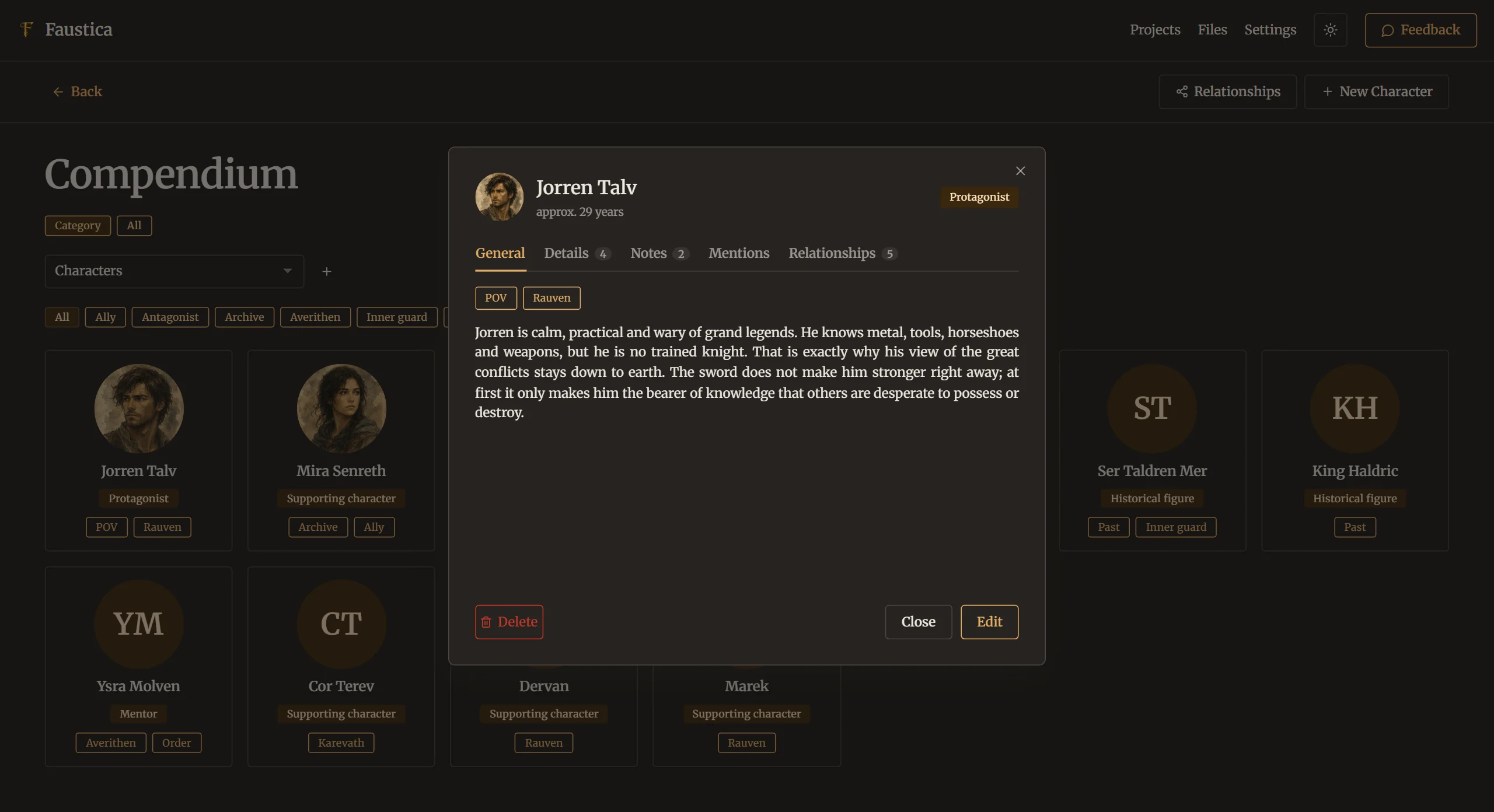
In addition to your profile notes, you can record relationships as labeled lines in the relationship graph. An entry’s reading view also shows where in the manuscript the character is mentioned, so you can check whether the profile and the text agree.
Frequently asked questions
How detailed should a character profile be?
For the protagonist, one or two pages are usually enough; for supporting characters, a few lines. What matters isn’t the length but that goal, motivation, conflict, flaw and arc are answered.
Do I need a profile for every character?
No. For characters who appear only once, a name and a line are enough. A detailed profile pays off for characters who act across several chapters or whose decisions change the plot.
Should I create the profile before or after writing?
Both work. If you plan, fill in the most important fields beforehand and add the rest as you write. If you’d rather dive in, create the profile after the first draft and use it for revision.
What is the difference between a character profile and a character biography?
A profile is a brief overview in fields. A character biography tells the character’s life before the story in continuous prose. The biography can help you understand a character; the profile is the handier tool while you write.