
The most effective place to improve your writing style is revision, not the first draft: cut filler words that carry nothing, replace weak verb constructions with precise verbs, check every adjective for the job it does and make sure long and short sentences alternate. The goal is not “beautiful” prose but prose that says exactly what you mean, in a rhythm that suits the scene.
Style is not a collection of prohibitions. Every rule on this page has exceptions, and your own voice grows precisely out of deliberate departures. Here you will find the most important levers, an order for working on style, before-and-after examples and common mistakes.
What makes a writing style
Style is the sum of a text’s language choices: word choice, sentence structure, sentence length, imagery, tone. Part of it is taste and personality, part of it is craft. Taste is open to debate. Craft much less so: a sentence you have to read twice to understand is rarely a gain in a novel, and a word that contributes nothing dilutes the text.
When you work on your own style, a simple distinction helps. Clarity means readers understand what is meant. Precision means the chosen word hits exactly what is meant, not just roughly. Rhythm means sentence length and structure fit the content. Only once these three are right is it worth polishing images and sound.
The most important levers
Filler words
Words like “just,” “really,” “very,” “quite,” “rather,” “somehow,” “actually,” “a little” or “suddenly” are not wrong, but they are often superfluous. They soften or intensify a statement without saying anything precise. “She was quite tired” is less than “She was tired” and much less than tiredness that is shown. Related habits are “started to” and “began to”: “She began to run” is rarely better than “She ran.”
In dialogue, on the other hand, filler words are often right, because that is how people talk. “Could you just come here for a sec?” sounds different from “Come here,” and exactly that difference can characterize a person. So check filler words mainly in the narration.
Verbs
Verbs carry a sentence. Three patterns often make it sluggish:
- Nominalizations. “He made a decision” instead of “He decided,” “She conducted an examination” instead of “She examined.” In fiction this quickly sounds like a government report.
- Bland all-purpose verbs. “Go,” “get,” “make,” “be,” “have” fit everywhere and therefore say little. “He went across the yard” leaves open whether he strolled, limped or ran.
- Unnecessary passive voice. “The door was opened” hides who opened it. That makes sense if it is unknown or unimportant; otherwise the active voice is usually clearer.
A precise verb can often replace an adverb: “He walked slowly and unsteadily” becomes “He felt his way forward.” A similar case is “There was” and “It was” at the start of a sentence: “There was a man standing at the gate” is weaker than “A man stood at the gate.”
Adjectives and adverbs
Adjectives are not bad, but they easily get in the way. For each one, ask whether it distinguishes something that would otherwise be missing. “The red coat” makes sense if the color matters. “The dark night” says the same thing twice. Stacked adjectives (“the old, rotten, crumbling jetty”) and judging adjectives (“a breathtakingly beautiful landscape”) are especially suspect, because they hand readers a verdict instead of the material for one. The guide to show, don’t tell explains how to show instead.
Sentence rhythm
If all sentences are of similar length and built the same way, a text sounds monotonous, even if each sentence is fine on its own. Variety helps: a short sentence after several long ones sets an accent. Long, flowing sentences suit calm, memory and description; short sentences suit action, shock and decision.
Watch the starts of your sentences too. If several sentences in a row begin with “He” or “Then,” the prose starts to drone. The guide to avoiding repetition covers this in detail.
Images and comparisons
A good simile makes something visible that is hard to describe. A worn-out one (“quick as lightning,” “cold as ice”) is skimmed over. An ill-fitting one pulls readers out of the scene. Comparisons should come from the world and the mind of the viewpoint character: a blacksmith compares things differently from an archivist.
Working on style in six passes
If you try to check everything at once, you miss most of it. A proven approach is to revise a scene or chapter in several targeted passes:
- Content first. Polishing the style of a scene that gets cut later is wasted time. First check whether the scene stays. The guide to revising a manuscript describes the order of revision.
- Cut. Filler words, things said twice, explanations after actions that have already been shown. Almost every first draft gets better by trimming.
- Verbs. Undo nominalizations, replace bland verbs with precise ones, check the passive voice.
- Adjectives and adverbs. Check every single one for its job.
- Rhythm. Read aloud. Where you stumble or tire, split sentences, join them or rearrange them.
- Repetition and pet words. Search specifically for words you use too often.
Before and after
These versions show a moment from an invented suspense novel: ferrywoman Rika has discovered that her childhood friend Hauke uses her for drug shipments. He responds aggressively to her refusal and threatens her. Now he calls, and she fears the conversation.
Before:
Rika was actually quite frightened. Suddenly her phone was heard. She made the decision not to answer because she felt great fear of Hauke.
After:
The phone vibrated on the logbook. Hauke. Rika turned it over. The buzzing traveled through the tabletop into her hand.
The revision replaces fillers, an awkward passive and an abstract decision with perception and action. The continuing signal makes fear immediate. Context must still explain why Hauke’s call is threatening; a vibrating phone alone is not suspense.
Showing rhythm through Rika’s wait
Two possible rhythms for Rika waiting for Hauke:
A car stopped. Footsteps. Then nothing.
Short units divide perception. Rika waits for another sound, and readers wait with her.
When the car door finally closed, Rika realized how long she had been gripping the rail and loosened one finger at a time.
The longer sentence connects sound, realization and slow movement. Both versions could belong to the same teaching moment. Constant short sentences would weaken the effect; variation carries the rhythm.
Common mistakes
- Polishing too early. If you perfect every sentence before the story is in place, you often never get past the first chapters. Work on style belongs mostly in revision.
- Just swapping words. A synonym from the list is not automatically better. Often the sentence is the problem, not the word.
- Treating rules as absolute. No adjectives, no passive, no filler words: writing like that quickly sounds bare and uniform.
- Copying someone else’s style. Models help you learn, but an imitated tone rarely suits your own story.
- Straining for effect. Rare words and striking images in every sentence wear readers out. Prose is allowed to be simple.
Practical tips
- Keep a list of your own pet words and habits. Almost every writer has some, and they are hardest to notice in your own text.
- Read aloud, or have your text read to you. Your ear finds rhythm problems your eye skips over.
- Revise with some distance. After a few days you are more likely to read what is on the page instead of what you meant.
- As an exercise, rewrite a weak paragraph three times: once as tightly as possible, once at length, once in a completely different tone. Afterward you will know better which version suits the scene.
- Read a lot, and read attentively. When a sentence in a book impresses you, ask yourself why: is it the verb, the rhythm, the image?
Using Faustica
In the Editor in Faustica, the repetition analysis in the side panel lists frequently used words, either for the current chapter or for the whole manuscript. Short, common words such as articles are left out, so what remains are mostly potential pet words. The offline synonyms suggest alternatives without an internet connection; whether a synonym fits or the sentence needs rebuilding remains your decision.
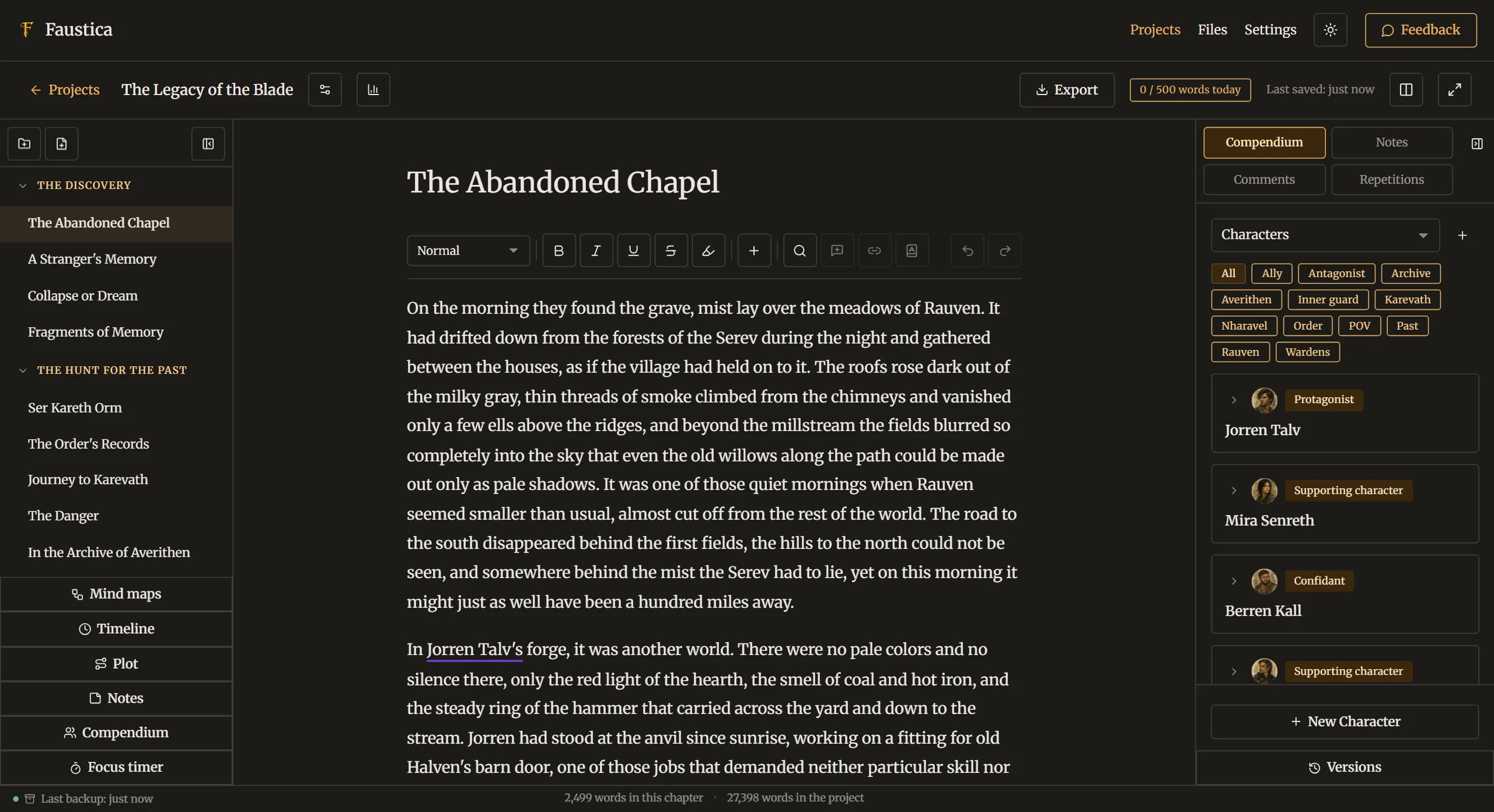
The text statistics in Project Statistics calculate your average sentence length, among other things, and compare the lengths of your chapters. An average says nothing about whether a single sentence works, but it can show whether your style changes a lot over the course of the book. In split view you can also place a revised version next to the original and compare them.
Frequently asked questions
Can you learn good writing style?
Yes, to a large extent. Clarity, precise word choice and deliberate rhythm are craft that develops through writing, revising and attentive reading. Your own voice usually emerges by itself along the way, if you write enough.
Which filler words should I cut?
There is no list that always applies. Common candidates are “just,” “really,” “very,” “quite,” “actually,” “somehow” and “suddenly.” Check every instance in the narration to see whether the sentence loses anything without the word; in dialogue they can often stay.
How long should a sentence in a novel be?
There is no fixed length. The mix matters more than the average: long sentences carry description and reflection, short ones set accents. If a sentence can no longer be understood in one breath when read aloud, it is worth a second look.
How do I find my own voice?
Through a lot of writing and honest revision, less through deliberate searching. Notice which sentences in your own writing you like best, and ask yourself what they have in common. That is often the core of your voice.