
“Show, don’t tell” means: don’t state what a character feels or what they are like; show it through actions, perceptions, ways of speaking and details from which readers draw the conclusion themselves. Instead of “She was nervous,” you write what the nervous character does. That feels more alive, because readers think along instead of simply being handed the results.
The rule is not a ban on telling, though. Every novel needs both: showing for the moments that matter and telling for transitions, time jumps and background. On this page you will learn what the two terms mean, how to turn a passage that tells into one that shows, when telling is the better choice and which mistakes often happen when showing.
What “showing” and “telling” mean
Telling summarizes and names: “He was angry.” “The town was poor.” “Three weeks went by.” The text delivers the result of an observation, not the observation itself.
Showing gives readers the material from which they draw their own conclusions: “He shoved the plate away so hard that the fork clattered to the floor.” Anger is not named, but it is understood. Showing usually happens in scene, close to the events, with actions, perceptions and dialogue, roughly in the time it takes for things to happen.
Why it works: readers who draw their own conclusions are involved. A feeling that is named gets noted; a feeling that is shown is experienced. Showing is also usually more precise. “She was nervous” fits a thousand situations; the hand searching her pocket for the key for the third time fits only this one.
The building blocks of showing
When you want to make a passage more vivid, five tools are at your disposal:
- Action. What does the character do, and how? Behavior under pressure reveals more than any description of character.
- Sensory perception. What does the character see, hear, smell, feel? One or two precise impressions are stronger than a complete list.
- Physical reaction. A dry mouth, hands that will not keep still. Use these sparingly, because clichés lurk close by.
- Dialogue and subtext. How someone speaks and what they leave unsaid shows attitude and relationship. More on this in writing dialogue.
- The telling detail. A single object or circumstance that stands for more: the hidden repair invoice, the crates Rika stops in front of.
Which perceptions and thoughts are available depends on the point of view. In close third person, you show the world through one character’s senses; an objective point of view shows only what is visible from the outside.
From telling to showing in five steps
- Find the statement. Mark sentences that name a feeling, a trait or a mood: “was sad,” “was a generous person,” “the atmosphere was tense.”
- Ask for the evidence. How would someone in the room recognize it? What does the character do, say or notice at this moment?
- Choose a few precise details. Two telling observations beat six vague ones. Prefer what fits only this situation and this character.
- Delete the statement if the showing carries. If the action is followed by “She was angry,” the text explains what readers have just understood for themselves.
- Weigh the moment. Is it important enough for a detailed rendering? If not, a sentence of telling may be the better solution.
Before and after: three examples
These teaching sentences use an invented suspense novel: ferrywoman Rika is used for drug shipments by her childhood friend Hauke without initially knowing it. When she discovers the cargo and tries to quit, he becomes aggressive and threatens her. Behavior, gestures and meaningful objects can reveal their conflict.
Example 1: fear
Before: Rika was afraid of Hauke.
After: When his name lit up, she put the phone under the logbook. She could still hear it.
Action makes fear visible. A concise transition can still name the emotion directly.
Example 2: control
Before: Hauke was domineering.
After: He pushed her sailing schedule aside and wrote the next collection on the blank page.
The added gesture shows his claim on her service. A developed scene still needs her response.
Example 3: changed familiarity
Before: The landing suddenly felt threatening.
After: The next crates were already waiting. Rika stopped. Each bore the same strip of tape.
Her knowledge changes the cargo’s meaning. Context supplies danger; the detail makes it tangible.
An example: showing and summarizing Rika’s fear
A possible scene after Hauke’s aggressive response:
Rika heard his footsteps on the jetty. She took the key from the lock and gripped it until the teeth pressed into her palm.
Neither fear nor helplessness is named. Steps, key and grip reveal a response. The action must fit the situation: why is the key there, and can she still lock the door? Vivid details need spatial logic too.
A transition could summarize: “Over the following days, she avoided every encounter with Hauke.” Not every avoided glance needs a scene. Showing carries the decisive encounter; telling can bridge repetitions.
When telling is better than showing
A novel that shows everything becomes long and sluggish. In these cases telling is often the better choice:
- Time jumps and transitions. “In the fall they moved” replaces pages full of boxes.
- Routine and repetition. How everyday life usually goes can be summarized before a scene shows what makes this one day different.
- Background knowledge. Short explanations about the world, the backstory or a situation, when they are needed.
- Things readers already know. If readers have already witnessed an event, one character does not have to recount it to another in a full scene. “He told her about the ambush” is enough.
- Minor matters. Not every journey, every meal or every conversation deserves a scene.
A useful rule of thumb is to ask about weight: the more important a moment is for the character and the plot, the more likely you are to show it. The more a passage merely connects, the more likely you are to tell it. Alternating between the two creates the rhythm of a novel.
Common mistakes when showing
- Showing and then explaining. “She slammed the door. She was furious.” The second sentence takes the force out of the first.
- Physical clichés. A pounding heart, a lump in the throat, an icy shiver: these formulas are so worn out that they read almost like statements. Look for reactions that fit this character and this situation.
- Too much showing. Every little thing gets painted in detail, and the text does not move forward. Showing costs space and belongs where it pays off.
- Puzzles instead of vividness. If the details shown are ambiguous and nothing in the scene puts them in context, readers do not understand what is meant. Showing should make conclusions possible, not prevent them.
- Filter words. “She saw that it was starting to rain” and “He felt the fear rising in him” put a layer between readers and the events. Often “It started to rain” is enough.
Practical tips
- Search a chapter for feeling words such as “sad,” “angry,” “relieved” or “afraid.” Not every one has to go, but each one is a spot you can check deliberately.
- Imagine the scene as a film without a narrator. What do you see and hear? That is your material for showing.
- Collect typical gestures and habits for your main characters. You can show them again and again later without naming the trait. More on this in developing characters.
- Read a scene aloud and notice where you grow impatient as a listener. That is often where too much is shown and too little told.
- Practice on other people’s writing: in a novel you like, underline shown and told passages in two colors. The balance is often different from what you would expect.
Using Faustica
In the Editor in Faustica, Focus Mode hides menus and side panels, which helps when you read a scene slowly and carefully. Passages where you are still telling instead of showing can be marked with comments during revision and worked through later, without interrupting your reading.
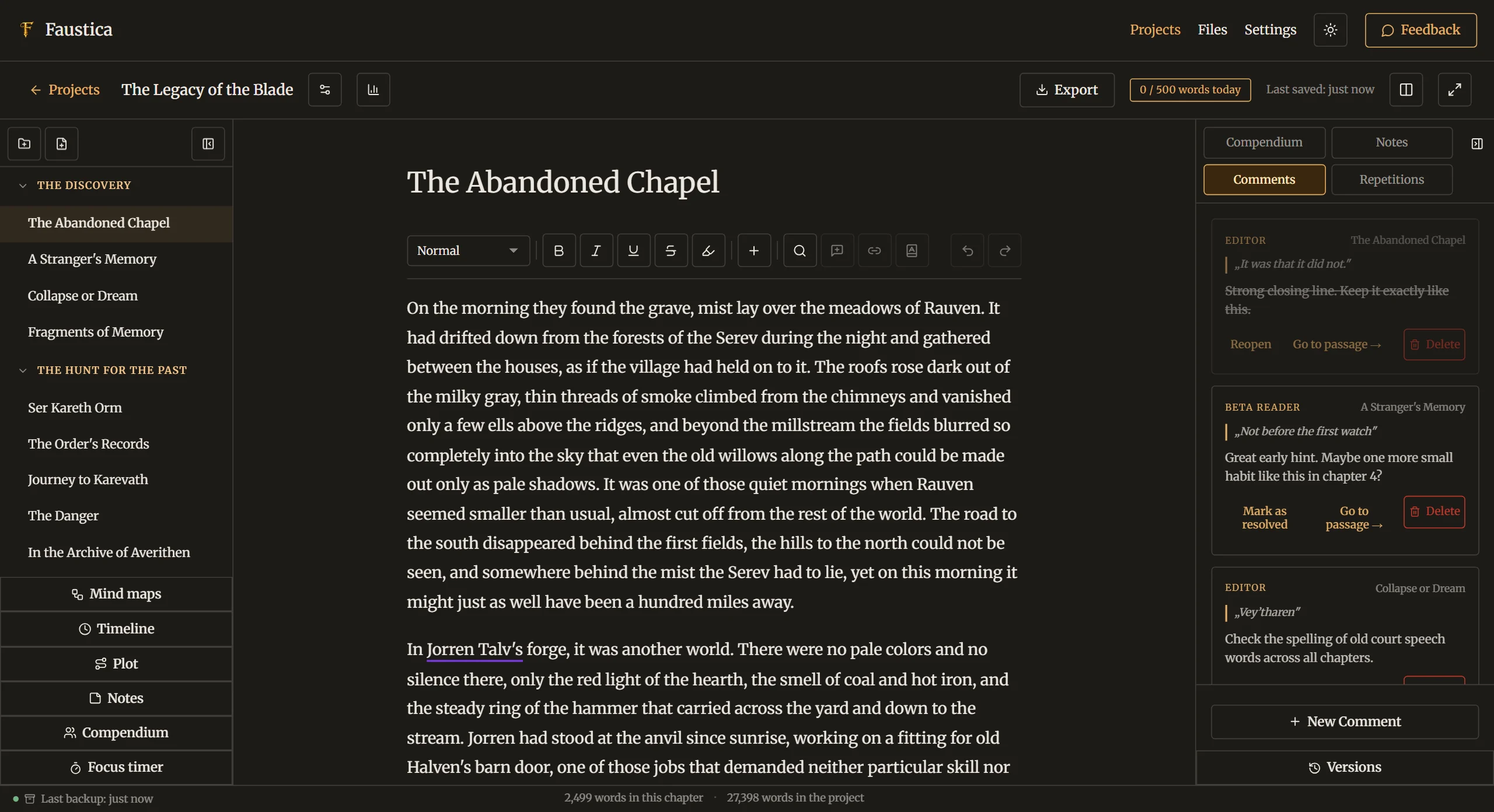
In the Compendium you can keep notes on characters and places, such as a character’s typical gestures or the smells and sounds of a setting. While you write, these entries stay one click away, so you do not have to invent shown details from scratch each time, and they stay consistent across the book.
Frequently asked questions
Where does “show, don’t tell” come from?
The phrase has no single author; it became a standard piece of advice in English-language creative writing teaching. It is often linked to Anton Chekhov, but the popular line “Don’t tell me the moon is shining; show me the glint of light on broken glass” is a later condensed paraphrase, not his wording, as Quote Investigator has traced. What Chekhov actually did, in an 1886 letter to his brother Alexander, was advise conveying a moonlit night through small details such as a piece of broken glass glittering on a mill dam.
Is “show, don’t tell” a strict rule?
No, it is more a rule of thumb for important moments. Good novels contain many passages of telling, for transitions and background, for example. Telling only becomes a problem when the decisive scenes themselves are merely summarized.
How do I show feelings without falling into clichés?
Look for reactions that belong to the character and the situation rather than generic body signals. What does this particular person do when they are afraid: talk more, go quiet, start tidying up? Often a thought or a small action is stronger than any description of the body.
Does the rule apply to first-person narrators too?
Yes, but with more leeway. A first-person narrator may name their feelings because they are talking about themselves, and they often do, especially when looking back. In important moments, though, it is usually stronger when they show what they perceive and do.