
The best way to revise a manuscript is from big to small: first check whether the story works as a whole, then the characters, then each individual scene, then the language, and only at the very end spelling and punctuation. The reason is simple. If you polish sentences first, you may be polishing scenes you later cut. Before the first pass there is also a break, so that you can read your text with fresh eyes again.
This guide walks you through the five passes, shows when and how to bring in beta readers, and gives you an invented example that assigns feedback to the appropriate revision passes. At the end you will find a compact checklist, common mistakes and answers to frequently asked questions.
Why you work from big to small
Revising means more than fixing mistakes. In the first draft you are telling yourself the story. In revision you turn it into a book for other people: you work out what the story is really about, sharpen the characters, cut detours and give the language its final polish.
These tasks have a natural order, because the bigger ones change the smaller ones. If you notice that the middle sags and you rewrite two chapters, every hour you spent on the commas in those chapters is lost. That is why it pays to work in separate passes and focus on only one level in each.
| Pass | Guiding question | Typical changes |
|---|---|---|
| 1. Structure | Does the story work as a whole? | Moving, cutting or rewriting chapters |
| 2. Characters | Do the characters act believably, and do they develop? | Sharpening motives, merging characters |
| 3. Scenes | Does every scene have a goal and change something? | Shortening, tightening, restructuring scenes |
| 4. Language | Does the text read clearly, vividly and at the right pace? | Reworking sentences, cutting filler words |
| 5. Proofreading | Are spelling, punctuation and consistency right? | Typos, spellings, formatting |
The first four passes roughly correspond to developmental editing and line editing, the fifth to copyediting and proofreading. Where exactly the line falls depends on what you agree with an editor. You can read more in Developmental editing, copyediting and proofreading.
Before the first pass: get some distance
Right after the last sentence, you know your text too well. You read what you meant, not what is on the page. A break can help you see the text the way a reader would again. A few days or a few weeks are possible time frames, not a fixed rule. How long it needs to be is individual; what matters is that you do not work on the manuscript during that time. Write something else, or read books that have nothing to do with your project.
Before you start, save a copy of the first draft. Revising also means cutting, and sometimes it turns out later that a cut scene is needed after all. The page on managing manuscript versions describes how to keep several drafts organized.
Then read the whole manuscript once in one go, ideally in a different format from the one you wrote in, for example printed, as a PDF or on an e-reader. Do not change anything in the text during this read. Only note where you stumble, get bored, feel confused or where something works especially well. These notes are the basis for all the passes that follow.
The five passes of revision
1. Structure: does the story hold up?
In the first pass you look at the book from above. A list of all chapters with one sentence each about what happens in them is helpful. It shows patterns that get lost while reading.
- Is it clear what the story is about, and does that become clear early enough?
- Do the major turning points follow from one another, or do things just happen one after the other?
- Does the middle hold up, or do situations repeat there?
- Is every subplot resolved or recognizably left open on purpose, and are the gaps between its appearances sensible?
- Does the ending follow from what came before?
This is where the big decisions are made: moving chapters, cutting subplots, writing a new ending. It often feels like a step backward, but it is the most effective part of revision. The page How to develop a plot describes how a plot that holds together is built.
2. Characters: do they act believably?
In the second pass you follow individual characters through the book.
- What does the protagonist want, and can readers see it at every stage?
- Is their attitude put to the test? If they change, is the change convincing; if they stay steady, does that have visible consequences?
- Do characters act for their own reasons, or only because the plot needs them to?
- Do names, ages, appearance and ways of speaking stay the same throughout the book?
- Are there supporting characters who do the same job and could be merged?
It helps to read only the scenes of your most important characters, one after the other. Breaks in their development or contradictions in details stand out much faster that way.
3. Scenes: does every scene change something?
Now you go scene by scene. The central question is: what is different at the end of the scene compared with the beginning? A scene in which nothing changes is a candidate for cutting or merging.
- What does the point-of-view character want in this scene, and what stands in the way?
- Does the scene start as late and end as early as possible?
- Is the pacing right: are important moments played out and minor ones summarized?
- Does the point of view stay stable within the scene?
- Does the dialogue carry weight, or does it repeat what is already clear?
4. Language: does it read well?
Only when structure, characters and scenes are in place is it worth working on individual sentences. Read aloud for this. Your ear finds clumsy sentences, accidental rhymes and a monotonous rhythm more reliably than your eye.
- Filler words such as “just,” “really,” “very” or “somewhat”: do they add anything?
- Do you repeat words, sentence openings or favorite images? More on this in Avoiding repetition.
- Where would shown emotions be stronger, and where is it better to name them briefly?
- Do short and long sentences alternate, or do all paragraphs sound the same?
- Are images and comparisons consistent, or do several mixed metaphors follow one another?
5. Proofreading: is every detail right?
The last pass is for spelling, punctuation and consistency. A list of the spellings you have decided on helps here: names, invented words, numbers as figures or words, serial comma or not. A spell checker finds many mistakes, but not all of them. Wrong words that do exist (“its” instead of “it’s,” “there” instead of “their”) slip through easily. When you proofread your own text, you also tend to read over mistakes. A different format, a different font or reading aloud helps here too. Typical problem spots are collected in Common writing mistakes.
Bringing in beta readers
At some point you reach the stage where you can no longer read your text without bias. Then you need other eyes. Beta readers are not editors but people who read the way your future audience will. Their strength is not the solution but the symptom: they notice where they get bored or stop believing something, even if they cannot say why.
One possible moment is after the passes on structure, characters and scenes, but before the line-level work. Earlier feedback can help with fundamental questions; you can have a largely finished text tested again as a whole later. That way you get feedback on the content before you invest time in sentences that may still change.
- Choose the right readers. The most helpful are people who enjoy reading your genre. Friends and family mean well but are often too kind.
- Ask specific questions. “How did you like it?” does not get you far. Better: “Where did you put the book down?”, “Which character did you not care about?”, “What did you expect at the end?”
- Collect before you change. If several people stumble at the same spot, there is almost certainly something to fix. A single opinion is a hint, not an instruction.
- Separate observations from suggestions. “I was confused here” is valuable. “Kill off the character” is an idea you decide on yourself.
There is more on this on the page Working with beta readers.
An example: four notes, four levels of work
The example is a draft of an invented suspense novel: ferrywoman Rika unknowingly carries drugs for her childhood friend Hauke. After discovery, he threatens her. Afraid, she plans a fake engine failure and anonymous tip so he is caught moving the cargo himself. These notes concern possible problems in developing that plot.
| Level | Note | Next step |
|---|---|---|
| Structure | “The check happens before the anonymous tip.” | Review the sequence: the tip should trigger the check. |
| Character | “Rika sounds carefree after Hauke’s aggressive threat.” | Show fear and how she handles it in action and perception. |
| Scene | “After discovery, she simply keeps sailing without a decision.” | Develop response and refusal; a transition must not silently change her stance. |
| Proofreading | “Her childhood friend is called Hauke once and Hauko elsewhere.” | Fix the name and check all occurrences. |
The first three issues may affect several scenes. Correcting a name does not solve them. Keep positive notes too, such as “I understood Rika’s fear during the call,” so revision preserves effective passages.
Checklist: revising a manuscript
The checklist, together with the questions for each pass, is also available as a printable PDF · Download Word file.
Preparation
- First draft saved as its own version
- Started with enough distance or a different reading format
- Manuscript read once in one go, only notes made
Structure
- Chapter overview with one sentence each created
- Turning points follow from one another, the middle holds up
- Subplots resolved or deliberately left open, ending follows from the story
Characters
- The protagonist’s drive and character arc are convincing
- Characters act for their own reasons
- Names, details and ways of speaking consistent
Scenes
- Every scene changes something
- Entered late, left early
- Point of view and intended switches easy to follow
Language
- Read aloud
- Filler words and repetition checked
- Varied sentence rhythm
Proofreading
- Spelling list created and checked against the text
- Spelling and punctuation checked
- Formatting consistent
Common mistakes
- Starting with the polish. If you start by fine-tuning the first sentence, you are working at the wrong end and lose sight of the big problems.
- Trying to do everything in one pass. Watching plot, characters and commas at the same time overloads your attention. Separate passes are faster in the end.
- Being unable to cut anything. A scene you love is not automatically a scene the book needs. Move it to a separate file instead of deleting it; that makes cutting easier.
- Following every piece of feedback. If you act on every suggestion, you end up writing other people’s book. Look for patterns, not single voices.
- Revising forever. At some point, new passes only change the text instead of improving it. When you find yourself changing sentences back and forth, it is time to let go.
Practical tips
- Keep a separate list of notes for each pass and tick off what is done. That way you can see how far along you are.
- Mark problems with a comment first instead of solving them right away. Often it turns out later that several passages share the same problem and need a common solution.
- Read the first and last chapters again back to back. The beginning and the ending should fit together, and what the story is really about often shifts during writing.
- Plan realistically: a thorough revision often takes longer than expected, sometimes as long as the first draft.
- If you are doing your own editing, you will find more tools in How to self-edit your novel.
Using Faustica
With comments you leave notes right at the passage, free-standing or tied to a selection. One click takes you back to the linked passage. That way you can simply mark things during the first read and work through them in the later passes.
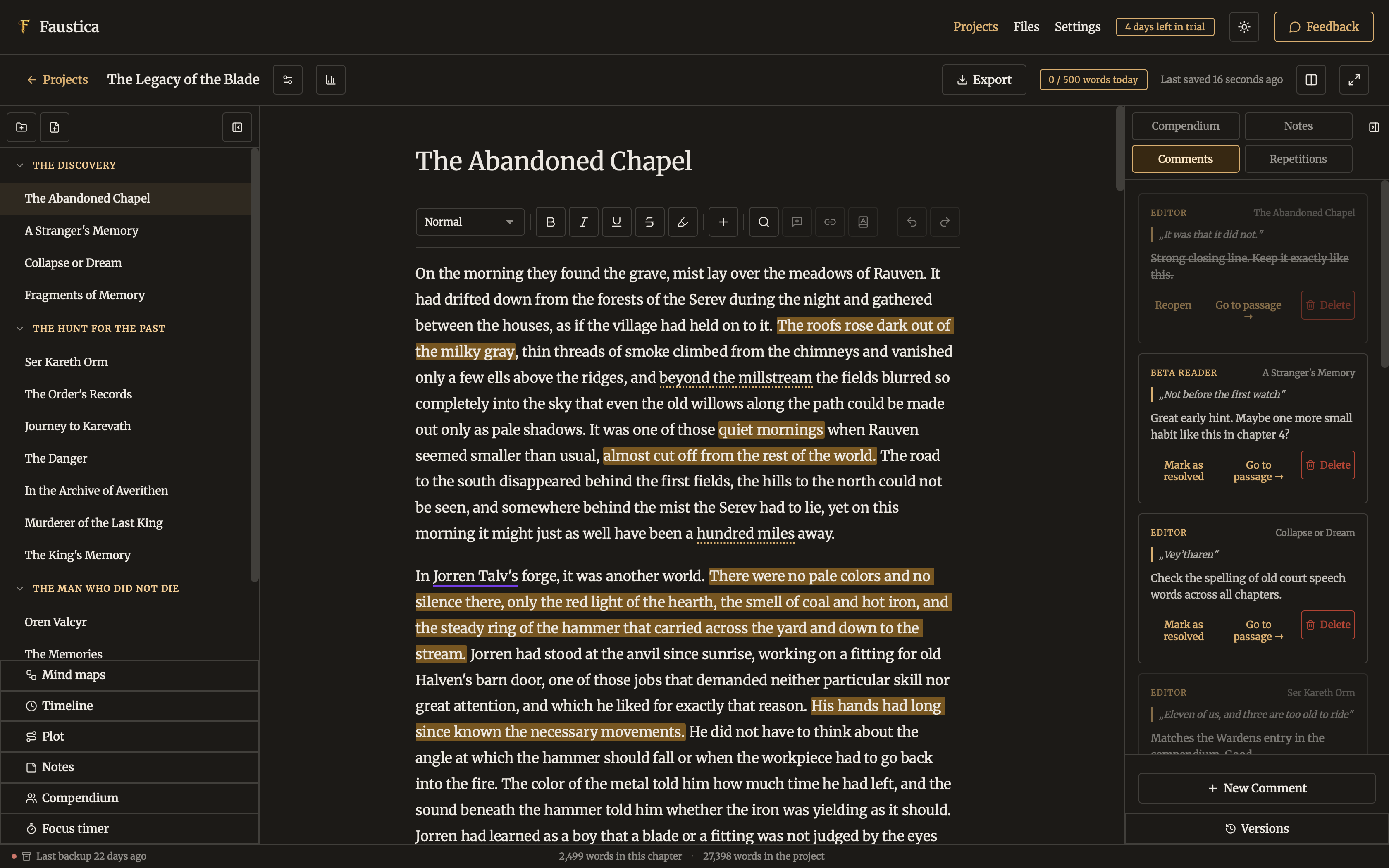
To work with an editor or beta readers, you export individual chapters as a Word file. Anchored comments come out as Word comments, and track changes is switched on. You import the returned file as an additional chapter next to the original, with comments and marked changes. This editing export always covers one chapter, not the whole manuscript. If you need the whole book as a file, for example as a PDF to read on your e-reader or in standard manuscript format, you use the regular Export to Word, PDF, EPUB or Markdown.
In the editor, repetition analysis makes repeated words visible, and offline synonyms help you replace them. Split view shows two chapters side by side, for example a revised version next to the original. Under Versions & Backup, Faustica keeps earlier versions automatically; up to 30 manuscript versions per project can be restored. An automatic version is created with the first change of a day; it is not a complete history of every editing step. In addition, you can create complete backups at a location of your choice, for example before a major restructuring phase.
Frequently asked questions
How many times should I revise a manuscript?
There is no fixed number. Many writers work in several passes, as described here, and repeat individual levels after feedback from beta readers. A good sign that you are done: new passes only bring small changes, and you find yourself changing sentences back and forth.
How long should I wait before revising?
Long enough that you can read the text with some distance again. A few days or weeks can help; more important than the exact length is that you do not work on the manuscript during that time. If you have a deadline, you can increase the distance by switching formats and reading in a different place.
Do I need a professional editor?
That depends on your goal. If you publish traditionally, the publisher usually provides editing. If you self-publish, consider developmental editing, line editing or copyediting, plus a final proofread, depending on the state of your text and your budget. Proofreading alone does not fix problems with plot or characters. A thorough revision of your own is worth it beforehand in any case, because an editor can then concentrate on the things you cannot see yourself.
Should I revise on screen or on paper?
Both have advantages. On screen you work faster and can make changes directly; on paper or an e-reader you read more like a reader and find different mistakes. Many writers combine the two: reading and marking on paper, making changes on screen.