
Self-editing your novel means no longer reading your text as its author, but the way an editor would: with fixed questions, written notes and the goal of finding problems rather than enjoying what works. Simply rereading will not get you there. You need tools that make up for the missing distance: a reverse outline, a style sheet, targeted reading techniques and a clear separation between finding and fixing.
The order of revision, from big to small in five passes, is described in the guide How to revise a manuscript. This page picks up from there and shows which methods you actually use in those passes, with a before-and-after example, and where the limits of self-editing lie.
What self-editing can do
A professional editor brings two things you lack with your own text: experience with many manuscripts and an unbiased eye. You can partly acquire the experience by learning which questions an editor asks. The unbiased eye you can only approximate. You know what a character is thinking even when it is not on the page, and you read over gaps because your mind fills them in.
Self-editing is therefore no substitute for other people’s eyes, but it is important groundwork. The more you find yourself, the more a later editor or a round of beta readers can focus on what only others can see. What sets developmental editing apart from copyediting and proofreading is explained on the page Developmental editing, copyediting and proofreading.
Methods for self-editing
1. Switch roles
Do not read as the person who wrote the text. Imagine the manuscript has been sent to you for assessment and you have to write feedback at the end. It sounds like a trick, but it changes what you pay attention to: you no longer ask “Did I say that well?” but “Does a reader understand this, and do they want to keep reading?”
It helps to separate finding from fixing. In the editor’s role, you mark passages and write a short note about each one, but you do not rewrite anything. Only in a second step do you work through the notes as the author. That way you do not get lost in a single paragraph while you actually meant to check the whole chapter.
2. Create a reverse outline
A reverse outline is an overview you create afterward from the finished text. For each chapter you note in a few words:
- what happens, in one sentence,
- whose point of view it is told from,
- which characters appear and where the scene takes place,
- what is different at the end compared with the beginning,
- which questions remain open.
Only in this condensed form can you see whether two chapters do the same job, whether a subplot disappears for many chapters or whether a character knows things they cannot have learned yet. The reverse outline is your tool for the structural passes.
3. Keep a style sheet
A style sheet is a list of every decision that should be consistent throughout the book. Publishers and copyeditors commonly work with such a list; for you it is at least as useful. It includes:
The table uses an invented suspense novel: ferrywoman Rika discovers that her childhood friend Hauke uses her for drug shipments and is threatened after refusing further trips. She plans a fake engine failure and an anonymous tip. A style sheet could record these decisions:
| Area | Possible decisions for Rika’s story |
|---|---|
| Names | Rika and Hauke; identify minor characters by role for now. |
| Places | Island, landing, mainland; specific place names remain open. |
| Address | Familiar speech between Rika and Hauke reflects their shared past. |
| Sequence | Real failure, repair, cargo trips, discovery, aggressive threat, deception and anonymous tip. |
| Viewpoint | Only Rika’s perceptions and thoughts in a limited scene. |
| Style | A consistent quotation-mark convention. |
A style sheet records decisions rather than filling gaps with arbitrary history. Record the trap’s sequence too: Rika fakes the failure and sends the tip anonymously.
PDF and Word downloads: three style sheets
These three complementary worksheets offer a practical way to organise your decisions, rather than a fixed classification of style sheets. Download these templates for free as printable PDFs or editable Word files. Start with what your manuscript needs:
- Language and form – download PDF (4 pages) · Download Word file: Record language variety, quotations, thoughts, embedded texts, numbers and emphasis, with examples. Useful for every manuscript, especially before a language edit.
- Names and terms – download PDF (8 pages, 24 entries) · Download Word file: Collect chosen spellings and alternative forms to search for. Especially useful with many proper names, technical terms or invented words. Print additional sheets and arrange entries alphabetically.
- Continuity – download PDF (6 pages) · Download Word file: Record established facts, changes, chronology and character knowledge, with chapter references. Useful for multiple viewpoints, flashbacks or a series. The template includes three records of two pages each for a character, place or plot thread. Reprint the page pairs for additional records.
A style sheet records decisions; a checklist helps you verify that you have applied them. Mark unresolved questions clearly. In Faustica, you can also collect these decisions on a note board and keep character or location details in the compendium.
The selection draws on the Chartered Institute of Editing and Proofreading's guidance on fiction style sheets. The PDFs are original worksheets, with prompts for your own decisions rather than universal writing rules. Choose a dictionary and style guide appropriate to your language variety and publisher.
4. Read with a purpose instead of simply rereading
Each level needs its own reading technique:
- Read in one go for structure and pacing. Ideally in a different format from the one you wrote in, such as a PDF or a printout.
- Follow one character for character development and contradictions: only the scenes with that character, one after the other.
- Read aloud for rhythm and dialogue. Where you stumble, your readers will stumble too.
- Read chapters one at a time and slowly for language, watching for filler words, repetition and mixed metaphors.
- Read backward, sentence by sentence from the end of the chapter to the beginning, for proofreading. Without the pull of the story, typos are easier to spot.
5. Keep your own list of habits
Almost every writer has recurring quirks: a favorite word, a typical sentence construction, an image that keeps coming back, characters who nod or sigh suspiciously often. Note what you come across more than once while self-editing, and check that list in every chapter, for example with the search function. The list gets more precise with every project. The page Avoiding repetition describes how to find repetition systematically.
Before and after: one paragraph, self-edited
In this invented suspense novel, ferrywoman Rika has discovered drugs in her childhood friend Hauke’s cargo. After his aggressive threat, she plans to expose him through a fake engine failure and anonymous tip. Both teaching versions show her fear before the call reporting the supposed fault.
Before:
Rika suddenly had the very unpleasant feeling that she was somehow afraid when she saw the number. She made the decision to wait a little. Then she suddenly looked at the number again.
Editorial-role notes:
- “Suddenly” repeats without a new reversal.
- “Very unpleasant feeling” and “somehow afraid” are vague.
- Waiting needs a concrete action or a new thought.
After:
Hauke’s number filled the screen. Rika ran her thumb along the case. What if he wanted to inspect the engine? She put the phone down.
The question connects fear to the deception. A small action carries hesitation. A later pass must show how she eventually makes the call; a better paragraph is not a complete scene.
Checklist for self-editing
The checklist is also available as a printable PDF · Download Word file.
Preparation
- Starting version saved before you make changes
- Reverse outline created from the finished text
- Style sheet set up (names, terms, forms of address, mechanics)
Content
- Every scene has an entry “What is different afterward?” in the outline
- No character knows something they cannot have learned yet
- Open questions are answered or deliberately left open
Language
- Every chapter read aloud once
- Your own list of habits worked through with search
- Announced instead of narrated events (“something strange happened”) rewritten
Final steps
- Style sheet checked against the whole text
- Proofreading in a separate pass, backward or in a different format
- Open notes done or deliberately discarded
Common mistakes
- Reading and rewriting at the same time. If you change things at every bump, you lose track of the chapter and get stuck on details.
- Reading only on screen in the same view. The familiar look tempts you to read what you meant.
- No written memory. Without a style sheet and a reverse outline, you rely on your memory, and with a novel of several hundred pages that is unreliable.
- Sparing your favorite passages. The passages you most enjoyed writing deserve a critical look precisely because you read them least neutrally.
- Confusing self-editing with proofreading. Flawless spelling does not make a revised book. The questions about content come first.
Practical tips
- Set a fixed format for the editor’s role, for example: every note starts with an observation (“It is unclear who is speaking here”), not a solution.
- Plan short sessions. Focused checking tires you out faster than writing; after one or two chapters, attention noticeably drops.
- Read through your style sheet briefly before each session. That keeps your decisions fresh in your mind.
- When you are done, pass the text on to beta readers. They show you what you cannot see despite all your methods.
Using Faustica
Comments are well suited to separating finding from fixing: you mark a passage and record your note next to it without touching the text. The overview shows all of the chapter’s comments, one click takes you back to the passage, and you mark notes as resolved once they are done.
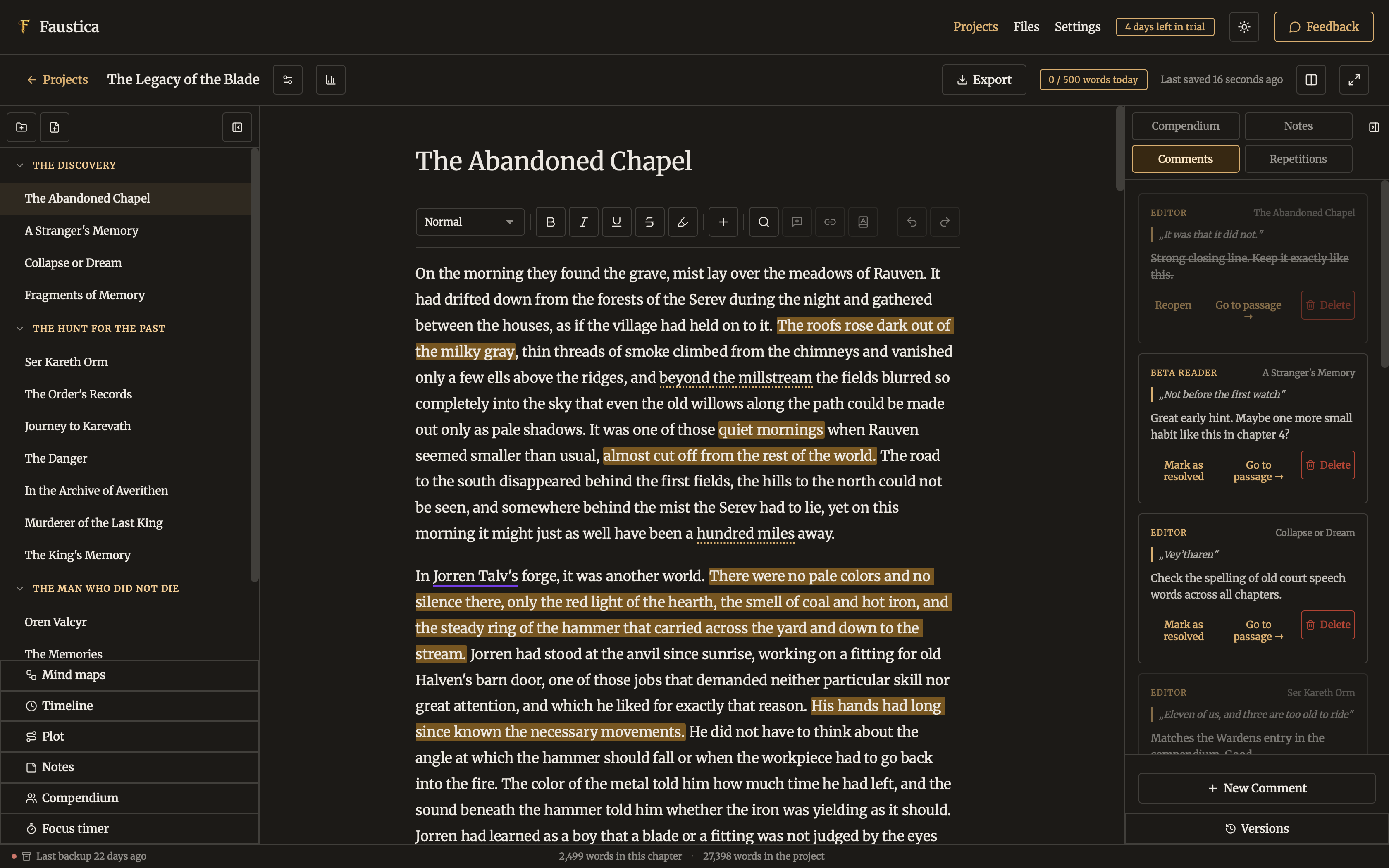
In the editor, repetition analysis shows frequently used words, and offline synonyms help you replace them. Split view puts two chapters side by side, for example the old and the new version. Before you start major changes, create a complete backup under Versions & Backup; in addition, Faustica keeps earlier versions automatically. To read in a different format, export the whole manuscript as a PDF or EPUB with Export.
Frequently asked questions
Can self-editing replace a professional editor?
Not completely. Thorough self-editing can fix many problems, but you lack an unbiased view of your own text. If you work alone, at least bring in beta readers and consider having someone else proofread before you publish.
How long does it take to self-edit a novel?
That depends on the length and state of the manuscript; there is no fixed duration. If you plan several separate passes with a reverse outline and a style sheet, it usually takes much longer than a simple reread. Think in weeks rather than days.
What is the difference between self-editing and revising?
The terms overlap. Revising describes the whole process from first draft to finished version, including rewriting. Self-editing mainly means the checking role within it: reading the text with fixed questions, noting problems and giving reasons for them.
Should I start the style sheet while I am still writing?
That can save a lot of work. If you note names, invented words and spellings from the start, there is less to make consistent during editing. It should be in place by the first editing pass at the latest.