
The best way to avoid repetition in your writing is to make it visible first and then decide case by case: often you can cut the repeated word, replace it with a pronoun or restructure the sentence so that it is needed only once. A synonym is just one of several solutions and not always the best one. And some repetition you should not remove at all, because it carries rhythm, clarity or a deliberate effect.
On this page you will find the different kinds of repetition, ways to find them, five strategies for fixing them with before-and-after examples, and a checklist. At the end, the page turns to repetition as a stylistic device, because if you remove every doubled word, you can sometimes do your text more harm than good.
The kinds of repetition
When people talk about repetition in writing, they usually mean several different things:
- Close repetition. The same noticeable word appears twice in one sentence or in two consecutive sentences. Readers notice this most.
- Repeated sentence openings. Several sentences in a row start with “He,” “She,” “Then” or “When.” The text takes on a monotonous beat.
- Pet words. Words that keep turning up across the whole manuscript, such as “suddenly,” “just,” “slightly,” “somehow” or “felt.” In a single chapter they hardly stand out; across the whole book they do.
- Recurring gestures and images. Characters who constantly nod, sigh, frown, shrug or run a hand through their hair. Or a comparison you liked so much that it appears three times.
- Repeated content. A piece of information is explained more than once, or a character thinks the same thing in several scenes. This belongs more to the content side of revision, but it is just as tiring.
Small function words such as “and,” “the” or “said” repeat constantly in every text. They usually do not bother anyone, because readers skim over them. What stands out are mainly content-rich, rare or vivid words.
Finding repetition
Unintended repetition is hard to see, because in your own text you pay attention to content, not to individual words. Several methods complement each other:
- Read aloud. Your ear often notices close repetition and repeated sentence openings faster than your eye.
- Check sentence openings paragraph by paragraph. Read only the first word of each sentence. Patterns become visible immediately.
- Use search. Search the whole manuscript for your known pet words and check every hit.
- Use a frequency analysis. Tools that count which words occur especially often in a chapter uncover pet words you did not even know you had.
- Keep your own list. Whatever you have found once goes into a personal list of habits, as described on the page How to self-edit your novel.
There is no number at which repetition becomes too much. What matters is whether it stands out while reading and whether it is meant to achieve something.
Five ways to fix repetition
The teaching sentences belong to an invented suspense novel about ferrywoman Rika. Her childhood friend Hauke has advanced repair costs and uses her crossings for drug shipments without her knowledge. These examples show how to revise repeated words in sentences about their work and conflict.
1. Cut
Before: Rika picked up the phone. The phone was vibrating.
After: Rika picked up the vibrating phone.
2. Restructure
Before: Hauke paid for the repair. Hauke demanded cargo crossings in return.
After: Hauke paid for the repair and demanded cargo crossings in return.
The developed passage must still establish that this is an advance, not a gift.
3. Vary openings
Before: Rika heard footsteps. Rika put the phone away. Rika looked at the door.
After: Footsteps on the stairs. Rika put the phone away and looked at the door.
4. Be more precise
Before: She went to the crate and opened the crate.
After: She knelt beside the crate and lifted the lid.
The more precise movement changes the scene slightly and must fit its geography.
5. Choose synonyms carefully
“Boat” need not alternate with “ship,” “tub” and “vessel.” Those words suggest different scale, condition and tone. Restructuring often helps more than substitution.
When repetition is right
Deliberate repetition can shape Rika’s waiting. These possible formulations are teaching variants.
- Parallel structure: “Not another crossing. Not another crate.” Repeated form gives weight to refusal.
- Recurring motif: A repair invoice can first mean relief, later dependence. The object returns with changed significance.
- Dialogue: Hauke says, “You sail.” Repeating the line in Rika’s thoughts can make his threatening voice present.
- Orientation: Repeat Rika’s name if a pronoun would be unclear. Clarity matters more than avoiding every repeated name.
Function decides: repetition offering only the same information may go, while pressure or changed meaning may justify keeping it.
Checklist: checking for repetition
Download checklist as PDF · Download Word file · Free to print or edit.
- Chapter read aloud, stumbling points marked
- Sentence openings of each paragraph skimmed
- Most frequent words of the chapter checked
- Personal pet words checked with search
- Recurring gestures (nodding, sighing, smiling) counted and reduced
- Every synonym checked: is it clear that the same thing is meant?
- Names, technical terms and invented words left consistent
- Deliberate repetition (motifs, parallelism) kept
Common mistakes
- Removing every repetition. A text without any repetition quickly sounds strained. Leave repetition that does not stand out or that carries something.
- Using thesaurus synonyms without checking the tone. “Steed” instead of “horse” suits one narrative voice and not another at all.
- Creating ambiguous pronouns. If, out of fear of repetition, you only write “he,” it becomes unclear who is acting.
- Searching too early. Checking for repetition belongs in the language pass. If you hunt every doubled word in the first draft, you lose your writing flow.
- Only looking at close repetition. Pet words spread across the whole book only stand out when you search for them specifically.
Practical tips
- Check for repetition chapter by chapter, not across the whole manuscript at once. That keeps the list manageable.
- If a word turns up very often, ask yourself whether a habit is behind it, such as “suddenly” as a substitute for real surprise. Restructuring often helps more than a replacement word.
- Record deliberate repetition in a comment so that you do not accidentally “correct” it in a later pass.
- You will find more on rhythm, sentence structure and word choice on the page Improving your writing style.
Using Faustica
The Faustica editor includes a repetition analysis that lists frequently used words in the side panel next to your text, either for the current chapter or for the whole manuscript. Short, common words such as articles and conjunctions are left out, so what remains are mainly noticeable repetitions and possible pet words. For replacing words there are offline synonyms that work without an internet connection. As with any thesaurus, you decide whether a suggestion fits.
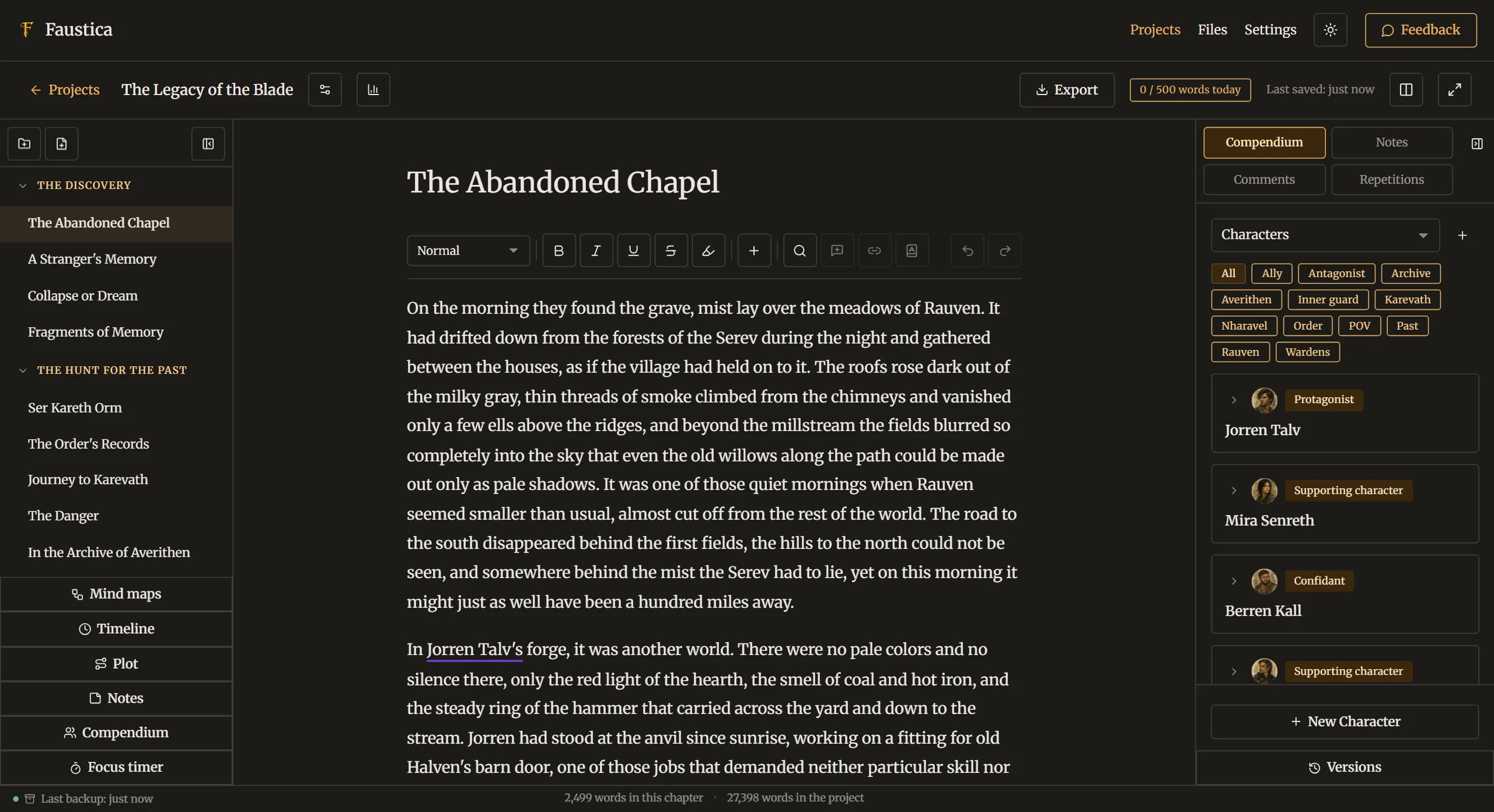
You mark deliberate repetition with a comment on the passage, for example “Echo of chapter 3, keep as is.” That way it stays clear in later passes that the passage is intentional.
Frequently asked questions
How many words should be between two identical words?
There is no fixed rule. How much repetition stands out depends on the word: a rare, vivid word still stands out a page later, while “said” hardly does even in the next sentence. Read the passage aloud and decide by ear.
Can I repeat a character’s name often?
Yes, in many cases that is better than a substitute. Descriptions such as “the smith” or “the young man” only work if they are unambiguous and fit the point of view. In scenes with several characters of the same gender, names also keep things clear.
Is repetition a spelling or grammar mistake?
No. Repetition is a matter of style, not correctness. That is why it belongs in the language pass or a line edit rather than in proofreading. The page Common writing mistakes describes which errors proofreading focuses on.
How do I find my pet words?
Most reliably with a frequency analysis across several chapters. Beta readers often notice them too, especially when they read several chapters in one go. Once you have found them, they go on your personal list.