
Planning subplots means deciding which stories run side by side in your novel, what each one contributes to the main plot and where they touch. A storyline is a sequence of scenes with an open question of its own: a love story, the antagonist’s schemes, the protagonist’s inner journey. Storylines are well connected when they affect each other, meaning a development in one has consequences in another, and when they converge at the climax.
Subplots can deepen a novel, regulate its pace and carry the flat stretches of the main plot. But they can also make it fray if they just run alongside. On this page you’ll find the common types of storyline, a six-step approach, an example with four storylines and the typical mistakes.
Main plot, subplot, storyline
The main plot carries the novel’s central question, which is answered at the climax. Subplots raise smaller questions of their own. In television writing, people often speak of the A, B and C plots. “Storyline” is the umbrella term for both: every line you can follow through the book is a storyline.
A storyline doesn’t have to be tied to a point-of-view character. It can follow a character, a relationship, a question or a conflict. What matters is that it develops on its own terms, with a beginning, turning points and a resolution or a deliberately open ending.
Types of storyline
- The inner storyline. The protagonist’s development: a mistaken belief, a fear, a question of identity. It often runs through the same scenes as the main plot but can be tracked separately.
- The relationship storyline. A friendship, romance or rivalry that changes over the course of the book.
- The antagonist storyline. What the antagonist plans and does, even when the protagonist can’t see it. It can be told from its own point of view or become visible only through its consequences.
- The mystery storyline. A question from the past or a secret that is gradually uncovered.
- The mirror storyline. A supporting character faces a conflict similar to the protagonist’s and resolves it differently. That sharpens the theme without anyone having to spell it out.
How to plan subplots in six steps
- Define each storyline’s job. What does it contribute to the main plot: pressure, information, contrast, emotion? A storyline without a job is a candidate for cutting.
- Give every storyline its own question. Will the friendship hold? What is the antagonist planning? The question tells you when the storyline starts and when it ends.
- Plan the turning points of each storyline. Even a subplot needs at least a trigger, a turn and a resolution. A few scenes are enough if each one changes something.
- Fix the crossing points. Where does one storyline affect another? A piece of information from the mystery storyline changes the main plot; a decision in the main plot strains the relationship.
- Pace the storylines. Decide on the rhythm in which they alternate. A storyline that lies dormant for too long is forgotten; one that shows up in every chapter without moving becomes tiresome.
- Bring them together. By the climax at the latest, the important storylines should affect the main plot. A storyline that is resolved afterward should be short, so the ending doesn’t fray.
An example: Rika’s interconnected storylines
This example uses an invented suspense novel: ferrywoman Rika keeps extra island supply runs going. Her childhood friend Hauke advances repair costs and uses the return crossings for drug shipments without her knowledge. After discovery, he becomes aggressive and threatens her. Rika seeks a way to escape his control.
| Storyline | Its own question | Connection to the main plot |
|---|---|---|
| Smuggling and escape | How can Rika stop Hauke? | Her decisions drive the main plot. |
| Supplies and money | How can the crossings remain viable? | The repair debt explains why she accepts his offer. |
| Friendship and trust | When does Rika recognize that Hauke exploits their bond? | Help becomes dependence and then blackmail. |
| Fear and resistance | How can Rika act without warning Hauke? | She devises a deception and sends an anonymous tip. |
A crossing point: After discovering the drugs, Rika demands that Hauke remove the cargo. She wants to end the smuggling and save her service. His threat connects the storylines: her boat, income and trust in him are at stake together.
These four areas do not all need separate viewpoint chapters. Several can advance in the confrontation with Hauke. Two storylines may be enough for an initial draft if extra rows merely repeat the same events.
Common mistakes
- Storylines that never touch. Two stories run in parallel and have nothing to do with each other. The novel then reads like two books told in alternation.
- Forgotten storylines. A subplot is introduced and then vanishes. Readers remember open questions longer than you might think.
- Too many storylines. Every extra storyline needs room for a trigger, development and resolution. With too many, each one stays thin.
- A subplot overtakes the main plot. If the love story is more gripping than the central conflict, either the weighting is off or the main plot is too weak.
- Resolution in the epilogue. If three subplots are wrapped up one by one after the climax, the ending loses its force. Resolve them earlier or at the climax itself.
Practical tips
- Draw a table with storylines as rows and chapters as columns. Gaps and clusters show up immediately.
- For each storyline, write down the question it raises and mark the scene in which it’s answered.
- For every subplot, find at least one scene in which it changes the main plot. If you can’t find one, check whether the storyline is needed.
- If you use several points of view, also check the sequence of perspectives. The guide on point of view in fiction can help. For storylines in different time periods, a timeline helps.
Using Faustica
In Faustica’s Plot Planner, storylines are the rows, each in its own color, and the chapters of your manuscript are the columns. You move scene cards between storylines and chapters by drag and drop. That puts the table from the practical tips right next to your text, and chapters you haven’t written yet can be planned as columns of their own.
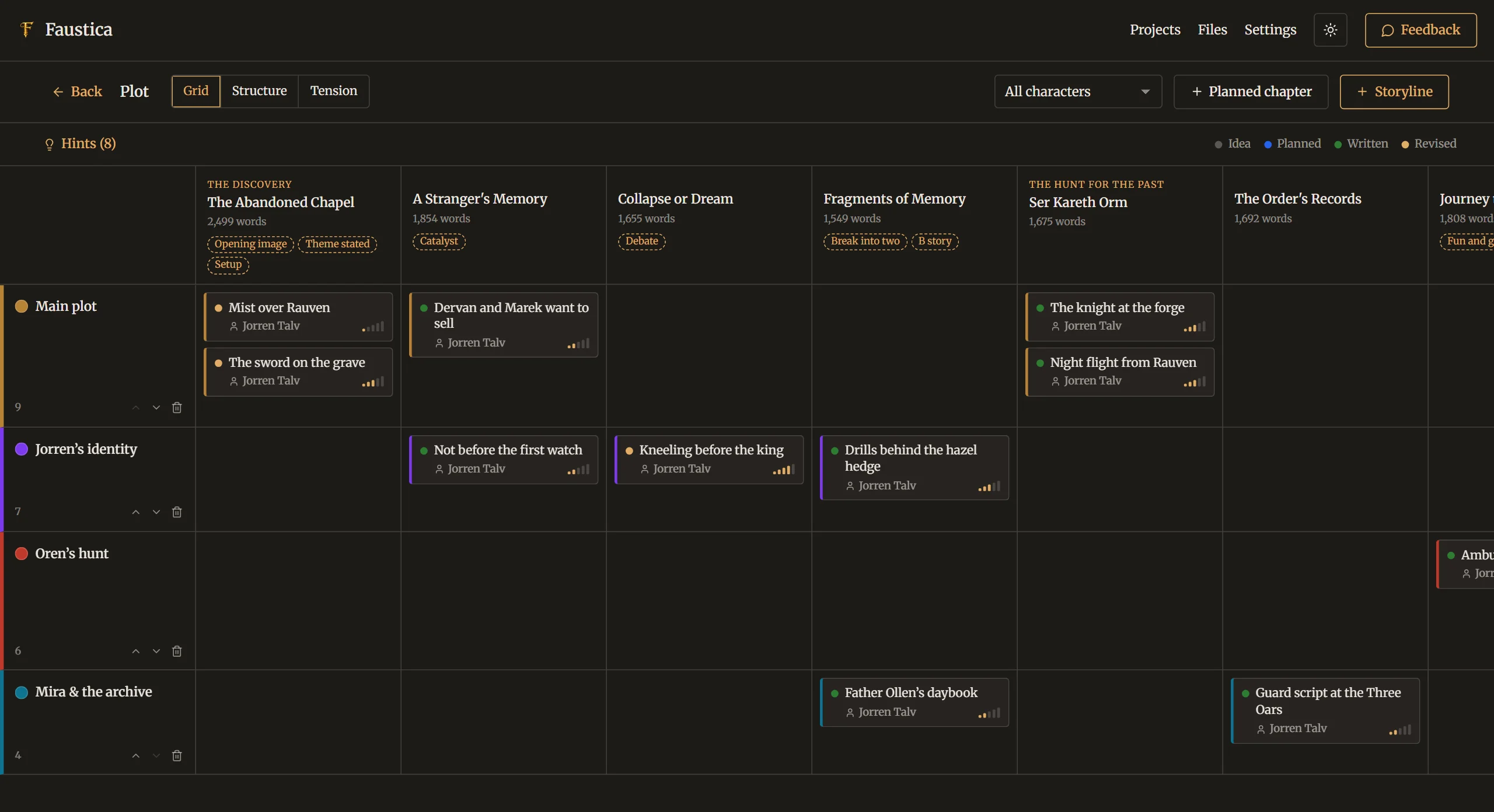
Hints point out storylines that have been dormant for a long time and characters who have been missing for a while; with “Highlight character” you see which scenes a character appears in. Whether a pause is intended is your call, and every hint can be dismissed individually. If your storylines run in different time periods, the Timeline with parallel storylines helps as well.
Frequently asked questions
How many subplots should a novel have?
There’s no fixed number. Many novels manage with one main plot and two or three subplots. What matters is that each storyline has a job and gets enough room for a beginning, development and ending.
How often should a subplot appear?
That depends on the length and pace of the novel. As a rule of thumb: often enough that readers don’t forget its question, and only when something in it moves. A longer pause isn’t a mistake if the storyline comes back with a change.
Does every subplot have to be resolved at the end?
It should either be resolved or recognizably left open on purpose. In a series, storylines may point to the next book, as long as the current book answers its own central question.
What’s the difference between a storyline and a point of view?
A point of view determines through whose eyes the story is told. A storyline is a sequence of events with its own question. Often the two coincide, for example when the antagonist gets chapters of their own, but a storyline can also be told entirely from the protagonist’s point of view.