
Writing dialogue that feels alive means compressing conversation: it should sound as if people could talk this way, yet leave out everything that only fills time in real life. Every line of dialogue should do at least one job. It shows who a character is, moves the plot forward or creates tension because two characters want different things. Dialogue feels most alive when the characters do not say everything they think.
On this page you will find what dialogue does in a novel, six steps to better conversations, before-and-after examples and the rules for punctuating dialogue. At the end there are common mistakes, practical tips and answers to frequently asked questions.
What dialogue is for in a novel
Dialogue is not a transcript of a conversation. Real conversations are full of greetings, repetition and detours that quickly drag on the page. Dialogue in fiction only keeps the impression of real speech.
In return, it can do things that narration struggles with:
- It reveals characters. The way someone speaks gives away their background, education, mood and attitude toward the others.
- It moves the plot forward. In conversation, decisions are made, secrets come out, alliances form or fall apart.
- It creates tension. As soon as two characters want different things, every conversation becomes a small fight, even if nobody raises their voice.
- It sets the pace. Quick back-and-forth exchanges read fast and break up long stretches of narration.
Dialogue that does none of these jobs can usually go. That is the most important question in revision: what changes because of this conversation?
How to write dialogue in six steps
- Work out what each character wants in the scene. Before you write the first line, note a goal for this conversation for every character involved: to find something out, to hide something, to persuade someone, to dodge a question. Different goals create friction. A friendly conversation can carry a scene too, for example through closeness, humor or a discovery.
- Come in late, get out early. Cut greetings and goodbyes unless they show something about the relationship or the situation. Start where the conversation gets interesting and stop as soon as the important thing has been said.
- Give every character their own voice. Sentence length, vocabulary, pet words, politeness, humor: one character talks in short commands, another in long, winding clauses. Ideally, readers can tell who is speaking even without a dialogue tag.
- Leave important things unsaid. People rarely say directly what they feel. They evade, change the subject, talk about one thing and mean another. This layer beneath the words is called subtext, and it is what brings dialogue to life.
- Keep dialogue tags sparse and simple. Readers barely notice “said” and “asked,” and that is exactly their advantage. Often a small action, a so-called beat, works better than a tag: it shows who is speaking and in what state.
- Read the dialogue aloud. When you read aloud, you hear where a sentence runs too long, where a character sounds like a textbook or where two voices sound the same.
Before and after: three examples
These dialogues belong to an invented suspense novel: ferrywoman Rika discovers that her childhood friend Hauke has been using her for drug shipments. He advanced repair costs and wants to force her into further crossings. After she refuses, he becomes aggressive; she is afraid of him. The teaching versions explore ways to reveal this conflict through speech.
Example 1: cut the warm-up
Before: “Hello, Hauke.” — “Hello, Rika. How are you?” — “Not well. We need to discuss the cargo.”
After:
Rika set the crate between them. “This isn’t coming aboard again.”
Hauke looked past her at the boat. “But the others are?”
The opening starts with conflict. Hauke treats continued transport as a given rather than answering her boundary.
Example 2: fear in subtext
Before: “I’m afraid of you because you threatened me,” Rika said.
After:
“Leave the door open,” Rika said.
“Since when does that bother you?”
Naming fear directly can work. Here, asking for an open door can show a changed relationship without explaining it.
Example 3: shared knowledge
Before: “As you know, you advanced my repair costs, and I’ve carried your crates since then.”
After:
“You’ll get your money back,” Rika said. “But not through these crossings.”
Backstory lives in the present argument rather than being explained to characters who know it.
A dialogue between Rika and Hauke
A possible short exchange after discovery:
“The crates stay here,” Rika said.
Hauke rested a hand on the rail. “Your boat runs again because I paid for it.”
“That wasn’t an agreement to do this.”
“Then listen carefully.”
Rika tries to draw a boundary; Hauke turns financial debt into a claim on her obedience. His final line anticipates the aggressive threat. A complete scene still needs his demand and her response. The dialogue should prepare danger, not merely deliver a sharp line.
How to punctuate dialogue
English dialogue follows a handful of firm conventions. The rules below follow American usage: double quotation marks, with commas and periods inside the closing quotation mark. British publishers often use single quotation marks instead, and some house styles differ in details. What matters most is using one style consistently.
| Case | Example |
|---|---|
| Tag after the dialogue | “I’ll come tomorrow,” she said. |
| Tag before the dialogue | She said, “I’ll come tomorrow.” |
| Question or exclamation, tag after | “Are you coming tomorrow?” she asked. |
| Tag in the middle of one sentence | “I’ll come,” she said, “but not until tomorrow.” |
| Two full sentences, tag in the middle | “I’ll come tomorrow,” she said. “Don’t wait for me.” |
| Action beat instead of a tag | “I’ll come tomorrow.” She reached for her jacket. |
| Speech that breaks off | “I’ll come tomorrow, unless—” “Unless what?” |
| Quote within dialogue | “He said, ‘I’ll come tomorrow.’ That’s all.” |
The key points in detail:
- A comma replaces the period before a tag. The tag then continues in lowercase: “I’ll come tomorrow,” she said. Write “she said,” not “She said,” because the tag belongs to the same sentence.
- Question marks and exclamation points stay, and no comma is added. “Really?” he asked. The tag still starts in lowercase.
- An action is not a tag. If the sentence after the dialogue contains no verb of speaking, the dialogue ends with its own period and the action starts a new sentence: “I’ll come tomorrow.” She reached for her jacket.
- Interruptions take an em dash, trailing off takes an ellipsis. “Unless—” for speech that is cut off, “I thought maybe…” for speech that fades.
- Quotes within dialogue use single quotation marks.
- When one speaker’s dialogue runs over several paragraphs, leave out the closing quotation mark at the end of each paragraph but put an opening one at the start of the next.
On top of that comes a layout convention that is not a grammar rule but holds almost everywhere: when the speaker changes, start a new paragraph. That keeps longer conversations readable and saves you many tags.
Common dialogue mistakes
- Everyone sounds the same. If any line could belong to any character, the characters have no voice of their own. Check whether their word choice and sentence structure differ.
- Tags that try too hard. “He grinned,” “she growled,” “he retorted indignantly”: hunting for a new verb in every tag distracts from what is being said. “Growled” can describe a way of speaking, but “grinned” is an action, and you cannot grin words. Clearer: “You don’t believe that yourself.” He grinned.
- Adverbs explaining the feeling. “She said sadly” can be redundant when word choice and situation already convey the mood. It can also show an important contrast, though, for example between a cheerful line and a sad tone.
- Monologues dressed up as conversation. One character talks for paragraphs while the other says “Oh, really?” Real conversations have interruptions, objections and misunderstandings.
- Too much dialect or phonetic spelling. Dialect and accent characterize, but they tire readers quickly when every syllable is respelled. A few typical words or turns of phrase are usually enough.
- Going too long without attribution. In long exchanges readers lose track of who is speaking. Add a tag or a small action now and then.
Practical tips
- Write a difficult dialogue first without tags or narration, just the lines back and forth. If it is still clear who is speaking and what it is about, the conversation holds.
- Listen to how the people around you talk, and pay attention to rhythm, interruptions and dodges.
- Settle a few speech habits for your main characters, such as pet words, how they address others, sentence length, swearing or the lack of it. That keeps a voice consistent across the whole book. You will find more on this in developing characters.
- Alternate between dialogue and what the character thinks while speaking. The guide to interior monologue describes how thoughts and speech work together.
Using Faustica
In the Editor in Faustica you write dialogue like any other text. When you revise, the repetition analysis shows whether you use the same tag verb or the same phrase too often, and the offline synonyms help with alternatives. Repeating “said” is not a mistake in itself, though; clarity matters more than constantly changing tag verbs. Focus Mode hides everything except your text, which helps when you read a conversation aloud and check it.
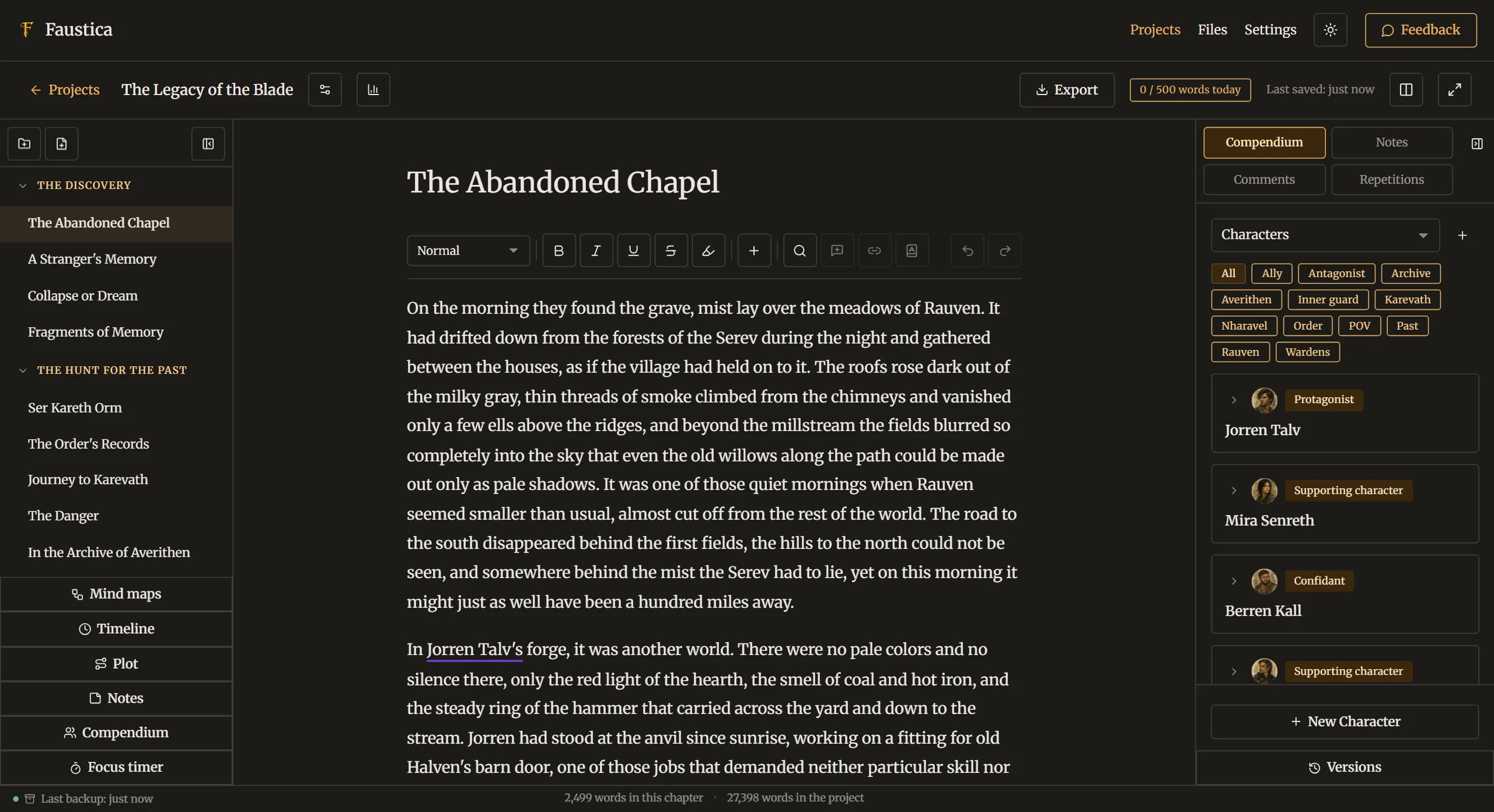
In its text statistics, Project Statistics estimates your dialogue share from the letters inside recognized quotation marks, along with your average sentence length. That does not tell you whether a conversation is good, but it shows whether a book goes long stretches with almost no dialogue at all. With comments you mark passages where a conversation does not work yet and return to them later.
Frequently asked questions
How much dialogue should a novel have?
There is no fixed amount. The share depends on genre, narrative style and scene. What matters is that the conversations contribute to the effect of the story. Long dialogue passages can work, and so can a novel with almost no dialogue.
Do I always have to write “said”?
No, but “said” is often the best choice because readers hardly notice it. Other verbs such as “whispered” or “shouted” make sense when they tell readers something important about how the words are spoken. Often it is even better to drop the tag entirely and show a small action instead.
How do I write dialogue with more than two characters?
Make sure every character has their own concern and a recognizable voice, and attribute lines more often than with two characters. Actions and glances help show who is talking to whom. If a character has nothing to say in the scene, ask whether they need to be there at all.
Why does my dialogue sound stiff?
One possible cause is that the characters speak too completely and too politely: in full sentences, without interruption, saying exactly what they mean. Shorten the sentences, let characters talk past each other or dodge a question, and read the result aloud.
Source on punctuation
The punctuation examples follow American usage as described in The Chicago Manual of Style, chapter 6 on punctuation and chapter 13 on quotations and dialogue.