
Building tension in a novel means guiding your readers’ expectations across the whole book so that, overall, they rise and peak at the climax. Tension doesn’t come from volume; it comes from an open question whose answer readers care about: Will the character reach their goal? What happened back then? Who is lying? The main levers are what is at stake, the obstacles, time pressure and who knows what, and when.
A good tension arc isn’t a straight line upward. It breathes: high-pressure scenes are followed by calmer ones in which characters process what happened, make decisions and set new goals. On this page you’ll find where tension comes from, six tools for controlling it, an example of a tension curve and the most common mistakes.
Where tension comes from
Tension is a state of uncertainty combined with emotional investment. You need both. An uncertain situation without investment leaves readers cold, such as a fight between two characters nobody cares about. Investment without uncertainty doesn’t last long either, once it’s clear how things will turn out.
In practice, there are two kinds:
- Suspense about the outcome. The reader knows what could happen and fears or hopes for it. In his conversations with François Truffaut, Alfred Hitchcock explained this with the example of a bomb under a table: if it goes off by surprise, the audience gets a brief shock. If the audience knows about the bomb but the characters don’t, every second of their harmless conversation becomes suspenseful.
- Curiosity about the mystery. Something is unclear, and readers want to know what lies behind it: Who did it? What does the sign mean? This curiosity drives mysteries above all, and any story built around a secret.
Most novels combine the two. What matters is that at least one question is always open that readers want answered.
The tension arc across the book
The best-known depiction of how tension develops comes from Gustav Freytag. In Technique of the Drama (1863), he describes classical drama as a pyramid in five parts: introduction, rising action, climax, falling action or reversal, and catastrophe. The pyramid is of limited use for novels because its peak sits in the middle. In most contemporary novels the high point comes near the end, and the curve rises toward it with dips along the way.
A useful rule of thumb for novels: each major turning point should lift the tension to a higher baseline than the one before. Between the turning points it can drop, but not below the level already reached. Where the major turning points fall is explained in Understanding the three-act structure.

Six tools for building tension
- Make clear what is at stake. Readers need to know what the character loses if they fail. Raise the stakes as the book goes on: first comfort, then safety, then something that defines who the character is.
- Give every scene a goal and resistance. A character who wants something and meets resistance creates tension on a small scale. The guide on writing scenes goes into this in depth.
- Set deadlines. A time limit turns a problem into a race. It doesn’t have to be a countdown; a festival at which everything will come out, or a strength that is running out, works as a clock too.
- Distribute knowledge deliberately. Decide whether readers know more than the character (dread), the same (puzzling along) or less (surprise). Switching between these can be very effective.
- Answer questions only by raising new ones. A solved question releases tension. If the answer raises a new, bigger question at the same time, the arc keeps climbing.
- Allow calm, but not emptiness. Quiet scenes are necessary for the peaks to work. In them, the character should process, decide or learn something. The writing teacher Dwight V. Swain called this alternation “scene” and “sequel”: a scene with a goal and conflict is followed by a reaction, from which the next goal emerges.
An example: Rika waits for Hauke
In this invented suspense novel, ferrywoman Rika discovers that her childhood friend Hauke is using her for drug shipments. After she refuses, he becomes aggressive and threatens her. She fakes an engine failure so he transports the cargo himself and sends an anonymous tip. The table develops a possible scene before his collection; the numbers are subjective tension ratings.
| Moment | Open question | Tension out of 10 |
|---|---|---|
| Rika reports the fake engine failure. | Does the now threatening Hauke believe her? | 5 |
| He agrees to come himself. | Will the plan work? | 6 |
| His car stops at the landing. | Has he noticed something? | 8 |
| Hauke gets out and reaches for his phone. | Has he noticed Rika’s deception? | 9 |
| He puts the phone away and takes the cargo. | Will the anonymous tip prompt a check in time? | 8 |
| Hauke is checked while transporting the cargo himself. | Will the smuggling be exposed without him identifying Rika’s tip? | 10, then a fall |
The waiting car is a possible addition, not an established event. Its function matters: Rika cannot fully control the encounter. Brief relief, such as his agreement to come, can strengthen the later uncertainty. Immediate danger may fall after the arrest. Rika’s sense of safety and the service’s future still need a resolution.
Common mistakes
- Constant maximum tension. If every scene is a fight or a catastrophe, readers go numb. Without valleys there are no peaks.
- The point-of-view character withholds what they know. When a point-of-view character knows something but doesn’t think about it just to keep things suspenseful, readers feel cheated.
- Danger without attachment. A fight on page five has little impact because readers don’t know the character yet. Build investment first, even if only in a few paragraphs.
- Answering everything too soon. If the central question is resolved in the middle and no bigger one follows, the arc drops off.
- Tension only in the main plot. Subplots with open questions of their own can carry flat stretches of the main plot. More on this in Planning and weaving subplots.
Practical tips
- Give every scene in your plan a tension value and draw the curve. Long flat stretches become obvious at once.
- At the end of each chapter, write down the open question it ends on. If there isn’t one, check whether the chapter should end somewhere else.
- Keep a list of your novel’s open questions and mark where each one is raised and where it is answered.
- If a scene feels too quiet, ask: What does the character want here, and what’s stopping them? Often all that’s missing is the resistance.
Using Faustica
In Faustica’s Plot Planner, you give each scene a tension value from 1 to 5. The “Tension” view turns these into a curve across the whole book, with the turning points of your structure template drawn in as lines.
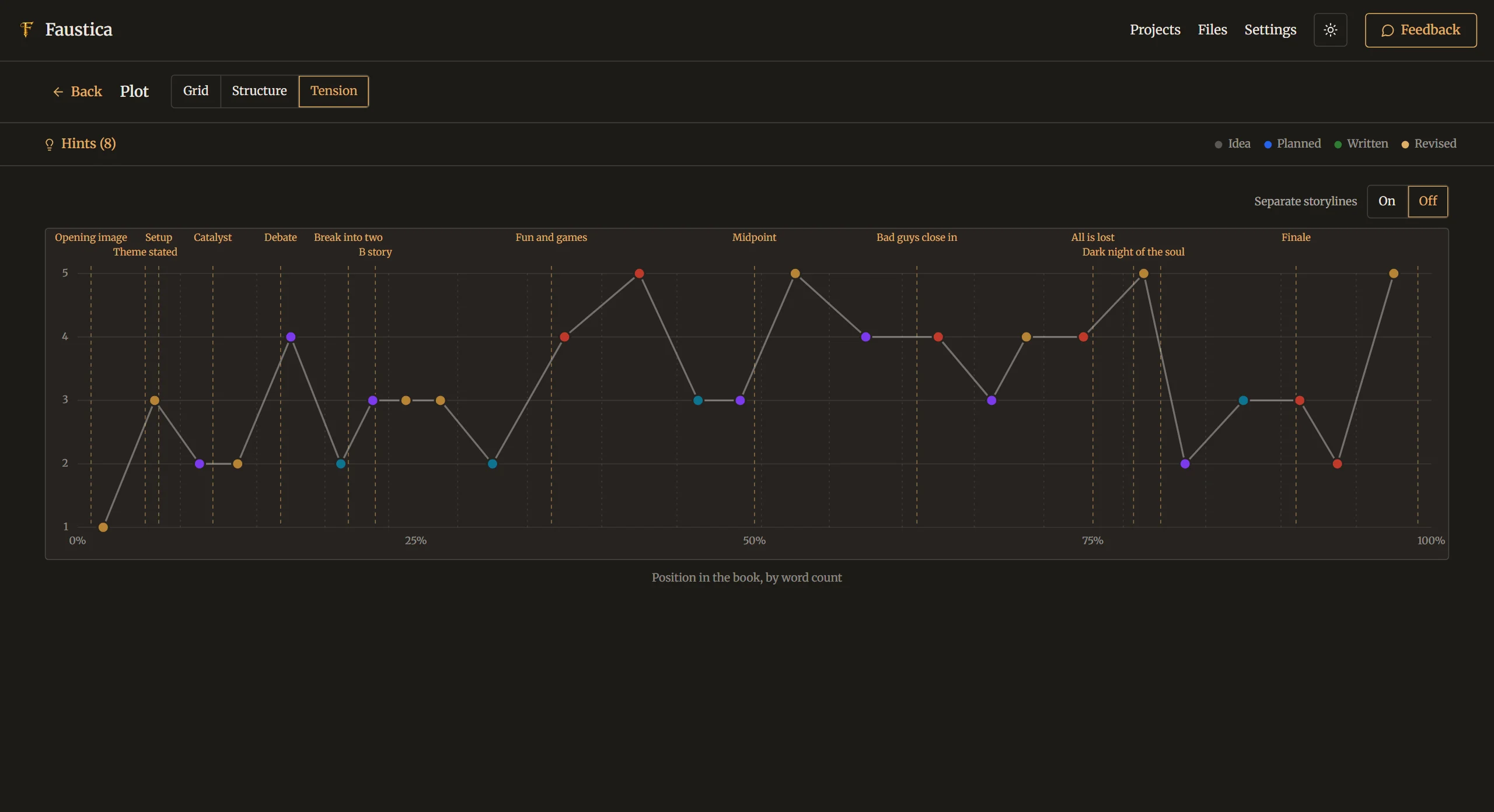
That way you see peaks, valleys and flat stretches at a glance. A hint draws your attention to tension that stays too flat. You set the values yourself; Faustica shows the course of your own assessment but doesn’t judge how gripping the text actually is.
Frequently asked questions
Does the tension have to rise constantly?
No. It should rise across the whole book, but not from scene to scene. Calm scenes after peaks give readers time to take in what happened and make the next rise noticeable in the first place.
How do I create tension in a novel without a crime or action plot?
With the same means, just quieter: a goal that matters, resistance, an open question. In a family saga, the tension can lie in whether a secret will be spoken aloud; in a love story, in whether two people will show each other how they feel.
What is a cliffhanger, and how often should I use one?
A cliffhanger ends a chapter in the middle of an unresolved, often threatening situation. It works, but it wears thin if every chapter ends that way. A chapter ending with an open question, such as a discovery or a decision, often works just as well.
How do the tension arc and the plot differ?
The plot describes what happens and how the events are connected. The tension arc describes how readers’ investment develops along the way. The same plot can be told with more or less tension depending on order, point of view and who knows what.