
Developing a plot means turning an idea into a story in which the important events are linked by cause and effect: a character wants something, meets resistance, has to make decisions and changes the situation by making them, until the conflict is settled at the end or deliberately left open. You don’t need a rigid formula for this. A clear central question, a character with a goal, an opposing force and a handful of turning points where the direction changes are enough.
On this page you’ll find the building blocks of a plot, a seven-step route from the first idea to a scene list, and a worked example. At the end are the most common mistakes and answers to frequently asked questions.
What a plot is, and what it isn’t
In everyday speech, “story” and “plot” are often used interchangeably. For working on a novel, though, it pays to tell them apart, as E. M. Forster did in Aspects of the Novel (1927), in the chapter “The Plot,” with a famous example: “The king died and then the queen died” is a story. “The king died, and then the queen died of grief” is a plot. The difference is the because.
So a plot isn’t the list of things that happen; it is the web of cause and effect behind them. That is why a story with few events can have a strong plot and an eventful story a weak one: if things simply happen one after another without following from each other, the plot can feel arbitrary despite spectacular events. This is a model for stories told through causality; episodic and experimental novels may deliberately work differently.
The building blocks of a plot
For many conflict-driven novels, the following building blocks are helpful. They are a working model, not a rule for every literary form:
- A protagonist with a goal. They want to achieve, protect or prevent something. The goal doesn’t have to be heroic, but it should be concrete enough that readers can tell whether the character is getting closer to it.
- An opposing force. An antagonist, a circumstance, a society or the character’s own fear. Resistance creates conflict; it needn’t be a villain or an outside threat.
- Something at stake. What does the character lose if they fail? The clearer that is, the more readers care.
- Turning points. Moments after which nothing is the same: a discovery, a decision, a loss. They give the plot direction and rhythm.
- A resolution. The central conflict is decided, not necessarily happily, but in a way that follows believably from what came before.
Often there is also an inner journey: at the start, the character believes something false about themselves or the world and has to let go of it over the course of the story. When outer plot and inner change drive each other, they can deepen the plot. Equally possible are characters who stay true to their convictions and change the world around them as a result.
How to develop a plot in seven steps
The following steps build on each other. You don’t have to work through them strictly in order, and some answers will change as you write. But once you’ve thought them through, you’ll write on much firmer ground.
- State the premise in one sentence. Who wants what, who or what stands against them, and what is at stake? If the sentence stumbles, the idea usually isn’t clear yet. That’s no cause for worry, just a sign of where to keep thinking.
- Define your protagonist’s goal and flaw. What do they want, and what do they lack to get it? The flaw, whether a weakness, a gap in knowledge or a mistaken belief, is often the engine of the inner journey.
- Design the opposing force. Give the resistance reasons of its own. An antagonist who is evil only because the plot needs one feels flat. One who believes they are in the right makes the conflict more interesting.
- Fix the beginning and the ending. Where does the character stand on the first page, and where on the last? If you know the ending, even roughly, you can check every step against whether it leads there.
- Place the major turning points. What tears the character out of everyday life? What forces them to commit? What turns the situation around in the middle? When does all seem lost? Models such as the three-act structure or the hero’s journey help you find these points without your having to follow them to the letter.
- Collect scenes and put them in order. Between the turning points you need scenes that lead from one to the next. For each scene, ask: What does the character want here, what stands in the way, and how has the situation changed by the end of the scene?
- Check your storylines. If other storylines run alongside the main plot, such as a love story or the antagonist’s schemes, check whether the gaps between their appearances make sense and whether each one is resolved or recognizably left open on purpose.
An example: turning a discovery into a plot
The example is an invented suspense novel about ferrywoman Rika, who organizes additional island deliveries. After an engine failure, her childhood friend Hauke offers financial help. These steps show how her decisions connect into a plot:
- Setup: After the daily ferry is withdrawn, she organizes additional supply runs.
- Disruption: An engine failure threatens the service; she cannot afford repairs.
- Decision: She accepts Hauke’s advance and carries his supposedly harmless cargo in return.
- Turn: She discovers drugs and refuses further shipments.
- Escalation: Hauke threatens to implicate her as the organizer and destroy her boat.
- New decision: Afraid of Hauke, Rika plans an indirect way out: a fake engine failure and an anonymous tip.
- Climax: Hauke transports the cargo himself; a check prompted by her anonymous tip exposes him.
- Consequence: He is arrested. Rika’s safety, debts and service still need attention.
An engine failure alone is not a plot. Rika’s response connects it to smuggling. Her refusal triggers blackmail; seeking help makes the trap possible. Each major step changes the options for the next.
The scene plan still needs transitions: how does she discover the drugs, and why does Hauke believe her second engine failure? The overview can expose those questions instead of assuming the answers.
Plotting or just writing?
Some writers plan every scene before they write the first line. Others start with a character and a situation and discover the plot as they write. Both are legitimate, and many work somewhere in between.
If you prefer to write without a plan, you can use the seven steps afterward: once the first draft is done, check whether the turning points hold and every storyline is resolved. If you like to plan, be careful not to treat the plan as untouchable. Often it’s only while writing that you realize a character would act differently than you intended. When that happens, it’s usually the plan that’s wrong, not the character.
Common plotting mistakes
- Coincidence resolves the conflict. A lucky find or an unexpected rescue at the decisive moment feels unearned. Especially when the central conflict is resolved, the characters’ decisions and possibilities set up earlier should carry more weight than a convenient accident.
- The protagonist only reacts. If other people always make the decisions and the protagonist is merely swept along, the plot lacks drive. Give them choices that have consequences.
- The middle sags. Too little new happens between the departure and the finale. A clear midpoint where the situation turns helps.
- Too many subplots. Every extra storyline needs room and a resolution. For each one, ask what it contributes to the main plot.
- Turning points without consequences. A dramatic event after which everything carries on as before isn’t a turning point. It has to change the direction of the story.
Practical tips
- Write your premise on an index card and keep it next to your keyboard. When you’re unsure whether a scene belongs in the story, a glance at it helps.
- For each scene, note in one sentence what changes because of it. Scenes in which nothing changes are candidates for cutting or merging.
- Plan backward from the ending: if you know where everything is heading, the steps to get there are easier to find.
- Allow gaps. A plot is scaffolding, not a shooting script. Knowing the broad lines is enough.
Using Faustica
In Faustica’s Plot Planner, your storylines form the rows and the chapters of your manuscript the columns. You create scenes as cards and move them by drag and drop. Each scene can hold a summary, point of view, characters, location as well as goal, conflict and outcome, which are exactly the questions from step 6. Chapters you haven’t written yet can be planned as columns of their own.
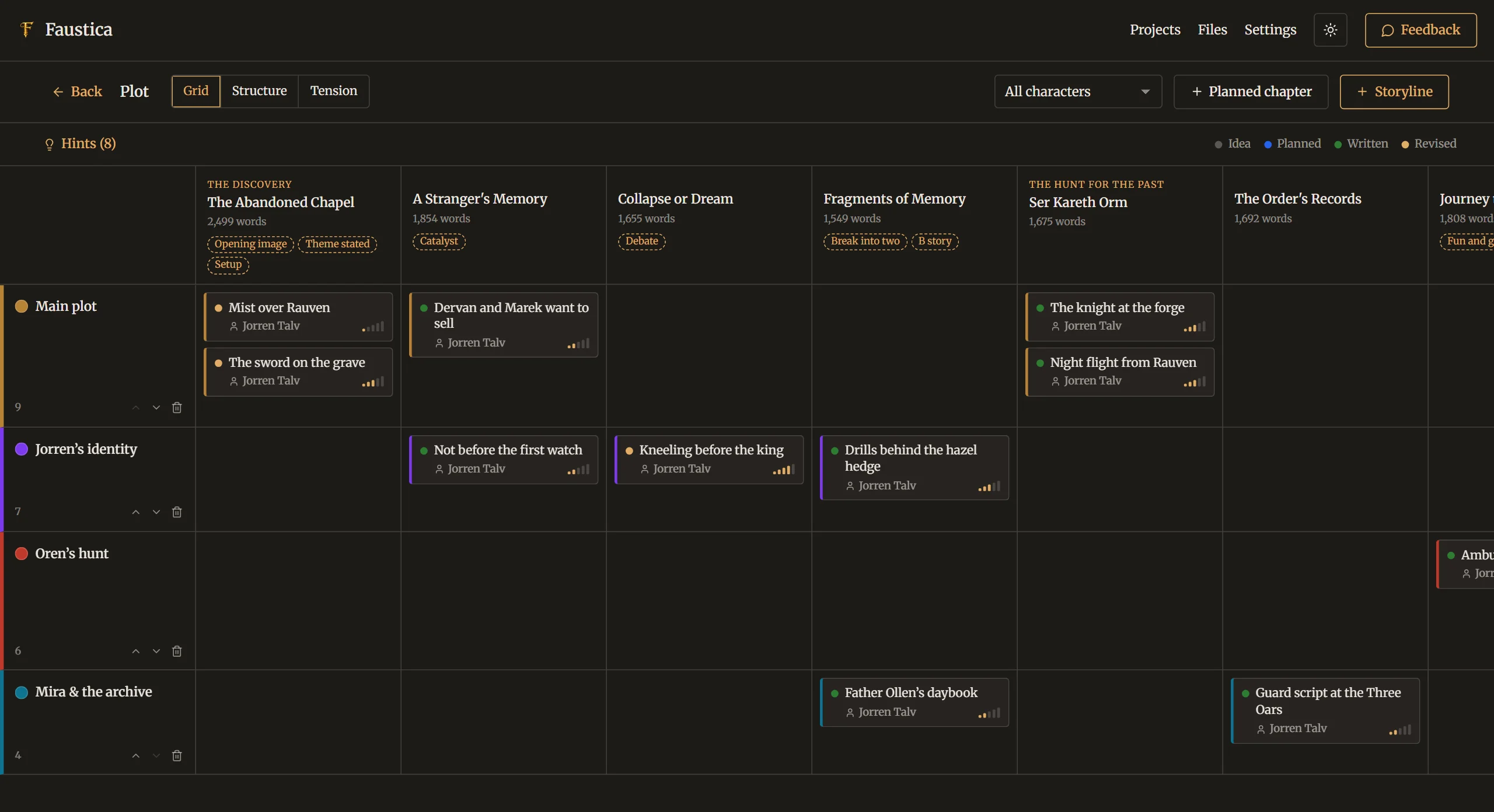
For the major turning points there are templates: the three-act structure, the hero’s journey, Blake Snyder’s 15-beat structure and Dan Wells’ 7-point structure. You assign scenes to the turning points, and Faustica calculates where they fall based on chapter word counts and how your scenes are distributed. The tension curve is built from the tension values you give your scenes. Both support your own judgment; neither rates the quality of your story automatically. Hints point out storylines that have been dormant for a long time or characters who haven’t appeared in a while. If your story has several time periods, the Timeline helps as well.
Frequently asked questions
What is the difference between story and plot?
In everyday use, the two words usually mean the same thing. If you make the finer distinction, story is the sequence of events and plot is the way those events are connected by cause and effect: the because behind the and then.
Do I need a plot structure like the three-act structure for every novel?
No. Structure models are tools, not rules. Above all, they help you find the major turning points and check whether the plot holds up in the middle. Many successful novels don’t follow any model exactly.
Can I still change the plot while I’m writing?
Yes, and that’s normal. A plot is a working plan. If you find while writing that a character would act differently or a turning point doesn’t hold, adjust the plan and then check whether the events that follow still fit together.
How detailed should a plot be before I start writing?
As detailed as helps you write. To begin with, a premise, the beginning, the ending and the major turning points are enough. If you like to plan more closely, add one sentence per scene. More important than the amount of planning is that every scene changes something.