
A gripping scene happens when a character wants something specific in a limited moment, runs into resistance and the scene ends with the situation changed. These three building blocks, goal, conflict and outcome, are the framework of almost every scene that moves the plot forward. If one of them is missing, something may happen, but nothing is at stake, and the scene reads like a report.
On this page you will learn what makes a scene, how to build one in six steps, how scenes and quieter reaction scenes work together and how to spot a scene that does not hold up. Teaching scenes from Rika’s story and a before-and-after comparison show the principle in practice.
What a scene is
A scene is a continuous stretch of action, usually in one place, over an unbroken period of time and from one character’s point of view. It is told in scene, close to the events, with actions, perceptions and often dialogue. A chapter can consist of one or several scenes; between them come scene breaks, time jumps or narrative transitions.
More important than this outer form is the inner one: in a scene, something changes. By the end, a character knows more, has lost or gained something, faces a new decision, or a relationship has shifted. A scene after which everything is the same as before is usually a candidate for cutting or merging. That applies to quiet scenes too: even a calm conversation can change the situation.
At the level of the whole book, the tension arc makes sure tension rises and breathes. This page goes one level deeper: to the single scene.
Goal, conflict, outcome
The model goes back to the American writing teacher Dwight V. Swain, who in Techniques of the Selling Writer breaks the scene down into goal, conflict and disaster. In writing practice the third part is often called the “outcome” more generally, because not every scene has to end in disaster.
- Goal. What does the viewpoint character want to achieve in this scene? It should be concrete and short-term: get a piece of information, persuade someone, escape, hide something. The scene goal is a step toward the character’s larger goal or a reaction to what has just happened.
- Conflict. What or who stands in the way of the goal? Another character with a goal of their own, a circumstance, a deadline, the character’s own fear. Without resistance, a scene is just a sequence of actions.
- Outcome. How does the scene end, and what has changed? The most gripping outcomes make the situation worse: the character fails, or reaches the goal but at a price. A common rule of thumb in writing classes therefore says that the best answer to “Does she get what she wants?” is often “Yes, but …” or “No, and furthermore …”.
A clean “yes” ends tension. It has its place, at the end of a storyline, for example, but it should be rare while the story still needs momentum.
Scene and sequel
Alongside the scene, Swain describes a second unit, the “sequel”: the reaction to the outcome. The character processes what has happened, weighs the options (Swain calls this the dilemma) and makes a decision that becomes the goal of the next scene. Sequels are often quieter, shorter or told in just a few sentences.
This alternation of action and reaction gives a novel its rhythm. If you write only scenes, you rush your characters from event to event without readers learning what it does to them. If you write too many reactions, the plot stands still.
How to write a scene in six steps
- Choose the viewpoint character. Through whose eyes do we experience the scene? Usually it is the character with the most at stake. More on this in point of view in fiction.
- Put goal, conflict and outcome into one sentence each. If you cannot come up with one of them, the scene is not thought through yet.
- Check what is at stake. What does the character lose if they fail? Do readers need to know that before the scene starts, or does it emerge during the scene?
- Come in late. Start as close as possible to the point where the conflict becomes noticeable, not with the journey there or the breakfast before. You can establish the place and the situation in a few sentences while the scene is already running.
- Let the resistance grow. Within the scene, the conflict should escalate: a first attempt, a countermove, a second attempt with higher stakes. The guide to writing dialogue describes how conversations can carry a conflict.
- Get out early. End the scene as soon as the outcome is settled. An ending that leaves a question open pulls readers into the next scene.
Goal, conflict, outcome and the key checkpoints are also available as a printable PDF · Download Word file.
An example: Rika’s refusal changes the situation
In this invented suspense novel, ferrywoman Rika has accepted financial help from her childhood friend Hauke and carried his supposedly harmless cargo in return. Then she discovers drugs. She wants to end the arrangement; he wants to keep using her crossings. Their confrontation shows how goal, resistance and outcome carry a scene.
| Element | Content |
|---|---|
| Goal | Rika wants Hauke to remove the drugs and stop using her crossings. |
| Conflict | He insists on continued transport and invokes the repair debt. |
| Turn | His tone becomes aggressive; he threatens her. |
| Outcome | She cannot openly quit and is afraid. |
| Consequence | She needs an indirect route: deception and an anonymous tip. |
The scene need not end in a fight. A prepared, credible threat can fundamentally change her options. The reaction needs room: what specifically does she fear, which options does she reject, and how does she form the plan? That makes the trap her decision rather than the writer’s convenient invention.
Before and after
Possible versions of the same confrontation:
Before:
Rika discussed the crates with Hauke. He wanted her to keep sailing. She did not want to. They argued for a long time and parted.
After:
“These come off,” Rika said.
Hauke stood in front of the crate. “First you pay your debts.”
“Not like this.”
He lowered his voice. “You haven’t understood what you could lose.”
The revision opens with her purpose and ends with changed power. Her goal is unmet; the threat changes her situation. The following scene can begin with fear and deliberation instead of repeating the argument.
Common mistakes
- Scenes without a goal. Characters go for walks, eat breakfast or chat without wanting anything. Such scenes can create atmosphere, but they should still change something.
- Conflicts that fizzle out at once. Resistance the character overcomes in the next paragraph creates no tension.
- Always the same outcome. If every scene ends in success, or every scene in disaster, the outcome becomes predictable. Mix successes, partial successes and setbacks.
- Coming in too early, leaving too late. The journey there, greetings, goodbyes and the trip home are rarely needed.
- Only summarizing important scenes. A decisive moment told in a single sentence wastes its effect. The guide to show, don’t tell explains when showing fits and when telling does.
- No reaction. After a drastic event the character moves straight on to the next goal, and readers never learn what it did to them.
Practical tips
- Before every scene, note goal, conflict and outcome on an index card or in a planning note. After writing, compare whether the scene really ends that way.
- For every scene in your first draft, ask: what does the character know, have or want at the end that they did not know, have or want at the start? If the answer is “nothing,” check whether the scene can be merged with another one.
- Give the supporting characters in a scene goals of their own. Then conflict arises by itself, without anyone having to be a villain.
- Decide on the last line of a scene deliberately. A sentence that raises a question or announces a decision pulls readers onward.
Using Faustica
In the Plot Planner in Faustica you create scenes as cards. Every scene card has its own fields for goal, conflict and outcome, along with a summary, status, point of view, characters involved and location. That way you can record steps 1 and 2 of this guide right while planning. You arrange the scenes in a grid of storylines and chapters and move them via drag and drop.
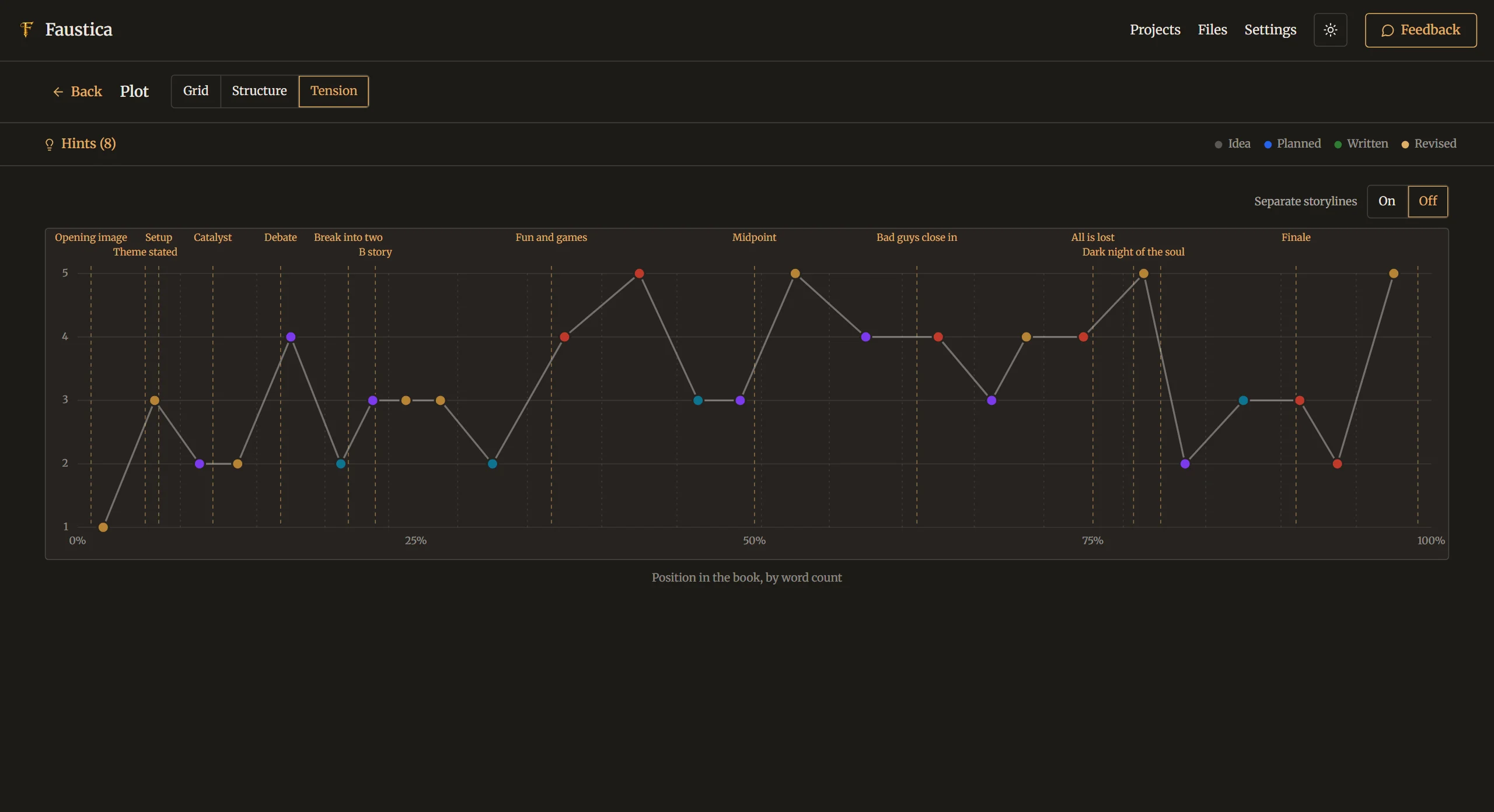
Each scene also gets a tension value from 1 to 5, which you assign yourself. The tension curve across the whole book then shows where peaks, quieter sequels and flat stretches alternate. It does not judge the quality of a scene, but it makes visible whether several scenes in a row stay at the same level. You then write the scene in the Editor, with the Plot Planner one click away.
Frequently asked questions
How long should a scene be?
There is no fixed length. A scene is as long as it needs to be to get from the goal through the conflict to the outcome. Some scenes take half a page, others a whole chapter. If a scene gets very long, it is worth asking whether there are really two scenes inside it.
What is the difference between a scene and a chapter?
A scene is a unit of action, a chapter a unit of structure. A chapter can contain one scene or several, separated by scene breaks. Chapter breaks are often placed where an open question pulls readers on.
Does every scene need conflict?
Every scene that drives the plot needs some form of resistance, which can also be quiet: a hesitation, a misunderstanding, an uncomfortable truth. Sequels often have an inner conflict, for example between two bad options. A scene with no resistance at all should at least change something.
How do I connect scenes?
Through cause and effect: the outcome of one scene leads to the reaction and thus to the goal of the next. Between scenes, a scene break or a short narrative transition that changes time or place is often enough. The guide to developing a plot describes how scenes add up to a plot.