
The three-act structure divides a story into setup, confrontation and resolution. In the first act you meet the protagonist and their world, until an event forces them into the central conflict. In the second act, the longest, they struggle against growing resistance, and at the midpoint a turn changes the situation fundamentally. In the third act, everything comes to a head. As a rough rule of thumb, the first act takes up about a quarter of the book, the second about half and the third the final quarter.
The model is simple, and precisely for that reason it’s often underestimated. This page is less about the list of turning points, which you’ll find in How to develop a plot, and more about what each act has to do for the story, how to use the model when planning and revising, and where its limits are.
Where the model comes from
The basic idea is old. In his Poetics, Aristotle asks that a plot be a whole, with a beginning, a middle and an end, and explains what he means: the beginning does not necessarily follow from anything else, the middle follows from the beginning, the end follows from the middle, and nothing needs to come after it. The form widely used today, with fixed turning points, comes from screenwriting. Syd Field described it in his guide Screenplay (1979) as a paradigm: three acts separated by two “plot points,” each of which spins the action in a new direction. Later guides added the midpoint as a third major pivot.
The model transfers to novels because it rests on a simple observation: readers first need orientation, then movement, then an answer. The percentages, on the other hand, are guidelines from film practice that a novel can handle more freely.
What the three acts do

Act one: ask the question
The first act doesn’t just answer “Who is this, and where are we?” It raises the question that will carry the whole book. It shows the protagonist in a state that is about to change and hints at what they lack or have to lose. Then the inciting incident breaks in. It calls the status quo into question but doesn’t yet take away the character’s options: they can hesitate, push back, tell themselves it doesn’t matter.
The act ends with the first plot point, and that is more than just another event. Here the character makes a decision or is pushed into a situation from which there is no going back. Only from this point on is the central question truly asked.
Act two: complicate the question
The second act is the longest, and it’s where many manuscripts stall. Its job is escalation: the character tries to reach their goal, and every attempt makes things more complicated. They gain allies and enemies and pay their first prices.
The midpoint splits the second act into two halves. Typically it’s a revelation or a reversal after which the character stops merely reacting and starts acting, or realizes they’ve been chasing the wrong goal. The second act thus consists of two movements: toward an insight up to the middle, then onward with that insight toward the abyss. The act ends with the second plot point, often a low point or a realization that makes the finale possible.
Act three: answer the question
In the third act, the threads come together. The climax is the confrontation in which the central question is decided, ideally through a decision by the protagonist rather than chance or someone else’s help. The resolution then shows what has changed. It can be short; long aftermaths weaken the climax unless the consequences are themselves the point.
Planning with the three-act structure
- State the central question. What do readers want to know by the end? Can Rika escape Hauke’s blackmail? Will her plan work despite her fear? The question tells you when the first act ends and when the third begins.
- Fix the starting and ending states. Where does the character stand before the question is asked, and where after it’s answered? The distance between the two is the journey the three acts cover.
- Define the first plot point as a decision. Don’t just ask “What happens?” Ask “What does the character do that they can’t take back?”
- Plan the midpoint as a reinterpretation. What does the character learn that casts everything so far in a new light? A good midpoint changes the goal or the method, not just the scenery.
- Place the second plot point. What has to break or become clear for the character to be ready for the finale?
- Fill in the stretches between. Only now do you plan the scenes that lead from one point to the next. Each one should tighten the situation a little more.
When you revise, ask the same questions in reverse: Where does your manuscript raise its central question, and where does it answer it? If you can’t find those places, that is usually where the problem lies.
An example: the three acts in one story
The example is an invented suspense novel about ferrywoman Rika. Money trouble after an engine failure leads her to cargo jobs for her childhood friend Hauke, which turn out to involve drugs. The outline shows how this can develop into a three-act conflict.
Act one – the commitment forms. After the daily ferry is withdrawn, Rika maintains additional supply runs. An engine failure threatens her service. Hauke, her childhood friend and a boat mechanic, offers to advance the money if she carries his cargo. Accepting commits her to the arrangement: a possible boundary with act two.
Act two – help becomes a trap. The crossings resume, but Rika discovers drugs in Hauke’s cargo. This turn changes the meaning of earlier events: a friend’s help also secured a transport route. Rika refuses further shipments. Hauke threatens to destroy her boat and implicate her as the organizer. Her old strategy of keeping everything under her own control no longer works. His aggression frightens her. At the act’s end, she decides to make him transport the cargo himself through a fake engine failure and send an anonymous tip.
Act three – Rika acts against Hauke. She fakes another engine failure. Hauke takes over the transport and is checked and arrested with the cargo following her anonymous tip. The resolution must address Rika’s fear, debts and service; a trouble-free fresh start does not follow automatically.
This division is a working choice. The draft can test whether accepting Hauke’s offer really closes act one and whether the discovery and blackmail leave room for Rika’s reactions. Percentages alone cannot answer that.
Common mistakes
- A first act without a question. Many pages of backstory, world description and everyday life before anything is at stake. The inciting incident can come early; the setup can continue after it.
- A second act made of episodes. Adventures follow one another without the situation getting harder. Check whether each stage costs a price or closes off an option.
- A midpoint without consequences. A spectacular event in the middle after which the character carries on exactly as before. The midpoint has to reframe something.
- A finale someone else wins. If an ally, a coincidence or a previously unknown device resolves the conflict, the third act fails to answer the question it was supposed to answer.
- Percentages as law. A plot point at 30 rather than 25 percent is no problem if what comes before it holds up.
Practical tips
- For each act, write one sentence that begins “In this act, …” and says what has to happen. Those three sentences make a compact plan.
- If the middle sags, plan outward from the midpoint in both directions: What has to happen to get there, and what inevitably follows from it?
- Combine the three-act structure with a more detailed model if you need more support, such as the hero’s journey. You control the tension between the turning points with a tension arc.
Using Faustica
In Faustica’s Plot Planner, you choose the three-act structure template in the “Structure” view, with its seven turning points: Opening, Inciting incident, First plot point, Midpoint, Second plot point, Climax and Resolution. You assign a scene to each turning point, and Faustica calculates from your chapter word counts and the distribution of scenes where that scene actually falls in the book.
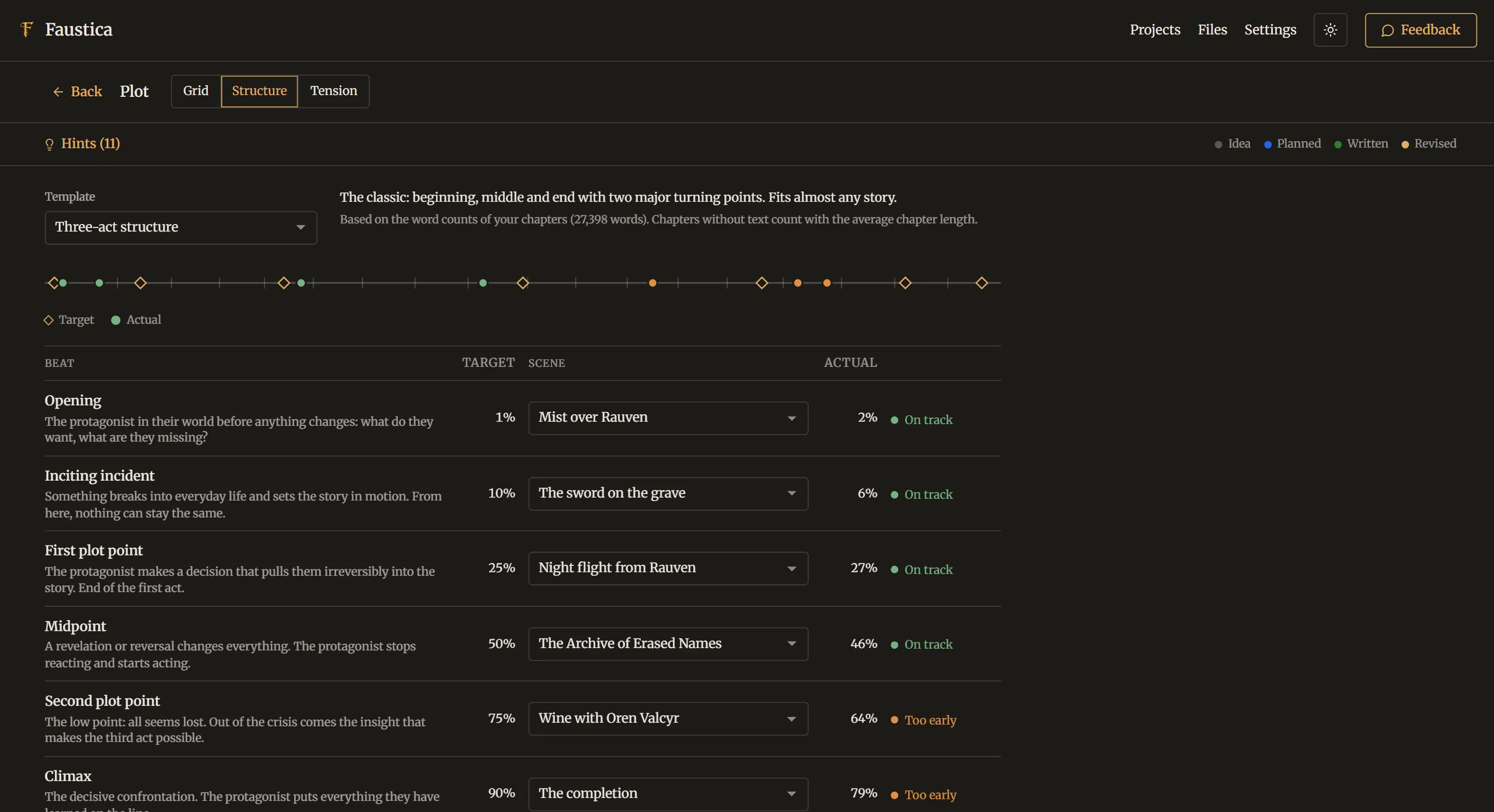
On the book axis you can see whether a turning point falls noticeably earlier or later than in the template, and a hint draws your attention to unusual positions. Whether that’s a problem is for you to decide: Faustica measures position, not effect. The other templates are the hero’s journey after Vogler, Blake Snyder’s 15-beat structure and Dan Wells’ 7-point structure.
Frequently asked questions
Does the first act have to be exactly a quarter of the book?
No. The quarters come from screenwriting practice and are a guideline. If your first act is much longer, check whether it really stays setup all the way through or whether the central question is already raised earlier. Often you can then cut or move the plot point forward.
What’s the difference between the inciting incident and the first plot point?
The inciting incident brings the problem into the character’s world. The first plot point is the moment they commit to it irreversibly. In the example above, the real engine failure is the inciting incident. Accepting Hauke’s offer is a possible first plot point: it commits Rika to the cargo jobs.
Are there models with four or five acts?
Yes. Some split the long second act at the midpoint and speak of four parts. The five-act scheme of classical drama is described by Gustav Freytag with his pyramid. At heart, these are refinements of the same movement from question to escalation to answer.
Does the three-act structure suit every genre?
It suits most stories with a central conflict, from mysteries to love stories. For episodic novels, stories with many equally weighted points of view or experimental forms, it may have little to say. Then it’s more of a tool for checking individual storylines.