
The hero’s journey is a story model that describes a narrative as a path through a series of stages: a character is called out of their ordinary world, crosses a threshold, faces tests, survives a decisive crisis and returns changed. The model goes back to the mythologist Joseph Campbell. It was adapted for writers by the story consultant Christopher Vogler, whose twelve-stage version is the one most widely used today.
The hero’s journey isn’t a recipe but a map. It helps you spot stages your story is missing and check whether your protagonist’s transformation has been set up convincingly. On this page you’ll find where the model comes from, the twelve stages, an example with deviations and the most common traps.
Campbell and Vogler: two very different books
In 1949 Joseph Campbell published The Hero with a Thousand Faces. He compared myths, fairy tales and religious narratives from many cultures and described a recurring underlying pattern, the “monomyth”: departure, initiation and return, subdivided into seventeen stages. Campbell wrote as a scholar of mythology, not as a writing teacher. His book explains what myths have in common, not how to build a novel.
Christopher Vogler worked as a story analyst in Hollywood and first summarized Campbell’s ideas in an internal memo for screenwriters. That memo grew into the book The Writer’s Journey (first published in 1992). Vogler condensed the pattern into twelve stages, mapped them onto the three acts and added archetypes such as the mentor, threshold guardian, herald, shapeshifter, shadow and trickster. When writing guides talk about “the hero’s journey,” they usually mean Vogler’s version, and so does this page.
Vogler’s twelve stages
The stages can be roughly assigned to the three acts, as Vogler himself suggests. If you work with the three-act structure, you can lay the two models on top of each other.

Departure (act one)
- The ordinary world. The protagonist’s everyday life, including what is missing from it. It forms the contrast to everything that follows.
- The call to adventure. A problem, a message or an encounter calls the ordinary world into question.
- Refusal of the call. The character hesitates or says no. This shows what they stand to lose.
- Meeting the mentor. Someone offers advice, courage, knowledge or a tool.
- Crossing the first threshold. The character leaves the ordinary world and enters an unfamiliar one. There’s no going back.
Initiation (act two)
- Tests, allies, enemies. The character learns the rules of the new world and finds out whom to trust.
- Approach to the inmost cave. The approach to the most dangerous place, outer or inner.
- The ordeal. The confrontation with the greatest danger or fear, often a symbolic death.
- The reward. The character gains what they were looking for: knowledge, an object, an insight, a reconciliation.
Return (act three)
- The road back. The consequences catch up with the character; often they are pursued or have to choose again.
- The resurrection. A final, hardest test that shows whether the transformation is real.
- Return with the elixir. The character comes back bringing something that changes their old world.
The stages are functions, not scenes. One stage can span several chapters, two stages can coincide in a single scene, and the order can shift. The mentor, for instance, doesn’t have to be a wise old figure; it can be a book, a memory or the character’s own experience.
Using the hero’s journey for your novel
- Start with the transformation. What is your character at the beginning, and what at the end? The hero’s journey is a model of change. If your character doesn’t change, it will usually fit only in part.
- Define the two worlds. What is the ordinary world, and what the unfamiliar one? It can be a change of place, but also a new job, a relationship, an illness.
- Find the load-bearing stages first. The threshold, the ordeal and the resurrection carry the model. Once you know them, the others fall into place more easily.
- Treat the remaining stages as questions. Where does my character hesitate? Who or what helps them? What do they gain in the middle? What do they bring back? A missing stage is a pointer, not a mistake.
- Let go of the template. If your story deliberately runs differently, for example without a return, that’s a decision you should be aware of, not one you have to correct.
An example: testing Rika’s story against the model
In this invented suspense novel, a repair advance makes ferrywoman Rika dependent on her childhood friend Hauke. She transports drugs for him without her knowledge. After discovery, he threatens her. Rika fakes another engine failure and sends an anonymous tip so he is caught moving the cargo himself. This plot lets us test which hero’s-journey questions fit and where the comparison reaches its limits.
| Stage | What Rika’s story offers |
|---|---|
| Ordinary world | Rika organizes additional supply runs and trusts her experience. |
| Call | A real engine failure threatens the service; Hauke offers help in exchange for cargo jobs. |
| Refusal | No explicit initial refusal is established. She accepts his offer. |
| Mentor | There is no classic mentor. Hauke appears helpful but exploits her. |
| Threshold | Accepting his advance and cargo brings her unknowingly into his business. |
| Tests | Crossings and financial dependence tie her own purpose to Hauke’s interests. |
| Approach | Discovering the drugs forces her to reconsider whom she can trust. |
| Ordeal | She refuses further shipments; Hauke’s threats show that she cannot simply quit. |
| Reward | No material gain yet: she recognizes she can turn Hauke’s need to move his cargo against him. |
| Road back | There is no literal homeward journey. Instead, she prepares the deception and anonymous tip. |
| Renewed test | Despite her fear, she reports the fake engine failure and sticks to her plan. Hauke transports the cargo himself. |
| Return | Hauke is checked and arrested following her tip. Consequences for Rika’s safety and service remain part of the resolution. |
The inner movement is clearer than the physical journey: Rika initially trusts her childhood friend. After discovery and his aggressive threats, she acts against him despite her fear. Her deception tests that resolve under pressure.
“Mentor” and “road back” fit only partially. Three-act structure may provide a clearer basic framework here. The hero’s journey adds questions about character change; it does not certify that all twelve stages are present.
Common mistakes
- Ticking off stages. If you give every stage its own chapter, you get a predictable story. Readers who know the pattern recognize it immediately.
- Archetypes instead of characters. A mentor who only gives advice or a shadow who is only evil stays flat. Archetypes describe functions, and real characters may take them on only for a while.
- The refusal as a box to tick. A character who briefly says no and then sets out anyway wastes the stage. The refusal is there to show what is at stake.
- An outer journey without an inner one. The hero’s journey describes a transformation. A change of place with some fights, after which the character is the same as before, uses only the model’s scenery.
- Putting the model above the story. If a stage doesn’t fit, the problem may lie with the stage, not with your story.
Practical tips
- Write one sentence from your novel for each stage. Where you can’t think of one, ask whether the gap is intentional.
- Pay particular attention to the ordeal in the middle. It’s often the moment when the inner change begins.
- Use the archetypes as questions for your supporting characters: Who tests my protagonist at the threshold? Who switches sides? You’ll find more on characters with goals of their own in the guide on developing characters.
- Read Campbell if you’re interested in the myths, and Vogler if you want a working tool. The two books pursue different goals.
Using Faustica
Faustica’s Plot Planner includes the hero’s journey after Vogler as a structure template with all twelve stages. In the “Structure” view you assign a scene to each stage. Faustica calculates from your chapter word counts where those scenes fall in the book and shows on the book axis whether they come noticeably earlier or later than in the template.
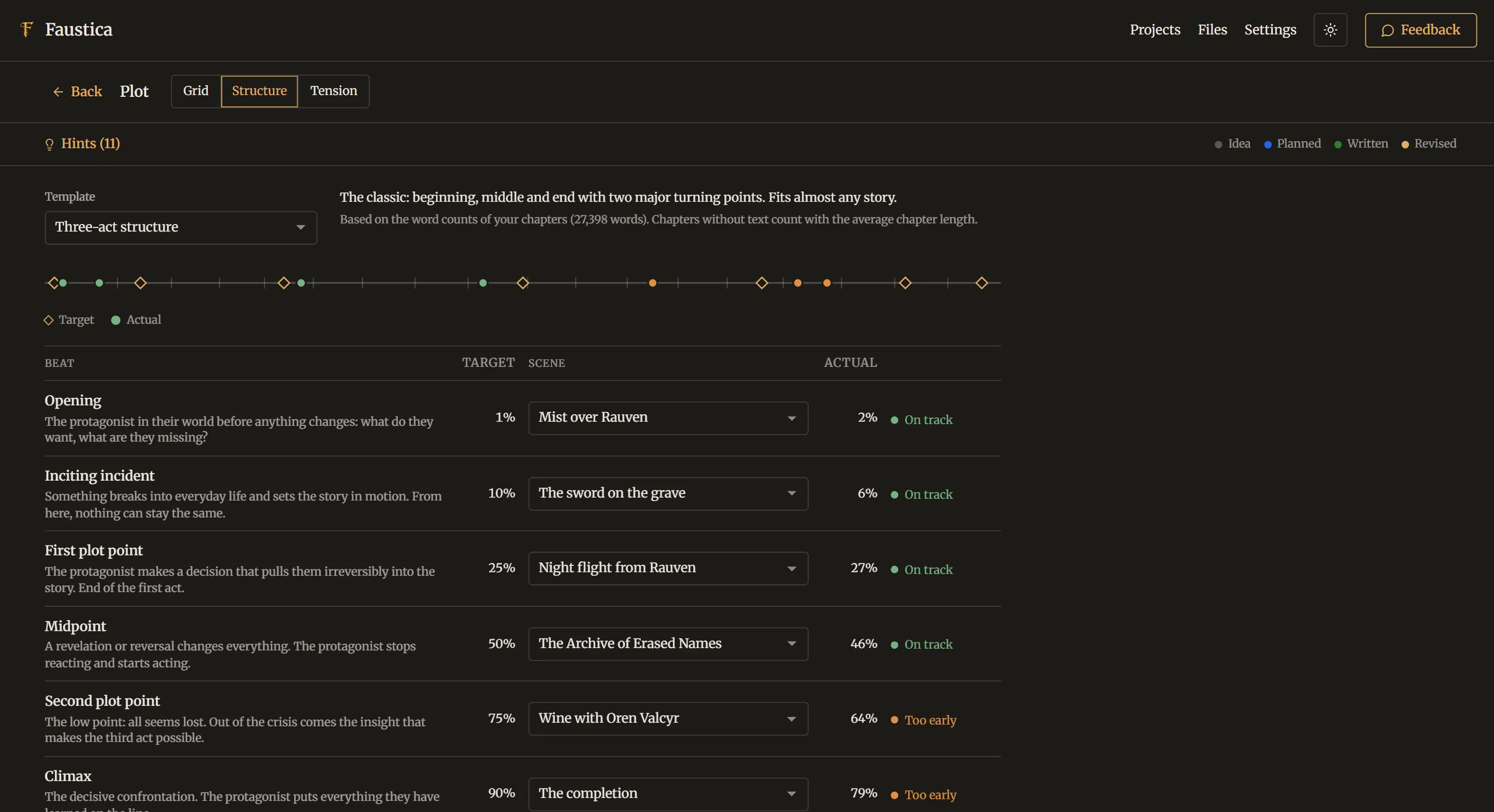
Stages your story doesn’t have can simply stay without a scene. Whether a deviation is intended is up to you; the template shows position and gaps, it doesn’t judge the story. For a simpler frame there’s the three-act structure, as well as Blake Snyder’s 15-beat structure and Dan Wells’ 7-point structure.
Frequently asked questions
How many stages does the hero’s journey have?
That depends on the version. Joseph Campbell describes seventeen stages in three phases, Christopher Vogler twelve. There are also simplified variants with fewer steps. For writers, Vogler’s version is the most widespread.
Does the hero’s journey only suit fantasy and adventure?
No. It suits any story in which a character leaves a familiar situation and comes out of it changed, including a love story, a family saga or a mystery. The “unfamiliar world” can be a new job or a period of grief. For stories without a transformation, it carries less weight.
Does the protagonist have to be a hero?
No. In the model, “hero” means the character whose journey is being told, not a morally admirable or especially brave person. A hesitant, flawed or unlikable protagonist can go through the stages too.
Can I combine the hero’s journey with the three-act structure?
Yes, the two don’t contradict each other. Vogler himself assigns the twelve stages to the three acts: departure in the first, initiation in the second, return in the third. The three-act structure provides the frame; the hero’s journey fills it with stages of inner development.