
Planning a novel means answering, before you write, the questions that would otherwise stall your manuscript a hundred pages in: What is the story really about? Who wants what, and what stands in the way? Where is the story going, and through which stages? A proven route leads from the idea to a one-sentence premise, on to the main characters, then to plot and structure, the world, a scene list and, if you need one, a timeline. How far you take each step depends on how you like to work.
This guide shows the whole planning process in context, explains where well-known methods such as the Snowflake Method, the three-act structure and the hero’s journey fit in, and points you to a deeper guide for each step. If you are more interested in what comes after planning, the drafting, revising and feedback, the Revision section of the Writing Academy picks up where this guide leaves off.
Why plan, and how much
Writers tend to fall into two broad camps. Some plan in detail before they write, often down to the individual scene. Others start with a character and a situation and discover the story as they go. In the English-speaking writing world they are known as “plotters” and “pantsers,” the latter because they write by the seat of their pants. Another popular image distinguishes architects from gardeners. Most writers work somewhere in between.
Neither approach is inherently better than the other. But planning has one advantage that even committed gardeners recognize: a novel is long. What fits in your head for a short story easily falls apart over three hundred pages into loose episodes, a sagging middle or an ending that doesn’t follow from the beginning. Planning reduces that risk. It doesn’t stop you from discovering new things as you write; it just gives you a yardstick to measure them against.
If you write by discovery but still want some orientation, a premise, a main character with a goal and a rough direction can help. You don’t need to know the ending yet. Everything else can come after the first draft, as a check rather than as preparation.
Planning a novel in eight steps
The steps build on each other, but not rigidly. Planning goes back and forth: a character changes the plot, a place changes a character. The order simply keeps you from starting on step six while step two is still wobbling.
1. Capture the idea
You rarely start with a finished story. More often it is an image, a character, a question or a “What if …?” Write down that seed and spend a while collecting everything that belongs with it, without sorting: scenes, sentences, places, conflicts. A mind map works well here because it shows connections before any order is fixed. How to find an idea and test whether it can carry a novel is covered in Finding and developing a story idea.
A simple test: does the idea create a conflict? “A ferrywoman takes on extra cargo” is an event. “A ferrywoman discovers drugs in her childhood friend’s cargo and is threatened when she tries to quit” is the beginning of a problem, and problems carry stories.
2. Write the premise
The premise sums up the story in one or two sentences: Who wants what, who or what stands against them, and what is at stake? It is the most important tool of the whole planning process, because you can test every later decision against it. A scene that has nothing to do with the premise needs a good reason to be in the book.
Write several versions. The first is usually too general (“A young man has to face his past”), the tenth often too crowded. A good premise is concrete and can still be said in a single breath.
3. Develop the main characters
Plot grows out of characters who want something. For each important character, work out what they want and what stands in their way. If they have a character arc, add a weakness or belief that will be put to the test. A protagonist can also stay true to who they are and change the world around them instead. The opposing force can be a person with reasons of their own, but equally an institution, a circumstance or an inner conflict.
You can collect backstory, appearance and quirks in a character profile, but not everything has to be settled before you write. What drives the character matters more. The guide on developing characters goes into this in depth.
4. Settle plot and structure
Now you connect character and conflict into a plot. Start by fixing the beginning and the ending, at least roughly: Where does your protagonist stand on the first page, and where on the last? Then place the major turning points in between: the event that pulls the character out of everyday life, the moment they commit, the shift at the midpoint, the low point and the climax.
Structure models help you find these points and check whether the middle holds. How to work through this step by step is shown in How to develop a plot. The models themselves are summarized in the overview of methods below.
5. Build the world and the settings
Every story takes place somewhere, and the setting shapes what is possible. For a contemporary novel, research into your locations is often enough. Fantasy, science fiction and historical fiction need more: rules, power structures, history, daily life. Plan mainly what the plot touches. How to go about it, and where useful planning turns into endless world-tinkering, is covered in the guide on worldbuilding.
6. Make a scene list
Between the turning points lie the scenes that lead from one to the next. A scene list is simply those scenes in reading order, with one to three sentences each. Three questions per scene are helpful: What does the character want here? What stands in the way? How is the situation different at the end than at the start?
If your novel has several storylines, such as a second point of view or the antagonist’s schemes, assign each scene to a storyline. That way you can see whether a storyline lies dormant for too long or never gets resolved. More on this in Planning and weaving subplots.
7. Add a timeline if you need one
If you don’t tell the story in a straight line, because of flashbacks, several time periods or characters acting in different places at the same time, then the order of telling and the order of events drift apart. A timeline records what happens when, independent of the chapters. Even in a linear story it can help you check travel times, deadlines or characters’ ages. If there are no such dependencies, the scene list is often enough. When a timeline is worth it and how to start one is explained in Creating a timeline for your novel.
8. Check the plan, then let go
Read the plan in one sitting. Does each major event follow from the one before? Does your protagonist make the crucial decisions? Does enough new happen in the middle? Does the ending lead back to the premise? If so, start writing. The plan will change, and that is as it should be: it is scaffolding, not a contract.
Planning methods at a glance
There are many planning methods. They don’t exclude each other, and most writers combine two or three.
| Method | Core idea | Works well if … |
|---|---|---|
| Snowflake Method | From sentence to paragraph to page: expand the story step by step | … you like to work from the big picture down to the details |
| Three-act structure | Beginning, middle and end with clear turning points in between | … you want a simple frame for your turning points |
| Hero’s journey | Stages of a transformation, from the ordinary world to the return | … your story is about setting out and being changed |
| Scene list or index cards | One scene per card, freely rearranged | … you still want to try out the order |
| Mind map | Collect ideas freely and connect them | … the story has no order yet |
The Snowflake Method was developed by the American author Randy Ingermanson. You start with a single sentence, expand it into a paragraph, then a page, develop the characters alongside, and end up with a list of scenes. Its strength is the clear sequence; its weakness is that it can quickly feel too rigid for writers who discover the story as they write.
The three-act structure goes back to the old observation that a story has a beginning, a middle and an end, and became popular mainly through screenwriting guides. It divides the plot into setup, confrontation and resolution, with turning points in between. It is the simplest model and works for almost any genre.
The hero’s journey is based on Joseph Campbell’s study of myths and was adapted for film and fiction by Christopher Vogler. It describes stages such as the call to adventure, the threshold, tests, the central ordeal and the return. It suits adventure and fantasy stories especially well, but can feel formulaic if you work through it stage by stage.
Which model you choose matters less than using it as a diagnostic tool rather than a template. Many successful novels follow no model exactly.
An example: a concise novel plan
For this example, we plan an invented suspense novel with the working title “The Last Ferry”: short of money, ferrywoman Rika accepts help from her childhood friend Hauke. He uses her for drug shipments without her knowledge and threatens her when she tries to quit. An initial plan could look like this:
| Planning step | A first answer |
|---|---|
| Premise | A ferrywoman unknowingly carries drugs, is blackmailed into continuing after discovering them and sets a trap for her blackmailer. |
| Protagonist | Rika finds practical solutions but tries to handle problems alone for too long. |
| Her own purpose | Keep additional supply runs viable and earn her living from them. |
| Opposition | Hauke exploits her repair debt and their shared past to secure his shipments. |
| First commitment | Rika accepts his money and initial cargo jobs. |
| Turn | Discovering the drugs changes her goal: she must escape Hauke’s business. |
| Escalation | Hauke becomes aggressive and threatens Rika. Afraid of him, she cannot openly walk away. |
| Climax | Rika fakes another engine failure. Hauke must transport the cargo himself and is checked following her anonymous tip. |
| Ending | Hauke’s smuggling is exposed. Rika’s fear and business problems do not automatically disappear. |
| Next scene | After the real engine failure, she discusses the repair and his terms with Hauke. |
Supplies, dependence and lost trust interlock. The scene plan must establish why the first offer seems reasonable and when her view of Hauke changes. A timeline can arrange deliveries, discovery and preparation of the trap. A history of the entire island or a family tree is not needed yet.
Common planning mistakes
- Planning instead of writing. Planning feels productive, and you can spend months building a world without writing a single scene. Set yourself a point at which you start, even if not everything is settled.
- Losing sight of the core. If you collect material for a long time, check now and then which question or conflict holds it together. If you write by discovery, that core may only become visible in the draft.
- Characters who only serve the plot. When characters do things because the plan demands it rather than because they want to, the plot feels contrived. Plan characters and plot together.
- No sense of direction. If you get stuck in the middle, a possible ending can give you something to steer by. It stays a suggestion you are free to change.
- Treating the plan as untouchable. If you find while writing that a scene doesn’t work or a character would act differently, the plan is usually what’s wrong. Change it and check what follows from the change.
Practical tips
- Start every planning session by looking at your premise. It keeps the planning on course.
- Plan in passes: first roughly for the whole book, then in more detail for the first act. Refine the rest as you get closer to it in the draft.
- Write open questions down explicitly instead of skipping them. A “still to decide” list belongs in every plan.
- Keep the ideas you discard. What has no place in this novel may fit the next one.
- If detailed planning slows you down, start as soon as you can see the next two or three scenes ahead of you. You can develop the rest as you write.
Using Faustica
Faustica covers the planning steps in dedicated areas that belong to the same project as your manuscript. You collect ideas in Mind Maps and on note boards, where notes can be linked to chapters or compendium entries and appear in the editor while you write. Characters, places and everything else in your world go into the Compendium, with your own categories and a relationship graph.
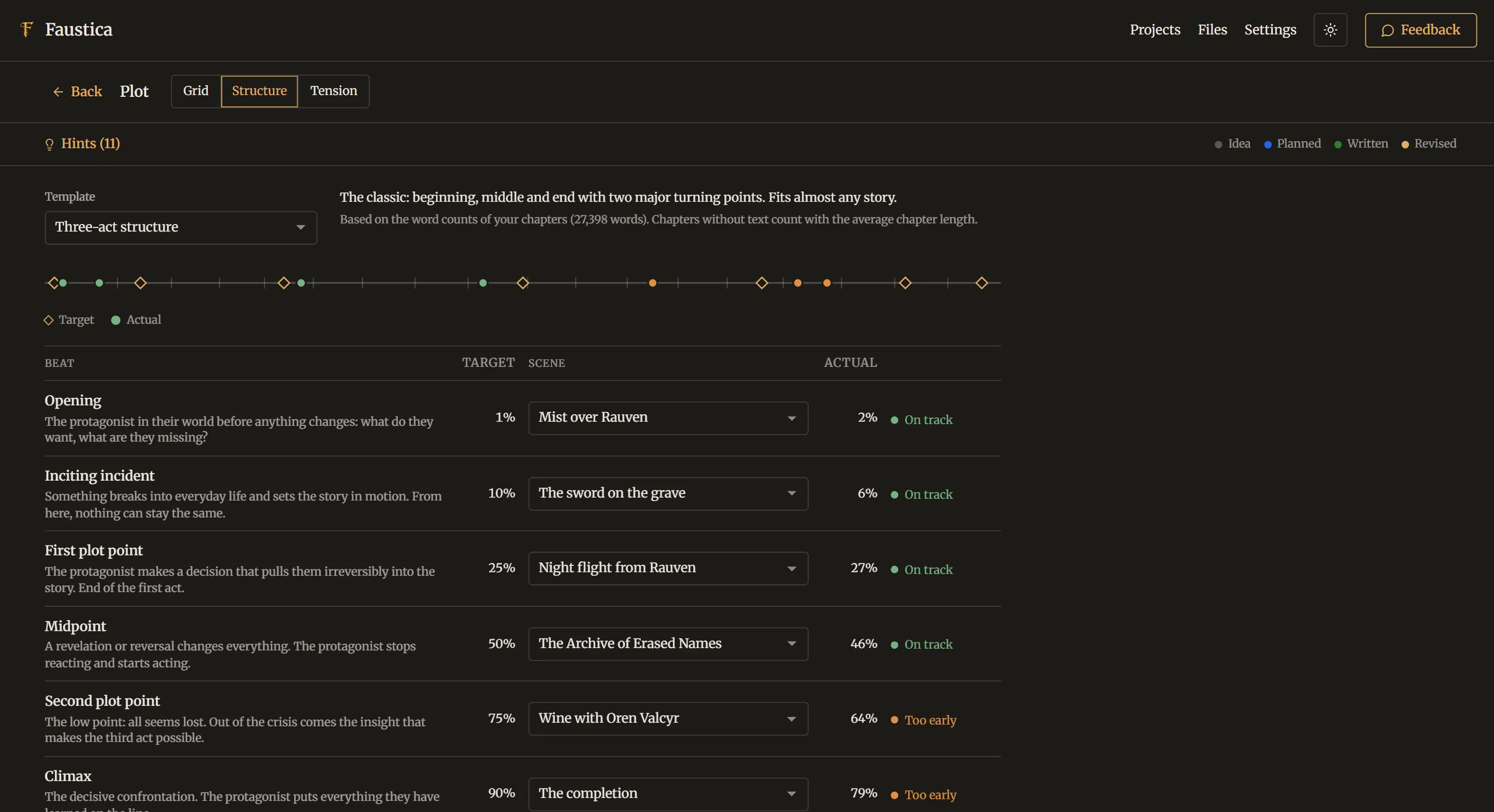
In the Plot Planner, storylines form the rows and chapters the columns. Each scene card can hold a summary, point of view, characters, location as well as goal, conflict and outcome. For the turning points there are templates for the three-act structure, the hero’s journey after Vogler, Blake Snyder’s 15-beat structure and Dan Wells’ 7-point structure. You assign scenes to the turning points, and Faustica calculates where they fall based on chapter word counts and how your scenes are distributed. Which scene belongs to which turning point, and whether the dramatic shape works, is still your call. For stories with several time periods there is the Timeline, with parallel storylines and either free-form or exact time references.
Frequently asked questions
How long should I plan a novel before I start writing?
There is no set time. A good rule of thumb: you can start once you know your premise, your main characters, the ending and the major turning points. If you keep planning without writing, check whether the planning still serves the story or has started to replace the writing.
Should I plan the characters or the plot first?
The two are so closely linked that it is best to alternate. Some stories start with a character from whom a conflict emerges, others with a situation that needs the right character. What matters is that, in the end, the character’s goal and the plot’s turning points fit together.
Which planning method is best?
None is best for everyone. If you like to go step by step from the big picture to the details, the Snowflake Method often works well. If you just want a frame for your turning points, use the three-act structure. Try a method on one novel and keep whatever helps you.
What do I do when the plan stops fitting while I write?
Change the plan rather than forcing the story against its grain. Then check which later scenes and turning points are affected by the change, and adjust them before you write on. A plan that grows with the book is more useful than one you stick to through the first draft.
Can I write a novel without a plan?
Yes, many writers do. In that case, revision takes over part of the planning: after the first draft, you check premise, turning points and storylines and rebuild what doesn’t hold up. That usually means more work during revision and less beforehand.