
A timeline for your novel puts the events of your story in the order in which they actually happen, regardless of which chapter you tell them in. You need one mainly when those two orders drift apart: with several points of view, flashbacks, long stretches of time or a world with its own history. To begin with, a few storylines, the most important events and, for each event, the chapter in which it appears are enough.
A typical case: your heroine sets out in spring, three chapters later she reaches the capital, and there is snow on the ground. You didn’t notice while writing, because two other characters were having adventures of their own in between. Maybe months have passed, maybe the city lies high in the mountains. If the text doesn’t explain it, readers are left with a timing question. With alternating storylines, gaps like this are easy to miss. On this page you’ll learn when a timeline helps, when it doesn’t, and how to build one.
Story order and chronological order
Every story has two orders. One is the order in which readers experience it: chapter 1, chapter 2, chapter 3. The other is the order in which events happen in the story world. Narrative theory distinguishes accordingly between the events and how they are presented; the literary theorist Gérard Genette calls the relationship between the two orders the “order” of a narrative.
In a linear story, both orders are the same. Your manuscript then already reflects the chronology, although that doesn’t yet tell you how much time passes between scenes. As soon as they diverge, through a flashback here and a change of point of view there, you have to remember what happened when, even though it sits in a completely different place in the book. You can keep that in your head for a while. Across a whole novel, usually not. The timeline is where you record the chronological order so that the manuscript is free to follow the order of telling.
When a timeline really helps
- Several points of view or storylines. If you switch between characters in different places, you need to know where each one is. Otherwise a character in chapter 14 runs into someone who, according to chapter 11, should still be three days’ journey away.
- Flashbacks and multiple time periods. If your story is set in the present and thirty years earlier, both have to fit together: ages, events, who knew what and when.
- Long time spans. Over months or years, seasons, birthdays, pregnancies and travel times quickly become a source of errors.
- Mysteries and thrillers. Who was where, and when? Who has an alibi? Where readers are trying to solve the puzzle alongside the detective, timing contradictions stand out.
- Fantasy and historical fiction. If your world has wars, dynasties and legends reaching back centuries, a timeline keeps that history consistent. There’s more on this in the guide on worldbuilding.
When you can skip it
To be just as honest: sometimes a timeline is more work than it saves. For a linear story without important deadlines, travel times or questions of age, a simple scene list is often enough. On the other hand, even a short mystery told in chronological order may need a precise timeline for its alibis.
If you like to write by discovery, a detailed timeline at the start can even slow you down. In that case, it’s often better to write first and build the timeline during revision. That is where it catches the contradictions that crept in while you were writing freely.
And there is a trap: planning feels productive. You can spend many evenings arranging five hundred years of a kingdom’s history without writing a single scene. A timeline should serve your story, not stand in for it.
How to build a timeline in five steps
Start small. You don’t have to record every event, only the ones where the order matters.
- Choose your level of precision. If your novel is set in our world and days or hours matter, as in a mystery, work with real dates. If your world has its own calendar, or a simple before and after is enough, free-form references such as “Autumn, day 1” or “300 years ago” will do. The only important thing is to stick to one way of counting within each storyline.
- Set up the storylines. One storyline per main character, per location or per time period is a good start. More than four or five quickly gets hard to follow.
- Enter the turning points. How to find them is explained in How to develop a plot. Departures, encounters, discoveries, losses: anything later chapters refer back to. One sentence per event is enough, such as who was there and what is different afterward.
- Link events to chapters. For each event, note where in the manuscript it is told or mentioned. Only then can you compare the chronological order with the order of telling.
- Read the storylines side by side. Now gaps and contradictions stand out: the character who travels too fast, the festival that takes place twice in one year, the message that arrives before it was sent.
Put it into practice with Faustica: The Timeline supports these five steps: use free-form time references or exact dates and times, create events in parallel storylines and link them to chapters. The storylines sit side by side so you can compare their timing. See Using Faustica below for more detail.
Whether you use paper, a spreadsheet or software is secondary. On paper or on a wall you see everything at a glance, but rearranging is awkward. A spreadsheet with columns for time, storyline, event and chapter can be sorted by any column, but it’s less visual.
An example: event time and narrative order
This example arranges the events of an invented suspense novel: after an engine failure, ferrywoman Rika accepts financial help from her childhood friend Hauke and unknowingly carries his drug cargo. After discovery, he threatens her. She then plans a fake failure and anonymous tip so he is caught moving the cargo himself. The dates below are provisional planning assumptions.
| Actual time | Event | Possible narrative position |
|---|---|---|
| Monday | The engine fails. | Opening: supply runs stop. |
| Tuesday | Rika accepts Hauke’s advance. | Discussion of repairs and terms. |
| Thursday | The first cargo crossing takes place. | Rika still believes the goods are harmless. |
| Saturday | She discovers the drugs. | The earlier help takes on a different meaning. |
| Sunday | Her refusal triggers Hauke’s threat. | Confrontation. |
| The following week | She fakes an engine failure and sends an anonymous tip. | The narrative may withhold parts of her plan. |
| Later | Hauke transports the cargo himself and is checked. | Climax. |
Withholding information does not change the actual sequence. A later flashback to the anonymous tip can explain Rika’s plan, but the tip must precede the check on Hauke.
Moving discovery before the first cargo run changes more than a date: Rika would be knowingly involved from the start. The timeline exposes that dependency; you must then reconsider her character logic.
Common mistakes
- Trying to record everything. If you log every meal, you lose sight of the important events. The timeline isn’t a second manuscript.
- Mixing ways of counting. If one storyline says “Day 12,” the next “third week” and the third a weekday, the storylines can no longer be compared.
- Not linking chapters. Without a link to the manuscript, the timeline shows only the chronology, not where in the book each event is told. That is exactly where contradictions arise.
- Forgetting travel time. When characters are on the road, the length of the journey belongs in the timeline. This is where a lot of errors happen, especially when several groups travel in parallel.
- Not maintaining the timeline. If you change the order of scenes during revision, the timeline has to keep up. An outdated timeline is worse than none, because you trust it.
Practical tips
- Record the ages and birth years of your main characters on the timeline. Then you won’t have to recalculate them for every flashback.
- For each event, note which character learns about it and when. In stories, knowledge often spreads more slowly than the events themselves.
- Give your world’s backstory its own storylines instead of mixing it into the main plot. That keeps the present day easy to follow.
- Before you revise, read only the timeline once, without the manuscript. Gaps and clusters are easier to spot that way.
- See the timeline as one building block of your planning, alongside premise, characters and scene list. How it all fits together is shown in How to plan a novel.
Using Faustica
In Faustica, the Timeline is a dedicated area in your project. You create as many storylines as you like, and they sit side by side as colored columns, so you can compare the events of different storylines. In free-form mode you put the events in the right order yourself; exact dates let Faustica arrange them chronologically.
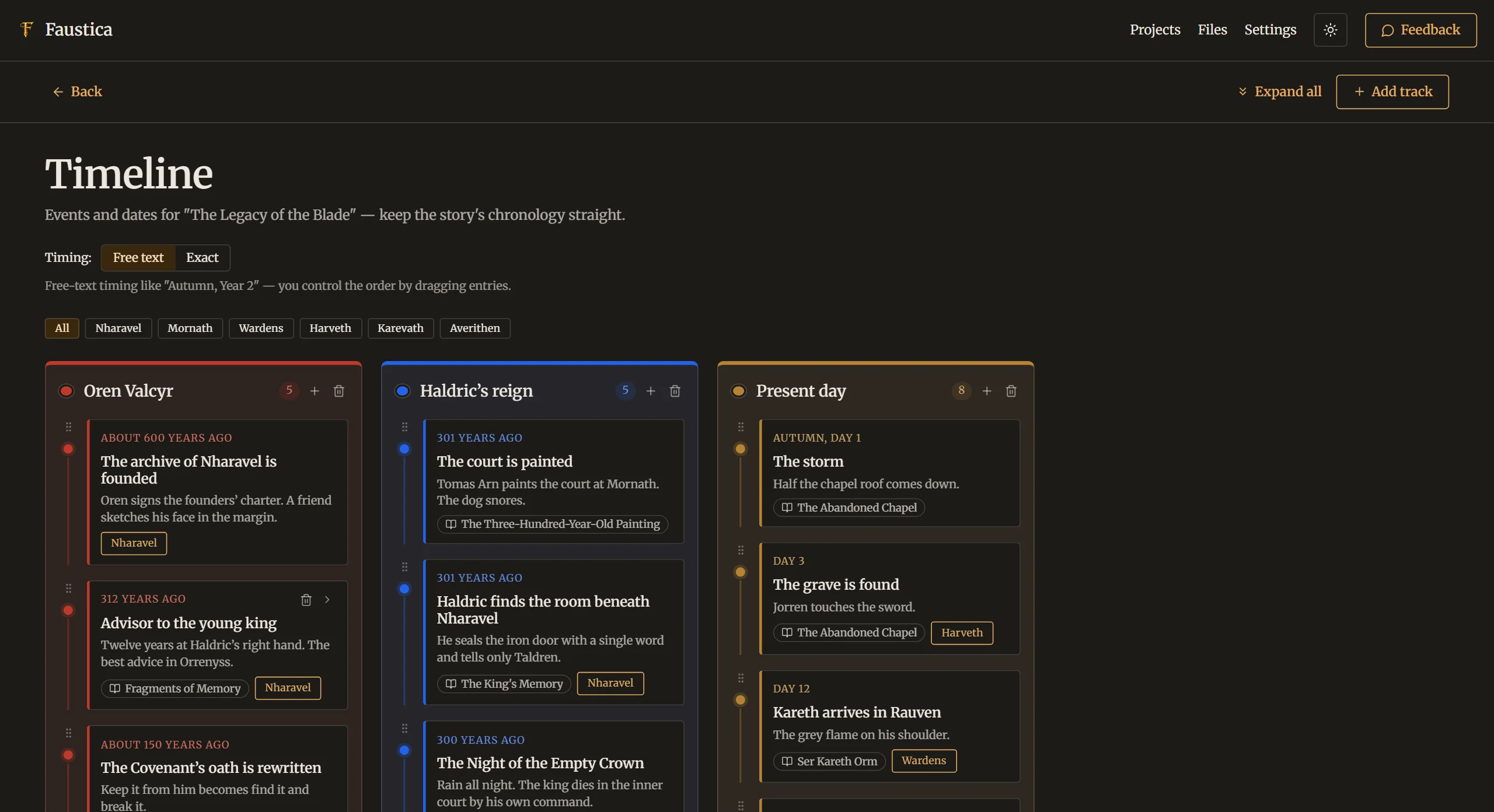
There are two modes for time references: free text, such as “Autumn, year 2,” or an exact date and time. You can link each entry to a chapter, add an image and keywords, and move it between storylines. Clicking the linked chapter opens that chapter in the editor; it doesn’t highlight a specific passage. If you prefer to think from the chapter outward, the Plot Planner is the counterpart: there you arrange scenes in the order in which you tell them, and with the timeline you check for yourself whether travel times, intervals and simultaneous events fit together.
Frequently asked questions
Should I create the timeline before or after the first draft?
That depends on how you work. If you like to plan and have several time periods, a rough timeline beforehand is worth it. If you prefer to write by discovery, build it during revision, when it will uncover the contradictions that arose while you were writing.
How do I handle an invented calendar?
Use relative references that you apply consistently, for example “Year 3 after the coronation, spring” or “Day 12.” All the timeline needs is for the events to be clearly orderable. You can use the names of your world’s months in the text; the timeline doesn’t need them.
Do I need both a timeline and a scene list?
For simple stories, one of the two is enough. Once the order of telling and the order of events diverge, they complement each other: the scene list shows the order in which you tell the story, the timeline the order in which it happens. Only side by side do they show whether the two fit together.
How many storylines make sense?
As many as the points of view, settings or time periods you need to keep track of at once, usually between two and five. If a storyline has only two or three events, you can assign them to an existing storyline with a related focus rather than create a separate one.