
Point of view determines whose eyes a story is told through and what the narrating voice is allowed to know. To get started, it helps to distinguish four common options: first person, where the narrator tells their own story; close third person, which stays near one character while using “he” or “she”; omniscient narration, with a narrator who knows more than any of the characters; and the objective point of view, which shows only what can be seen and heard from the outside. None of them is better than the others. What matters is that you choose one deliberately and stay within its limits.
On this page you will see all four applied to the same short scene, a comparison table, guidelines for switching between points of view and the most common point-of-view slips.
Point of view, narrator and person
Three terms often get mixed up. Person only describes the grammatical form of the narration: “I” or “he/she/they.” The narrator is the voice that tells the story, and it is not the same as the author. Point of view, finally, describes how much that voice knows and how close it stands to the events.
Narrative theory draws these lines more finely. The French theorist Gérard Genette, in Narrative Discourse, separates the question of who speaks from the question of whose perception the story is filtered through, which he calls focalization. English-language craft books usually work with simpler labels: first person, third person limited (or close third), third person omniscient and objective. The overview below simplifies these models for writing practice; the categories are not airtight boxes. In practice, one simple question usually does the job: whose head am I allowed to look into right now, and whose not?
Four points of view in one scene
This example uses an invented suspense novel: ferrywoman Rika discovers that her childhood friend Hauke is using her for drug transport. When she tries to quit, he becomes aggressive and threatens her. Four possible versions show the same later moment: Rika waits for him and fears the encounter.
First person
I heard his footsteps above me. Three more steps. I took my hand off the phone before he appeared in the doorway.
A participating character narrates. Hauke’s thoughts are unavailable in this immediate account. A retrospective voice could explicitly add knowledge gained later.
Limited third person
Rika heard his footsteps above her. Three more steps. She took her hand off the phone before he appeared in the doorway.
Third person stays with Rika’s perception. “Three more steps” approaches her thought. The scene does not automatically know what Hauke noticed outside.
Omniscient narration
Rika took her hand off the phone as Hauke came down the stairs. He mistook her silence for agreement. She was already seeking a way out.
The narrator accesses both inner worlds. This is deliberate overview; in a closely limited scene, the same knowledge shift would be a break.
Objective narration
Footsteps on the stairs. Rika took her hand off the phone. Hauke stopped in the doorway. “You wanted to say something?”
Thoughts and intentions remain unstated. Fear must be inferred from action and context. No version is inherently more suspenseful; what matters is the knowledge it provides here.
The points of view at a glance

| Point of view | Person | Access to thoughts | What the narrator knows | Effect | Good for |
|---|---|---|---|---|---|
| First person | 1st | only the narrator’s | tied to their experience; looking back, also what they learned later | strong closeness, distinctive voice | coming-of-age stories, suspense through not knowing |
| Close third | 3rd | usually one viewpoint character per section | as much as the viewpoint character | closeness with flexibility | most genres, several viewpoint characters |
| Omniscient | 3rd | all characters | more than any character | overview, storyteller’s tone | big stories, family sagas and social novels |
| Objective | 3rd | none | only what can be seen and heard | distance, restraint | single scenes, prologues, suspense through withholding |
Less common is second person, in which a character is addressed as “you.” It can feel urgent and intimate, but it is hard to sustain across a whole novel.
Choosing the right point of view
These questions help you decide:
- Whose story is it? If everything revolves around one character’s development, first person or close third is the natural choice.
- How much should readers know? If suspense comes from not knowing, as in many mysteries, stick to one character’s view. If readers should know more than the characters and fear for them, access to several heads helps.
- Do you need several locations at once? If several storylines run in different places, you need either several viewpoint characters or an omniscient narrator.
- What tone do you want? A quirky, idiosyncratic voice suits first person; a storytelling, commenting tone suits omniscient narration.
When in doubt, write a test scene in two points of view, as above. You can often tell right away which version feels more alive.
Switching point of view and point-of-view slips
A change of point of view is deliberate: a novel is told in turns from the perspective of several characters, usually chapter by chapter or scene by scene. To keep readers from stumbling, the switch should happen at a scene break or the start of a chapter, and the first sentences should make clear whose head we are in now. Every viewpoint character needs a reason to be telling this part.
A point-of-view slip, by contrast, happens by accident: in the middle of a close third scene, readers suddenly learn what another character thinks. This is often called head-hopping. An example written for this page:
Rika put the phone away. Hauke thought she looked nervous and decided to remain friendly for now.
The scene initially stays with Rika, then enters Hauke’s thoughts without marking the shift. A closely limited version can instead show what Rika perceives:
Rika put the phone away. Hauke studied her hands. “Everything all right?”
Other common slips are knowledge the viewpoint character cannot have (“Behind him, unnoticed, the door opened”) and descriptions of the character from the outside, such as their own face, which they cannot see at that moment. In very close third, “Heat rose into his face” is often more immediate than “His face turned red.” The second phrasing on its own is not necessarily a slip, though.
Common mistakes
- An unclear start. In the first paragraphs of a scene, it remains open whose point of view we are in. Anchor the point of view early through something the character perceives or thinks.
- Too many viewpoint characters. Every additional point of view spreads the closeness over more heads. Check whether a character really needs their own point of view or could work from the outside.
- Omniscient by default. Unprepared jumps between heads can confuse readers when the text has established a tight close third before. An omniscient narrator has a recognizable voice and an overview.
- The first-person narrator knows too much. They report events they did not witness without any recognizable source, or present guesses about others as certain knowledge.
- Explanation instead of perception. Especially in close third, it feels off when the character explains things they take for granted.
Practical tips
- Note for every scene whose point of view it is told from. With several viewpoint characters, this also shows you whether one voice stays silent for too long.
- Read a finished scene with one question in mind: could the viewpoint character know, see or think this right now? Every sentence where the answer is no is a candidate for a slip.
- Use verbs of perception sparingly. Writers often call them filter words. In close third, “He saw that the fire was going out” is usually weaker than “The fire was going out”; the point of view is clear anyway.
- A flashback changes the time, not necessarily the point of view. The guide to flashbacks explains how to work one in cleanly.
Using Faustica
In the Plot Planner in Faustica you can give every scene card a point of view, alongside the summary, characters and location. That way you record whose point of view a scene is told from before you write it, and you see while planning how the points of view are distributed across chapters and storylines. With “Highlight character” you can see which scenes a particular character appears in.
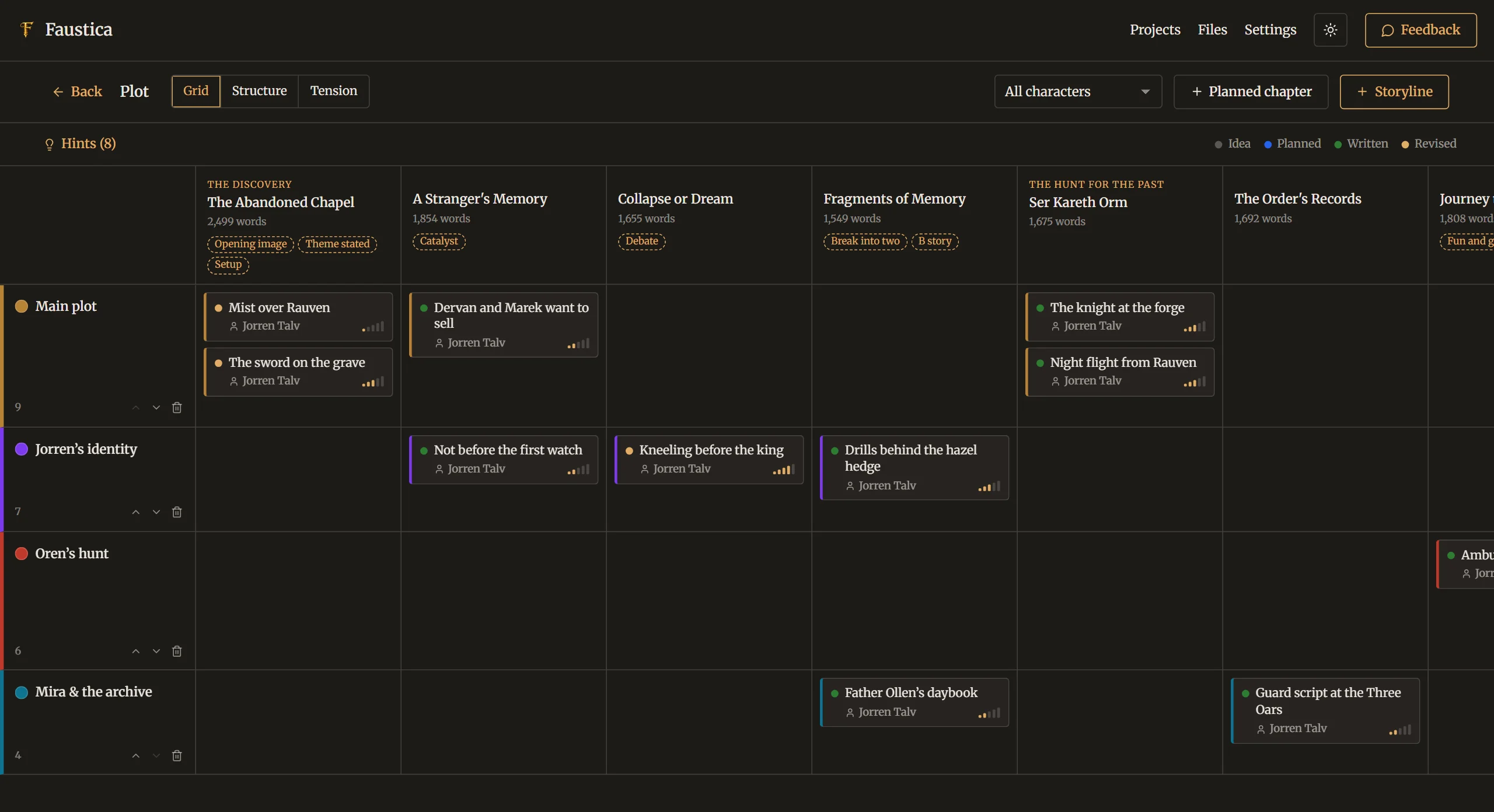
In the Compendium you can mark viewpoint characters with a tag and note the quirks of their perception, such as what a character pays attention to and what they overlook. While you write in the Editor, these entries stay one click away.
Frequently asked questions
Which point of view is best for a first novel?
Many writers start with close third limited to a single character, because it creates closeness and has clear rules. First person is also a good starting point if the character’s voice comes easily to you. Sticking to your choice consistently matters more than the choice itself.
Can I change point of view within a chapter?
Yes, if the switch is visible, for example through a blank line or a scene break symbol, and it becomes clear whose view now applies. Deliberately handled switches within a scene are possible too. In deep close third, though, clear scene breaks are usually the most readable solution; a blank line alone does not replace a recognizable new point of view.
Can I mix first person and third person in one novel?
That is possible and does happen, for example when the protagonist narrates in first person and the antagonist gets chapters of their own in third person. The chapters should then be clearly separated, and the mix needs a storytelling reason.
Is close third the same as third person?
Not quite. Third person is only the grammatical form. It becomes close third when the narration is limited to one character’s perception. Omniscient and objective narrators use the third person too.
Theoretical background
This overview simplifies several models for writing practice. On the distinction between narrative voice and focalization, see the entry “Focalization” by Burkhard Niederhoff in the living handbook of narratology. The foundational work is Gérard Genette’s Narrative Discourse.