
The best way to use feedback from beta readers is to treat it as an observation, not an instruction. Beta readers reliably tell you where they got bored, felt confused or stopped believing something. Why that happened and how to fix it is usually up to you to work out. Their feedback becomes most valuable when you choose several suitable readers, give them specific questions, collect all the responses first and then look for patterns.
The guide How to revise a manuscript shows where beta readers fit into the revision process. This page goes deeper: it describes whom to ask, what to send them, how to evaluate their responses and how to deal with criticism, with feedback on Rika’s story.
What beta readers can and cannot do
Beta readers read your manuscript before publication the way your future audience would. They are usually not professionals, and that is their strength. They experience the story without preconceptions and react to its effect, not to technique. Some writers also distinguish alpha readers, who see an early draft, and critique partners, fellow writers who give feedback on craft, often chapter by chapter. Beta readers usually come later and read the whole book.
What they are good at:
- showing where the tension drops or interest in a character fades,
- pointing to passages they did not understand or did not believe,
- saying what they expected and whether the ending convinced them,
- showing what works especially well.
What they usually cannot do: reliably identify the cause of a problem, propose a solution that holds up, or check the text systematically for style and errors. That is what editors are for; the page Developmental editing, copyediting and proofreading explains the difference.
Finding the right beta readers
Readers of your genre. Someone who rarely reads fantasy may be put off by things genre fans take for granted, and miss what would bother those fans. At least some of your beta readers should belong to your target readership.
More than one person. A single response shows either a personal preference or a real problem, and you cannot tell which. Only when several people stumble at the same spot independently of one another does it become a pattern. A small group is often enough for one round; a second round with new readers shows you whether your changes work.
Honesty over closeness. Family and close friends mean well but often spare your feelings. Helpful readers are people who can be open with you: contacts from writing groups, forums and online reading communities, or other writers you swap manuscripts with.
Different perspectives. Some people read fast and pay attention to tension, others read slowly and pay attention to characters. A mix covers more ground.
What to send your beta readers
A manuscript without guidance usually leads to general answers like “I liked it.” So include:
- A short introduction. Genre, approximate length, the state of the text (“the content is finished, the language is not polished yet”) and what you do not need right now, such as comma corrections.
- A deadline that is realistic and lets you plan.
- A reader-friendly format. Many people prefer reading on an e-reader or tablet to reading a Word file. If you want readers to write comments directly in the text, though, they need an editable file.
- Specific questions. They are the most important part.
Before and after: better questions
| Less helpful | Better |
|---|---|
| How did you like it? | Where did you first put the book down, and why? |
| Is the main character good? | When did you start worrying about the main character? Was there a moment when you did not care about them? |
| Was it exciting? | Which chapters did you read quickly, and which slowly? |
| Is the ending good? | What did you expect at the end? Did anything surprise or disappoint you? |
| Are there plot holes? | Were there places where you did not understand why a character acted the way they did? |
Good questions target the reading experience, not a verdict. Also ask readers to mark passages that worked well. You will need that just as much later.
The questions, together with the checklist for a beta reading round, are also available as a printable PDF · Download Word file.
Evaluating feedback in five steps
- Read everything first, change nothing. Read each response in full and let it sit for a day. The first impulse is often to defend yourself or rewrite in a hurry.
- Collect it in one place. Enter all comments in an overview: passage, observation, who made it. A table or a list per chapter is simplest.
- Separate observations from suggestions. “I was confused here” is an observation that almost always counts. “Kill off the character” is a suggestion you decide on yourself. Behind every suggestion there is an observation; ask yourself which one.
- Look for patterns. Where do several people stumble? Where do responses contradict each other? A pattern is a strong signal, a single opinion a weak one.
- Sort by level and prioritize. Structure before characters before scenes before language. That way you deal first with what affects most of the other changes.
An example: turning a verdict into a question
For this example, beta readers review an invented suspense novel: ferrywoman Rika discovers that her childhood friend Hauke is using her for drug shipments. After she refuses, he threatens her. Afraid, Rika plans a fake engine failure and anonymous tip so he is caught moving the cargo himself. These are possible responses to their confrontation and her counterplan.
| Feedback | Useful follow-up | Possible consequence |
|---|---|---|
| “Why doesn’t she openly ask for help?” | Was her fear of Hauke’s response understandable? | Clarify the threat and deliberation rather than dismissing the question. |
| “Hauke suddenly becomes another person.” | What earlier gesture or demand could prepare the shift? | Prepare the change from familiar friend to blackmailer. |
| “I was nervous during the fake failure.” | Which detail made the risk felt? | Preserve it when shortening the scene. |
Feedback does not decide the novel. Unclear fear is a concrete problem, and revision should make that fear understandable while preparing the chosen anonymous-tip plot.
Dealing with criticism
Criticism of your own manuscript hurts, even when it is kindly phrased. It helps to remember that you asked for this feedback because you want to improve the book. Thank people for every response, but do not argue about it. If you explain to a beta reader what a passage was supposed to mean, you learn nothing new: you cannot explain anything in the finished book either.
At the same time, you do not have to act on every suggestion. If you fulfill every wish, you end up with a book that fully belongs to nobody. Test each comment against your own intention: does the change help the story you want to tell?
Checklist for a beta reading round
- Starting version saved before the round
- Several beta readers chosen, at least some from your genre
- Introduction, deadline and format agreed
- List of questions sent, including questions about what works
- All responses collected before changing anything
- Observations separated from suggestions
- Patterns marked, single opinions noted as hints
- Changes sorted by level
- Every beta reader thanked
Common mistakes
- Asking too early. A rough draft full of known problems wastes readers’ attention on things you were going to change anyway.
- Asking too late. Once the language is polished, it is hard to make big changes.
- Rewriting right after each response. You end up reacting to the first voice before you know whether others share it.
- Using the same beta readers for every round. Someone who knows the first version no longer reads the second one with fresh eyes.
- Only asking about problems. Without feedback on what works, you may “improve” passages that were good.
Practical tips
- Return the favor: if you swap manuscripts, give feedback as thorough as you would want yourself.
- Note which version you sent. If responses arrive weeks later, you will know which state they refer to. The page Managing manuscript versions describes how.
- Ask for feedback in reading order. A note at the end of each chapter is more precise than a memory after the whole book.
- Ask one closing question: “Would you read the sequel?” The answer often says more than long explanations.
Using Faustica
For beta readers who write comments directly in the text, you export individual chapters as a Word file. Your own anchored comments, such as questions for the reader, come out as Word comments, and track changes is switched on. You import the returned file as an additional chapter next to the original, with comments and marked changes. This editing export always covers one chapter, not the whole manuscript.
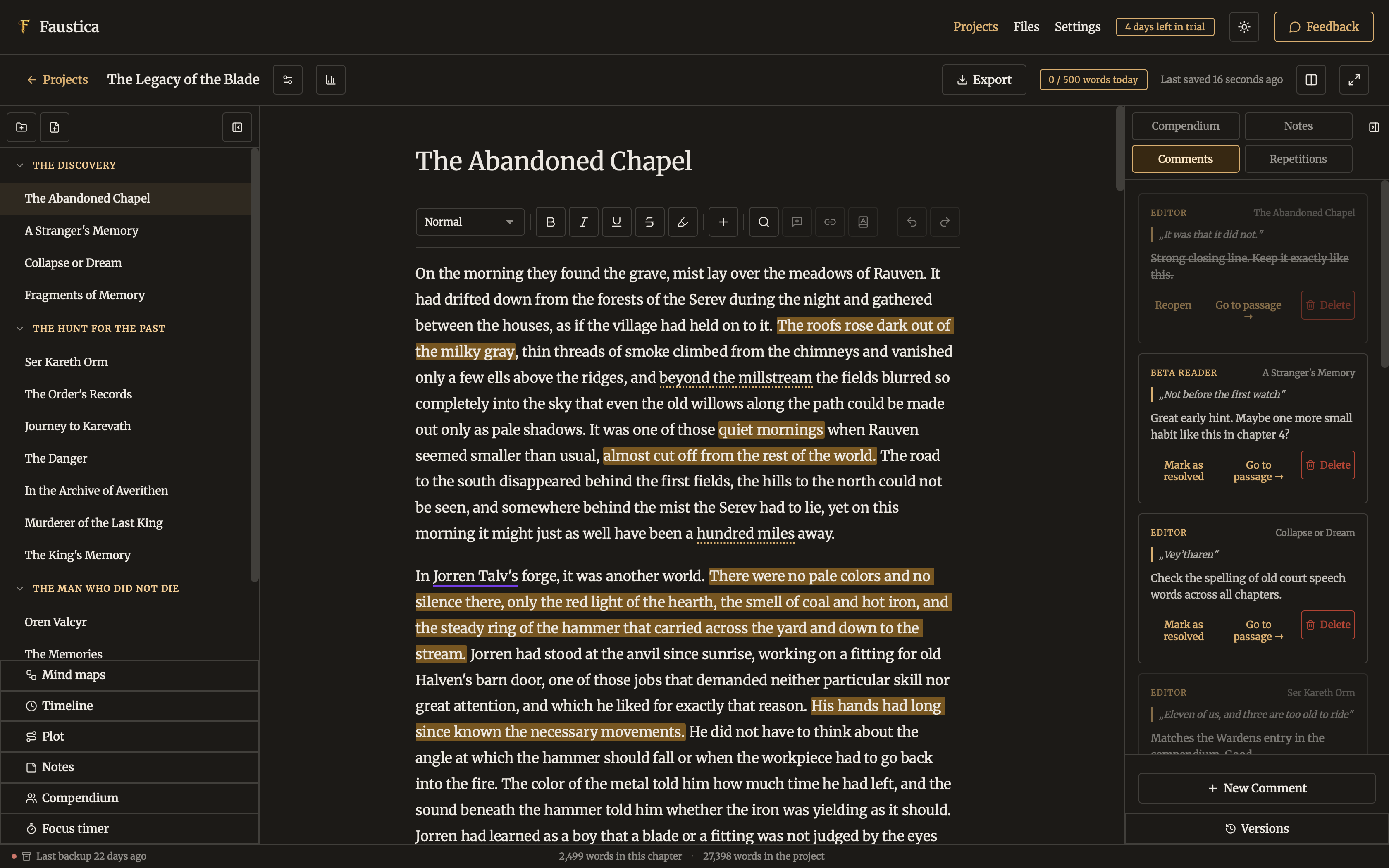
In the split view of the editor, the returned version and your original sit side by side. Beta readers who should simply read get the whole manuscript via Export as an EPUB for their e-reader or as a PDF.
Frequently asked questions
How many beta readers do I need?
There is no fixed number. What matters is that it is more than one person, so you can tell patterns from single opinions. Many writers work with a small group per round and bring in new readers for a second round.
Where can I find beta readers?
In writing groups and writer forums, in online reading communities and social networks around your genre, or by swapping manuscripts with other writers. Make sure at least some of your beta readers enjoy your genre.
Should I pay beta readers?
Beta reading is often a favor or a swap. Paid beta reading services exist too; they do not replace an editor, though, and should clearly describe what they offer. For unpaid beta reading, a small thank-you, such as a copy of the finished book or a mention in the acknowledgments, is a nice gesture.
What do I do when feedback contradicts itself?
Then the passage usually comes across differently to different people, and that need not be a problem. Ask yourself which effect you intend and which response comes from readers in your target readership. If in doubt, get one more opinion on exactly that passage.