
The difference between editing and proofreading lies in the level at which someone works on your text. Editing asks whether the text works as a whole and sentence by sentence: plot, characters, structure, style and clarity. Proofreading asks whether the text is correct: spelling, grammar, punctuation and consistency. Editing can change a book; proofreading makes it clean. That is why editing comes before proofreading, and one does not replace the other.
In the English-speaking market, the work is usually split into four levels: developmental editing, line editing, copyediting and proofreading. On this page you will find what each one covers, which related services exist, how fees are usually calculated and how to tell what your manuscript needs right now. A before-and-after example shows how differently the levels treat the same passage.
The four levels of editing
The terms are not protected, and editors draw the lines differently. As a rough guide, the levels run from big to small:
| Service | What it usually covers | When it makes sense |
|---|---|---|
| Developmental editing | Structure, plot, characters, logic, pacing, point of view | When the story is there but does not hold together yet |
| Line editing | Style sentence by sentence: clarity, rhythm, tone, word choice | When the content is finished |
| Copyediting | Grammar, spelling, punctuation, consistency, usage | When content and style are finished |
| Proofreading | Final check for remaining errors, often on the typeset pages | After typesetting, shortly before publication |

Names vary. Some editors speak of substantive or structural editing instead of developmental editing, and some combine line editing and copyediting into one service. If in doubt, ask exactly what an offer includes.
Developmental and line editing: working on content and language
In developmental editing, an editor reads your manuscript asking whether it achieves its effect. As a rule, they do not rewrite it for you; they make problems visible, explain them and suggest solutions. The decision stays with you.
- Developmental editing. Does the plot hold up? Are the characters believable and their motives convincing? Do pacing, tension and point of view work? Are there plot holes or contradictions? The result is often margin comments plus a summary letter, sometimes called an editorial letter.
- Line editing. Work on the sentence: unclear phrasing, repetition, mixed metaphors, filler words, clumsy rhythm, the wrong tone. Here you usually get concrete suggestions for changes in the text.
An editor will inevitably catch spelling mistakes too, but the work is not designed to find all of them. If you book a developmental or line edit, do not expect a clean text afterward.
Copyediting and proofreading: working on correctness
Copyediting checks the text against rules and against itself. It usually covers:
- spelling, including hyphenation and capitalization,
- grammar, such as agreement, pronoun reference and tense,
- punctuation, especially commas and dialogue punctuation,
- consistency of spellings, names, numbers and quotation marks,
- obvious typos and doubled words.
Proofreading is the last check. Traditionally it happens on the typeset pages (the proofs) and looks for remaining errors as well as layout problems such as bad line breaks, missing words or wrong page numbers. In self-publishing, “proofreading” often also means a final error check of the manuscript before formatting.
Neither copyediting nor proofreading touches content or style. A clumsy but correct sentence stays as it is. English has no official spelling authority; copyeditors work from a style guide and a dictionary. Many US book publishers use The Chicago Manual of Style and a dictionary such as Merriam-Webster. Where the rules allow variants, the copyeditor makes sure the whole text uses the same one, ideally as recorded in your style sheet.
Before and after: one passage, two kinds of work
The scene belongs to an invented suspense novel: ferrywoman Rika discovers drugs in her childhood friend Hauke’s cargo. When she tries to quit, he threatens her. These comparison versions show her fear of another call and were written for this exercise.
Draft:
Since Haukes visit Rika knew that she was afraid. “You sail” he had said. She was very frightened and felt great fear about calling him.
After proofreading:
Since Hauke’s visit, Rika knew that she was afraid. “You sail,” he had said. She was very frightened and felt great fear about calling him.
Possessive apostrophe and punctuation are corrected. Repeated statements of fear remain a stylistic issue.
Possible editorial notes:
- The three statements of fear do similar work.
- A concrete response could prepare the call.
- Hauke’s line needs the context of his aggressive threat.
A stylistic revision:
“You sail.” Rika could still hear his voice. His number waited on the screen. She put the phone down and picked it up again.
Proofreading corrects the existing text; editing also examines effect, repetition and scene purpose. The revision is an option, not an authoritative original.
How fees are usually calculated
Fees for editing and proofreading are freely negotiated and vary widely by editor, the state of the text, genre and scope. Common bases for calculation are:
- per word or per thousand words, common for fiction,
- per hour, often with an estimate in advance,
- as a flat fee for the whole manuscript.
As a rule, developmental editing costs more per word than proofreading, because it takes more reading passes and more thought. A sample edit of a few pages is common, so the editor can judge the effort and you can see how they work. Compare offers not only by price but by what exactly is included: how many passes, whether there is a written report, whether follow-up questions are covered. Professional bodies offer orientation on how freelance editors work and directories of their members, for example the Editorial Freelancers Association in the US and the Chartered Institute of Editing and Proofreading (CIEP) in the UK.
What does your manuscript need?
- The story is still shaky, and beta readers drop out at similar points: a manuscript assessment or developmental edit helps. Proofreading would be too early now.
- The story works, but the text reads heavily: a line edit makes sense.
- Content and language are finished, and the text is going to typesetting or to a publisher: now it is time for copyediting and proofreading.
- You are querying agents: they expect a carefully revised manuscript with as few errors as possible, but generally not a paid professional edit. If you publish traditionally, editing is usually part of the work with the publisher.
- You are self-publishing: then you are responsible for every level. The page Self-publishing describes how to go about it.
Before paying for any service, a thorough revision of your own is worth it. You will find methods in How to self-edit your novel.
Common mistakes
- Booking proofreading when you need developmental editing. An error-free text with a weak plot is still a weak text.
- Rewriting after the proofread. Every change to the content afterward can introduce new errors. If you do change something, have the changed passages checked again.
- Not providing a style sheet. Without a list of names, invented words and deliberate deviations, the editor has to guess or ask.
- Vague agreements. “Just give it a once-over” can mean anything. Put in writing which service you expect.
- Accepting every suggestion without thinking. Even with a professional editor, it remains your book. Accept what convinces you, and ask where you disagree.
Practical tips
- Before you hire someone, send a short overview: genre, target readership, length and what you feel unsure about yourself. That helps the editor give a fitting assessment.
- Agree on the file format. Many editors work in Word with track changes.
- Work through the feedback calmly and sort it by level, as described in the guide How to revise a manuscript.
- Allow time for working in the feedback. A good edit creates work, not just a finished result.
Using Faustica
To work with an editor, you export individual chapters from Faustica as a Word file. Anchored comments come out as Word comments, and track changes is switched on. You bring the edited file back as an additional chapter and compare it with the original in split view. This editing export always covers one chapter.
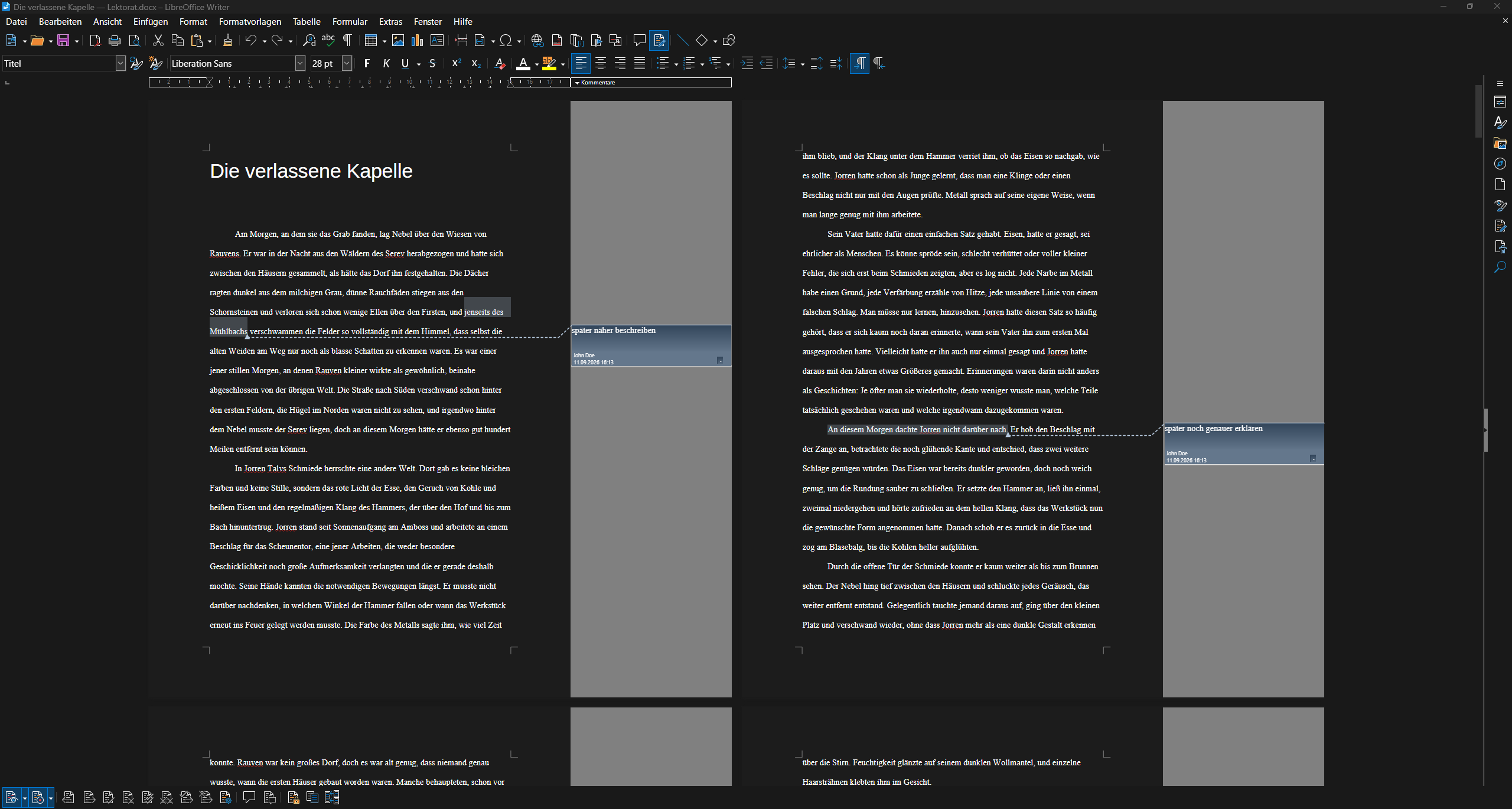
If the whole manuscript is going to an editor or proofreader, use the regular Export as a Word file or PDF, with the standard manuscript template if you like.
Frequently asked questions
Is proofreading included in editing?
Usually not completely. An editor corrects errors they notice along the way, but developmental and line editing are not designed to be exhaustive. Some editors offer several levels as a package; what is included should be stated in the offer.
What is the difference between copyediting and proofreading?
Copyediting is the thorough correctness pass on the manuscript: grammar, spelling, punctuation and consistency. Proofreading is the final check for anything that slipped through, traditionally on the typeset pages. In everyday use the two terms are often mixed up, so ask about the exact scope.
Do I need a professional edit before I query agents?
Not necessarily. Publishers usually edit the manuscripts they acquire. What matters is a carefully revised text with as few errors as possible. A manuscript assessment or an edit can still make sense if you are stuck on your own.
Can a spell checker replace proofreading?
No. Automatic checks find many errors but miss correctly spelled words used in the wrong place, unclear references and inconsistencies. With invented words and deliberately nonstandard speech, on the other hand, they often flag what is correct. They are useful as groundwork, not as the final check.