
You describe a setting most effectively when you don’t show everything that’s there, but what a character perceives in that moment: a clear overall impression, two or three precise details from different senses, and something that matters for the scene. A place doesn’t come alive on the page through completeness but through selection. Well-described settings create mood, say something about the characters and contribute to the plot.
This page deals with the single place on the page: how to choose it, perceive it and get it into your text. How to design a whole world with history, society and rules is covered in Worldbuilding.
What a setting does in a story
A setting is more than a backdrop. It can do several jobs at once:
- Orientation. Readers want to know where they are. A few details are enough to anchor a scene.
- Mood. Light, sounds, temperature and closeness color how a scene feels before a word is spoken.
- Characterization. How someone lives, works or what they collect reveals a lot about them. And what a character notices in a place reveals something about the character.
- Plot. A place can offer obstacles, escape routes, hiding places or dangers. Some places have an effect that directly influences the plot.
- Meaning. A place that appears several times collects memories. When the character returns, they see it with different eyes.
Not every place has to do everything. An inn where a letter is merely handed over needs one sentence. A place where the climax happens deserves more attention.
How to describe a setting in six steps
- Clarify the place’s job in this scene. Should it soothe or threaten, surprise or feel familiar, make an escape possible or prevent it? The job decides which details you need.
- Choose the character’s view. Who perceives the place, and what does this particular character notice? A blacksmith sees a forge differently from a visitor, an archivist sees an archive differently from a thief. How closely the description is tied to the character depends on your point of view.
- Find the overall impression. Sum up the place in one image or comparison before you go into detail. That first impression shapes how every further detail is read.
- Choose a few precise details from several senses. Instead of “an old workshop,” a particular smell, a particular sound, a particular light. Two or three details nobody would expect work better than a list.
- Put the description in motion. Spread the details of the place across the action: the character walks through, touches something, is held up by something. That keeps the scene moving. More on this in Writing descriptions.
- Let the place change. When a character returns to a place, show what is different now, in the place itself or in the way they see it.
An example: the same place, a different effect
In this invented suspense novel, ferrywoman Rika maintains extra supply runs. She discovers that her childhood friend Hauke is using her for drug shipments; when she tries to quit, he threatens her. These possible scenes take place at her landing. Her changed knowledge gives the same familiar place a different effect.
Before discovery:
The crates stood under the awning. Rika dragged the first across the boards; fresh bread scented the air from the quay shop. Behind its window, the shopkeeper raised a hand.
Work, smell and a familiar gesture establish a used place without a complete harbor plan.
After Hauke’s threat:
The shop window was dark. The next crates waited under the awning. Rika stopped in front of the first and heard a loose sheet of metal strike the wall above her.
The crates now mean danger. The closed surroundings and sound reflect Rika’s attention, not a suddenly different island.
The trap’s geography needs establishing in advance: where can Hauke collect the cargo, and where does he go next? An exit invented only at the climax would make the solution convenient. A check following the anonymous tip does not replace planning those routes.
Common mistakes
- The inventory. The text lists what’s in the room, from left to right. Readers retain little of it. Select.
- The camera pan at the start of a chapter. A paragraph of landscape before anything happens. It often works better to start with a character in motion and weave the place in bit by bit.
- Only the eye. Many descriptions stick to sight. Sounds, smells, temperature and textures make a place tangible.
- The wrong eyes. A character notices things they couldn’t know or name. A character with no architectural training will describe a room differently from an architect.
- Generic words. “A beautiful old forest” creates no image. A particular tree, a particular path, a particular sound does.
- Contradictions. An inn has two floors in chapter three and three floors in chapter twelve. Keeping track of your places prevents mistakes like this.
Practical tips
- For every important place, write one sentence that captures its overall impression, such as the warmth of the window table. You can come back to that sentence again and again while writing.
- Decide what each place smells and sounds like. Those are the details most often missing in a draft.
- Collect pictures as reference, even for invented places. A photo of a real ruin helps you find details you’d never think up.
- Keep track of distances and travel times between places if your characters are on the move a lot. A novel timeline helps you avoid contradictions.
- Read a description of a place aloud and cut every detail that carries neither mood, character nor plot.
- For real places: note what you found on location or in sources, and check street names and routes carefully.
Using Faustica
In Faustica’s Compendium you create every setting as an entry of its own, with an image, keywords and custom sections such as “Landmarks,” “Levels” or “Layout.” The reading view also shows where in the manuscript the place is mentioned, so you can check whether the details in the text match your notes.
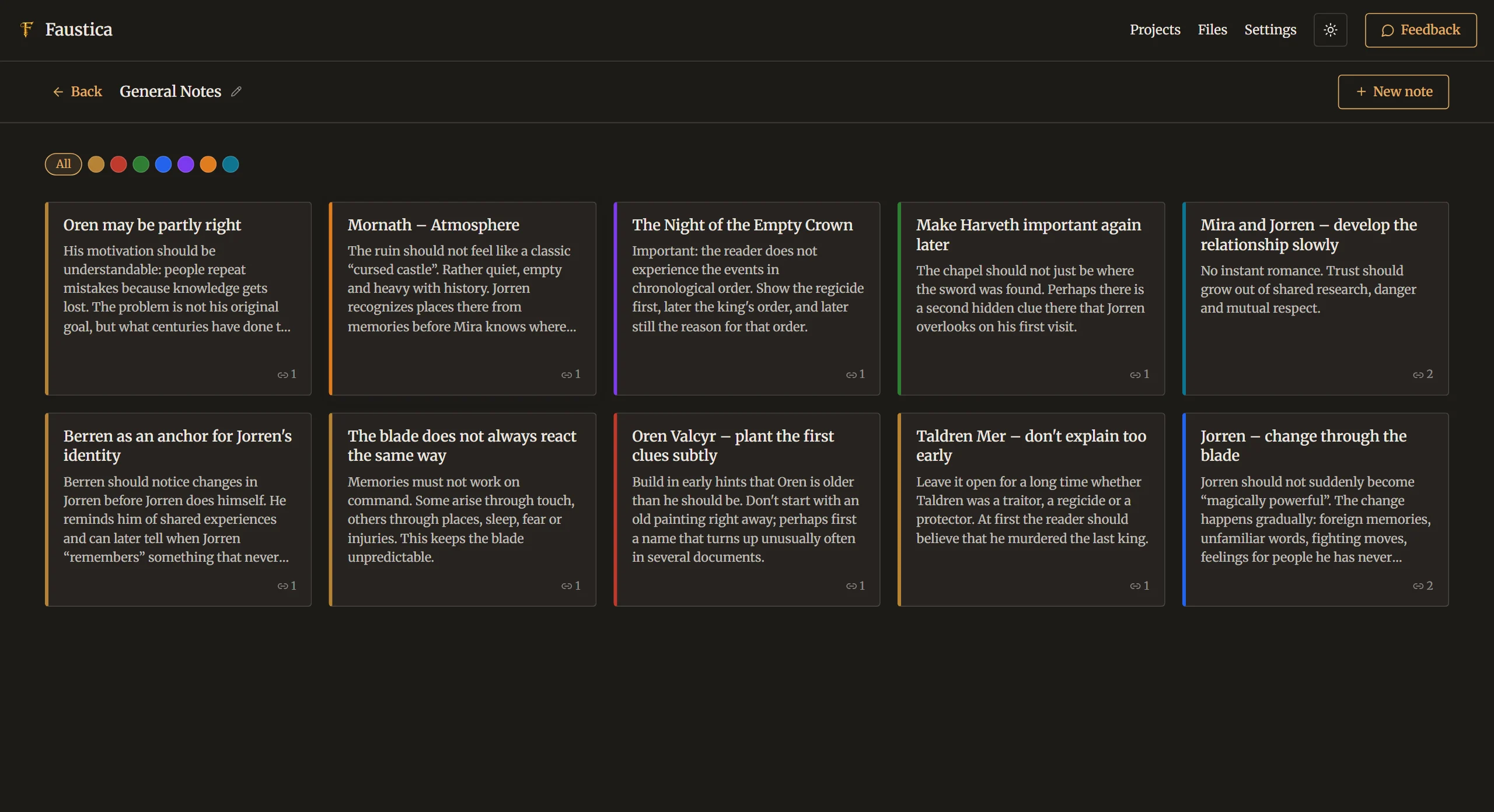
You collect reference images, PDFs and links in Notes and link them to chapters or compendium entries. Linked notes appear right in the editor’s right-hand column while you write. In the Plot Planner you can assign a location to each scene and see which settings appear how often.
Frequently asked questions
How much detail should I use to describe a setting?
As much as the scene needs. A place that’s only a stop along the way gets by with one sentence. A place where a key scene happens deserves a clear impression and a few precise details, spread across the action rather than in one block.
Should I describe the place at the start of a scene?
A brief anchor at the start helps readers know where they are. Longer description often works better when it’s woven into the action. One sentence for orientation, then the character in motion, is a good starting point for many scenes.
Can I change real places?
Yes, but do it deliberately. Many novels move buildings or invent inns or entire streets in real cities. If you do, do it in a way that serves the story, and you can mention it in an author’s note. People who know the place will spot the changes quickly.
What is the difference between a setting and worldbuilding?
Worldbuilding designs the whole world of a story: geography, history, society, rules. Describing a setting puts a single place from that world on the page in a particular scene. One is planning in the background; the other is craft on the page.