
Worldbuilding is the work of inventing and fleshing out the world your story takes place in: its places, history, society, rules and everything else that shapes your characters’ lives. A world feels believable when it runs on consistent rules, when those rules have consequences for everyday life, and when the world generates conflicts that spark the plot. The amount of detail comes second.
This isn’t only true for fantasy and science fiction. A mystery set in an invented small town or a family saga on a farm also needs a setting that hangs together. On this page you’ll learn what a world is made of, how to build one step by step and what that looks like in an example.
What worldbuilding covers
Which areas you work out depends on your story. The following show up in almost every world:
- Geography and places. Landscapes, cities, roads and distances. How long does a journey take, and what lies in between?
- History. Which past events still have an effect? Wars, upheavals, disasters, foundings.
- Society and power. Who rules, who works, who has no say? Which groups, orders, guilds or parties exist?
- Daily life and culture. What do people eat, how do they talk, what counts as polite, what is taboo? Language, religion, customs.
- Rules of the extraordinary. Magic, technology, supernatural forces. What is possible, what isn’t, and what does it cost?
With realistic settings, research replaces part of the invention, but the questions stay the same: what is daily life like in this place, who has influence there, what history shapes it? If you want to focus on a single location, see Describing settings.
Two approaches: top-down or bottom-up
Worldbuilding is often divided into two approaches. Top-down, you start with the big picture: continent, kingdoms, history, religion, and work your way down to the individual village. That gives you a self-contained world, but it takes a lot of time before the first scene gets written.
Bottom-up, you start where your character stands: in their village, their workshop, their street. The world grows with the story, and only as far as the plot needs it. That keeps you focused, but it can lead to contradictions when you settle larger connections later.
Many writers combine both: they fix a few big pillars, such as one defining historical event and the rules of the magic, and invent everything else outward from the character.
How to build a world in six steps
- Start with the question your world asks. A core that connects to the story’s theme can help you choose which details matter. What is different here from our world, and why does that matter for your story?
- Define the rules of the extraordinary. If there’s magic or special technology, decide what it can do, what it can’t, and what price it demands. Fantasy author Brandon Sanderson put a rule of thumb for this into words in “Sanderson’s First Law”: an author’s ability to solve conflict with magic is directly proportional to how well the reader understands that magic.
- Choose one defining event from the past. An upheaval, a disaster, a founding. A single well-thought-out event whose consequences are felt everywhere carries more weight than a long chronicle.
- Derive power structures and groups from it. Who profited from the event, who lost? Which groups have interests of their own and clash because of them?
- Build the places your characters enter. Start with the opening location, then the stations of the plot. For each place, it’s enough at first to know: what does it look like, who lives there, and what does it mean for the story?
- Check consequences and contradictions. If there’s magic, why doesn’t everyone use it? If a city is rich, where does the money come from? Questions like these expose gaps before readers do.
All the questions on this page are also available as a printable PDF · Download Word file.
An example: the rules of Rika’s island life
This example develops the island setting of an invented suspense novel. Ferrywoman Rika takes on extra supply runs after the daily winter service is withdrawn. An engine failure leaves her short of money. Her childhood friend Hauke advances repair costs, then uses her crossings for drug cargo without her initial knowledge. The island’s conditions should make this conflict plausible.
| Established condition | Story consequence |
|---|---|
| The daily ferry service is withdrawn for winter. | Rika’s extra crossings matter for deliveries; other connections may still exist. |
| Her small boat has limited capacity and running costs. | Supplies and additional cargo are economically connected. |
| A real engine failure stops the service. | Hauke’s advance offers a tempting solution. |
| Return crossings can carry extra cargo. | Hauke can propose the seemingly harmless exchange. |
These are decisions about a fictional island, not claims about all real ferry services. Travel times, weather and landing conditions still require research for a developed novel.
A rule must not disappear at the climax: after the genuine repair, the second failure must be identifiable as a deliberate deception. A suddenly available free replacement boat would undermine the dependence established earlier.
Common worldbuilding mistakes
- Worldbuilding instead of writing. Some writers spend years on maps, languages and family trees without a story ever emerging. The world exists for the story, not the other way around.
- The info dump. A chapter opens with three pages of the kingdom’s history. Show the world through what characters do, see and take for granted instead.
- Magic solves every problem. If a power could resolve the central conflict at any time without obstacles, the conflict loses its tension. Limits, costs or consequences can prevent that. Mysterious magic may stay unexplained, but it shouldn’t deliver a convenient rescue.
- One culture, one trait. A whole people is warlike, another is wise. Real societies are contradictory and divided.
- Missing consequences. Teleportation exists, but merchants still travel for weeks with carts. Every special feature changes daily life, and that change has to be visible.
- Contradictions in distance and time. A journey takes three days in chapter four and half a day in chapter twelve. A novel timeline helps here.
Practical tips
- Work by the iceberg principle: you can record more about your world than ends up in the book. How much background you need depends on the story. What does appear in the text then feels sure-footed and natural.
- Capture rules in one sentence. “What comes in pushes something out” can be checked at any point while you write; a page of explanation can’t.
- Invent names with a system. Places, people and words from the same culture should sound alike.
- Give every important group a goal, just like a character. Then conflicts between them arise on their own.
- Let characters see the world differently. A blacksmith, an archivist and a knight experience the same city in different ways. That shows more of the world than any description. More on how characters work together in How to develop characters.
- For realistic settings: research on location or thoroughly from afar, and note your sources. A wrong street name stands out immediately to anyone who knows the place.
Using Faustica
In Faustica’s Compendium you collect places, organizations, items, events, cultures, religions or technology as entries of their own, each with an image, keywords and custom sections. You create custom categories such as “Factions” yourself. An entry’s reading view also shows where in the manuscript it appears.
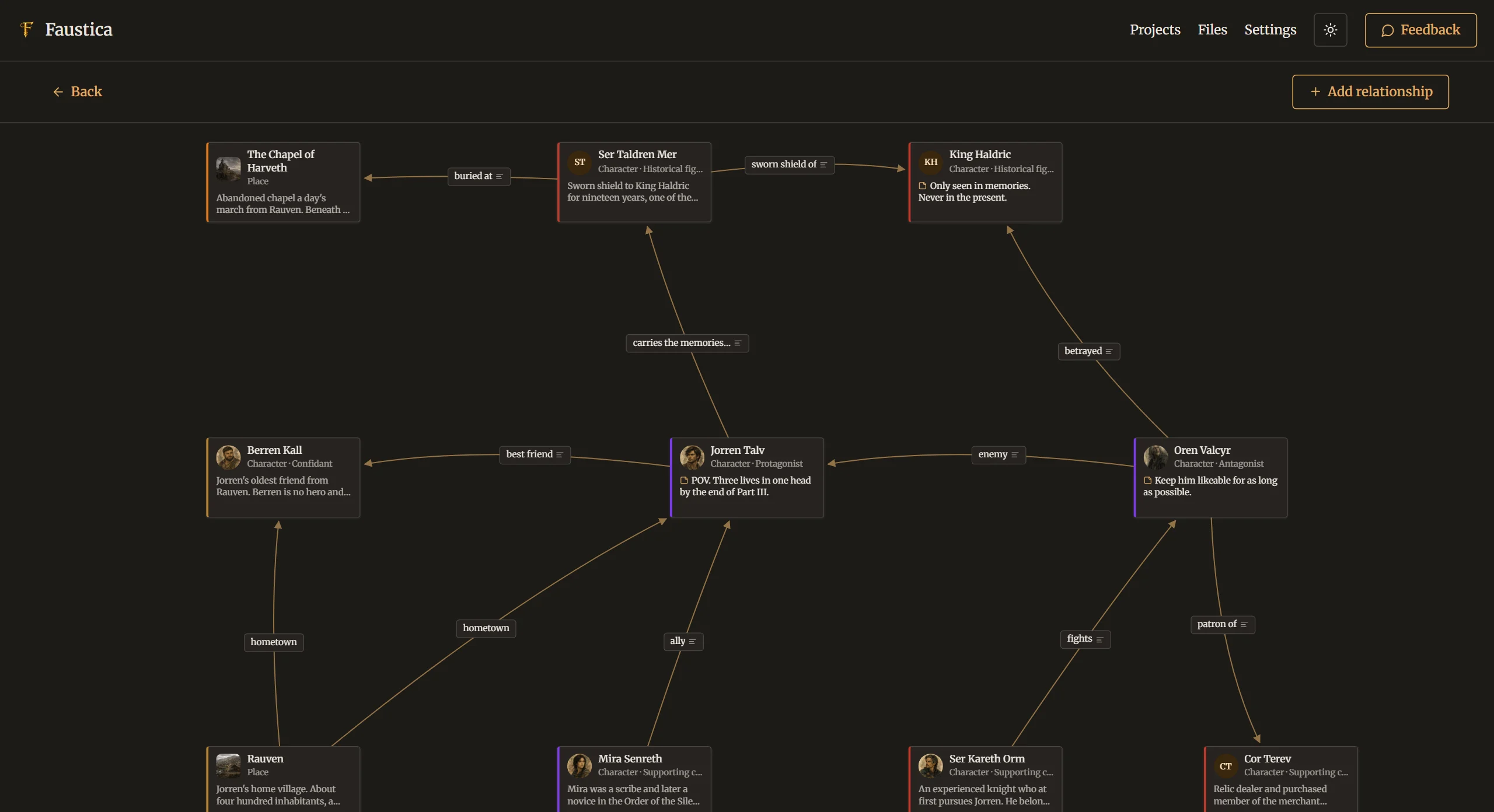
In the relationship graph you connect not only characters but also places and worldbuilding elements, such as a character and the order they’ve left. You can record your world’s history in the Timeline with free-form time references like “300 years ago,” and collect first ideas about the world freely in Mind Maps.
Frequently asked questions
How much worldbuilding do I need before I start writing?
For many stories, the opening location and the rules or living conditions that shape the first conflict are enough to begin with. One defining event from the past helps if its consequences matter for the plot. Everything else can emerge as you write. If you notice you’d rather work on the world than on the story, it’s usually time to start writing.
Do I need a map for my fantasy world?
Not necessarily for your readers, but often for yourself. A rough sketch with places and distances prevents contradictions in travel times. Whether it goes into the book is a separate decision.
Does worldbuilding apply to novels set in the real world?
Yes. A real place also has to be chosen, researched and filtered for the story. With invented places in a real environment, such as a fictional small town, you develop history, power structures and daily life just as you would in a fantasy world, only within narrower limits.
How do I convey the world without overwhelming readers?
Show it through the characters’ actions and perceptions, and explain only what each scene needs. Terms can stay unexplained at first, as long as their meaning becomes clear from context. Explanations work best where a character needs them too.