
A flashback interrupts the ongoing action to tell an event from the past that matters to the story’s present. It works when three things are true: there is a reason to look back right now, the move into the past and back out again is clear to readers, and what is told changes how they understand the present. A flashback that merely delivers background information, on the other hand, usually slows the story down.
On this page you will find the different kinds of flashback, a guide to entry, tense and return, an example from a novel in which the past comes back in an unusual way, a before-and-after revision, and common mistakes and practical tips.
What a flashback is
In narrative theory, following Gérard Genette, a flashback is called an analepsis and its counterpart, a jump ahead to something later, a prolepsis (the familiar flash-forward). Both change the order of the narration: the story is not told in the order in which the events happen. For work on a novel, the everyday term flashback is usually enough.
It is important to distinguish a flashback from backstory. Backstory is everything that happened before the plot begins. A flashback is one technique for telling part of it. Much of the backstory needs no flashback of its own; half a sentence of dialogue or a thought from the character is enough.
A flashback changes the time, not automatically the point of view. If the viewpoint character remembers, you stay in their perspective. The guide to point of view explains how points of view work together and when a switch gets in the way.
Kinds of flashback
- The scene flashback. A past event is told as a complete scene, with setting, dialogue and action. It is powerful, but it holds up the present-day plot the longest.
- The remembered or summarized flashback. The character remembers in a few sentences, often triggered by an object or a word. It suits information readers need without having to live through it.
- A second timeline. The past runs alongside as a storyline of its own, for example in alternating chapters. It is less an interruption than a second story that converges with the first. The guide to subplots describes how to distribute several storylines.
- The past in documents. A letter, a diary entry or a chronicle brings the past into the present without the narration changing timelines.
Writing a flashback in six steps
- Check whether you need it. Ask yourself what readers would lose if the flashback were missing. If the answer is “a piece of information,” a sentence is often enough. If it is “an experience that shows the present in a new light,” the scene is worth it.
- Pick the right moment. A flashback works best when readers already want to know what happened back then. At the very beginning, before they care about the present, it usually comes too early.
- Give it a trigger. A smell, an object, a sentence or a place leads the character back. The trigger connects the two timelines and makes the switch easy to follow.
- Mark the entry with tense. If your novel is told in the past tense, the flashback starts in the past perfect: “She had stood …”. After two or three sentences you can slip into the simple past, so the flashback does not groan under a pile of “had” and “had been.” If you narrate in the present tense, the flashback is in the simple past (or the present perfect) accordingly.
- Tell it as if it were the present. A scene flashback needs the same tools as any other scene: a goal for the character, conflict and concrete details.
- Come back clearly. A sentence in the past perfect, a return to the trigger or an action in the present shows that we are back in the now. After that, the present should do something with what was remembered.
For more on tense consistency and similar slips, see the guide to common writing mistakes.
An example: a sound leads back
In this invented suspense novel, ferrywoman Rika initially accepted apparently harmless cargo jobs from her childhood friend Hauke. After discovering drugs, she refuses further crossings; he threatens her. In this possible scene, a crate’s sound recalls their first, still friendly cargo conversation.
The crate struck the rail. Rika pulled her hand back.
During their first loading, Hauke had pressed down that same lid. “Workshop supplies,” he had said. She handed him the second crate. Back then, she had only been relieved that the boat ran again.
Now her hand rested on the lid again. She left the crate and went to the phone.
Trigger: the loading sound. Time shift: “During their first loading” and past perfect establish the memory; the recalled action can then continue in simple past. Return: “Now” and the same lid bring us back.
The memory changes an earlier encounter’s meaning rather than repeating the repair agreement. Rika’s move toward the phone resumes the present.
Before and after
Two possible versions of the memory transition:
Before:
Rika had known Hauke since childhood. He had paid for her repair. He had said the crates were harmless. Now she was afraid.
After:
Diesel on his sleeves: Hauke had smelled like that during their first loading too. He pushed the invoice across. “We’ll manage.” She signed.
The phone vibrated. Rika looked at the name and let it ring.
The revision gives memory a trigger, brief action and return to present fear. The signature is a possible addition for this exercise, not a requirement of the basic plot.
Common mistakes
- The flashback comes too early. On the first pages, readers are not yet interested in the past of a character they have only just met.
- Unclear transitions. Readers only notice half a page in that they are in the past, or they cannot find their way out again.
- Past perfect all the way through. Pages of “had” chains make any flashback a slog.
- The present loses its tension. If you cut away at the very climax of a scene, the tension often drains out. Sometimes that is exactly the intention; then the flashback should be worth the wait.
- Too many flashbacks. If the past keeps barging in, the present never gets going. Check whether a second timeline as its own storyline would be clearer.
- Contradictions between timelines. Ages, years or what characters know do not add up. Attentive readers notice.
Practical tips
- Write one sentence for every flashback: what do readers know afterward that they did not know before, and why does it matter right now?
- Keep the trigger and the return as short as possible. One sentence for the entry and one for the return are often enough.
- Check whether a flashback could be replaced by a scene in the present in which the past shows its consequences. That is often more alive.
- At the end, read all the flashbacks one after another. That shows you whether together they add up to a consistent backstory.
Using Faustica
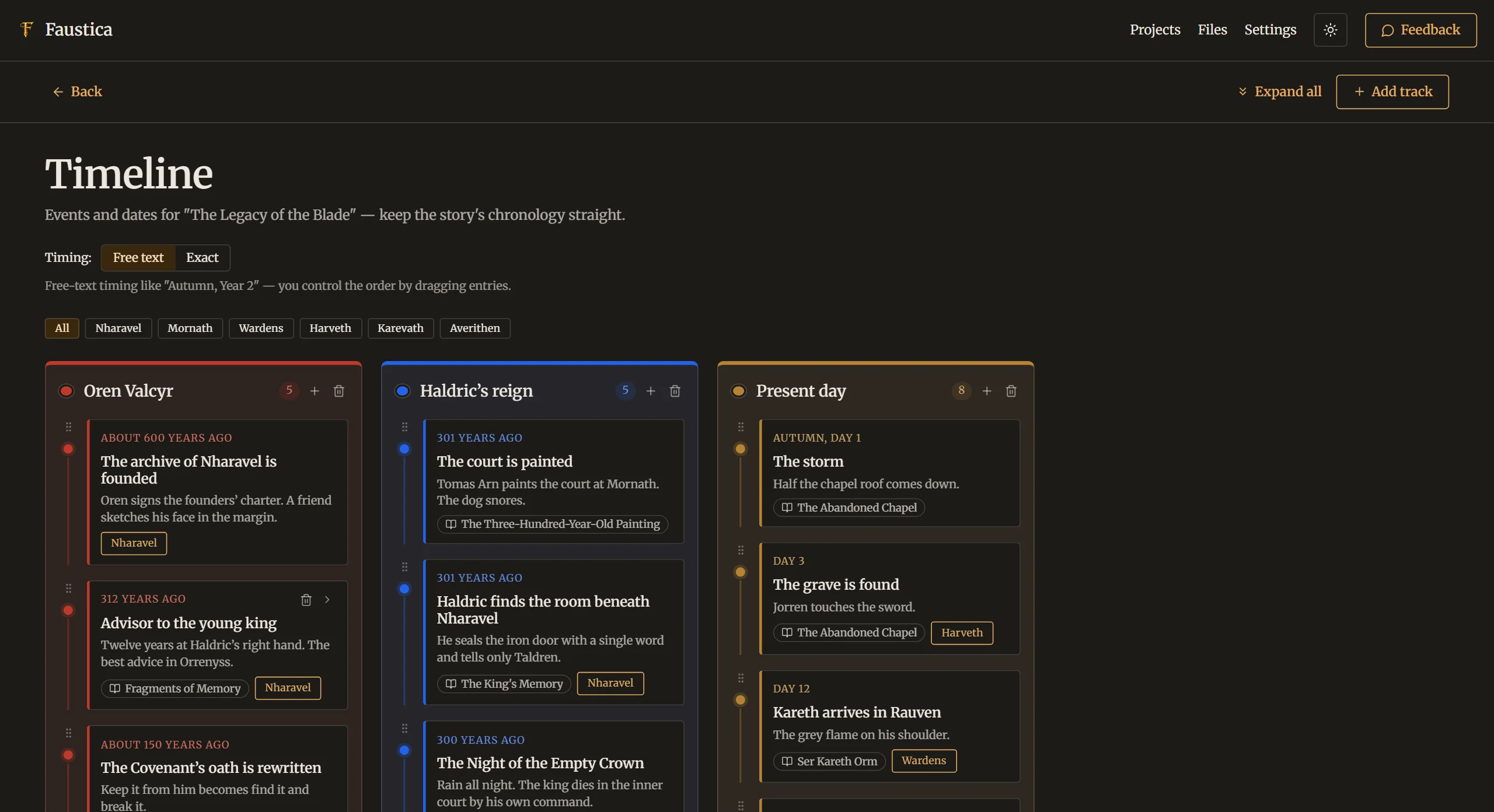
The Timeline in Faustica arranges events in their actual chronological order, independent of the chapter order. Each card can be linked to a chapter, so you can see where in the manuscript a past event is told. You enter times as free text, for example “300 years ago,” or as an exact date. Several storylines in their own colors help you keep past and present apart.
In the Plot Planner you plan flashbacks as scene cards in the chapter in which they are told, and you can set up a second timeline as a storyline of its own.
Frequently asked questions
How long can a flashback be?
That depends on what it needs to do. A remembered flashback can be a single paragraph, a scene flashback several pages. The longer it gets, the more it needs tension of its own, or readers will simply wait for the present to move on.
Should I put flashbacks in italics?
That is not necessary, and for longer passages italics are rather tiring to read. A clear trigger, the past perfect at the entry and, for long flashbacks, a scene break or a chapter of its own are clearer. Italics can work for very short, fragmentary memories.
Is a prologue a flashback?
Not necessarily. A prologue can be set in the past and so work like a flashback placed up front, but it can also anticipate a moment from later in the plot. Either way, it should show something the first chapter cannot.
What is the difference between a flashback and foreshadowing?
A flashback tells something that happened before the current action. Foreshadowing hints at something still to come, for example in a sentence like “He had no idea he would never see the village again.” Both break the chronological order, but they work differently: one explains, the other builds anticipation.