
The most common writing mistakes in novel manuscripts are not obscure rules but the same mix-ups and slips again and again: “it’s” instead of “its,” “there” instead of “their,” “affect” instead of “effect,” comma splices, dangling modifiers, misplaced punctuation in dialogue and tenses that get tangled in flashbacks. On top of that come careless errors that break no rule but are just as distracting: doubled words, swapped names, contradictions in the details.
This page presents the classics with short explanations and examples and shows how to find them in your own text. It follows American conventions. English has no official spelling authority; for questions of style and usage, many US book publishers rely on The Chicago Manual of Style, together with a dictionary such as Merriam-Webster. The sample sentences belong to an invented suspense novel: Rika is a ferrywoman whose childhood friend Hauke uses her crossings for drug shipments without her knowledge and threatens her after discovery.
Why you overlook your own mistakes
When you read your own text, you know what is supposed to be there. Your brain fills in missing letters, skips doubled words and hears commas that are not there. That is why you find mistakes more easily in other people’s texts than in your own, and why reading through once is rarely enough.
Proofreading is also the last step of revision, not the first. Every structural change creates new mistakes. So it pays to do the thorough error hunt only when content and language are settled, as described in the guide How to revise a manuscript.
Classic word mix-ups
“its” or “it’s”
“It’s” is short for “it is” or “it has.” “Its” is the possessive, with no apostrophe, just like “his” and “hers.” Test: if you can replace the word with “it is,” write “it’s.”
- Rika checked the boat and its engine.
- “It’s broken,” Rika said. (it is)
“their,” “there” or “they’re”
“Their” shows possession, “there” refers to a place or introduces a sentence, “they’re” is short for “they are.” The same pattern applies to “your” and “you’re” and to “whose” and “who’s.”
- Rika and the shopkeeper checked their lists. There were more crates. They’re still waiting for the next crossing.
“affect” or “effect”
In most cases, “affect” is the verb and “effect” is the noun: Hauke’s threats affect Rika; his aggression has a frightening effect on her. As a verb, “effect” means “to bring about”: “to effect a change.” If in doubt, look up both words in a dictionary.
“lie” or “lay”
“Lie” (to recline) takes no object; its past tense is “lay.” “Lay” (to put something down) takes an object; its past tense is “laid.” Three teaching sentences show the forms side by side:
- On the table lay the repair invoice. (past of “lie”)
- Rika lay down but could not sleep. (past of “lie”)
- Rika laid the phone on the logbook. (past of “lay”)
“then” or “than”
“Then” is about time, “than” is for comparisons: Rika waited longer than she intended, then called Hauke.
Classic grammar and punctuation mistakes
Comma splices
A comma splice joins two complete sentences with only a comma. Use a period, a semicolon or a conjunction instead.
- Wrong: Hauke wanted another crossing, Rika refused.
- Right: Hauke wanted another crossing. Rika refused.
Fiction sometimes uses short spliced sentences on purpose for rhythm. That is a style decision; record it in your style sheet so that it is not “corrected” by accident.
Dangling modifiers
An introductory phrase refers to the subject of the main clause. If the subject does not fit, the sentence says something you did not mean.
- Wrong: Walking onto the boat, the phone rang. (The phone is not walking.)
- Right: Walking onto the boat, Rika heard the phone ring.
Dialogue punctuation
In American usage, commas and periods go inside the closing quotation mark. When a dialogue tag follows, the spoken sentence ends with a comma instead of a period, and the tag starts in lowercase, even after a question mark or exclamation point:
- “The engine has failed,” Rika said.
- “Again?” Hauke asked.
An action beat without a speech verb is a separate sentence. The page How to write dialogue gives an overview of all cases.
Hyphens and dashes
The hyphen (-) joins parts of words, as in “Three-Hundred-Year-Old.” The em dash (—) marks a break in a sentence; Chicago style sets it without spaces. British publishers often use a spaced en dash (–) instead. Decide on one form and check it with search at the end.
Tense in flashbacks
If you narrate in the past tense, earlier events take the past perfect: “Rika had accepted Hauke’s offer because she could not afford the repair”. In longer flashbacks, many writers switch back to the simple past after the opening, because a long chain of “had” quickly feels heavy, and then mark the end with the past perfect again. The common mistake is not this switch but an unclear one: readers do not notice when the flashback begins or ends. Unintended shifts between past and present tense within a scene belong in the same category. There is more on this in Writing flashbacks.
Careless and continuity errors
Some mistakes are not caught by any rule or dictionary, because they are only wrong in the context of the novel:
- Doubled or missing words after rephrasing: “He laid the the fitting back.”
- Leftovers from earlier versions, such as a sentence that refers to a cut scene.
- Swapped or inconsistent names. Variants creep in especially with invented names.
- Contradictions in the details. Eye color, age, the day of the week, who is transporting the cargo right now.
- Time jumps that do not add up. When a journey takes two days in one chapter and a week in the next.
A style sheet with all fixed spellings and facts helps against these mistakes, as described on the page How to self-edit your novel. For Rika’s story, it might record: “Distinguish the real and fake engine failures; spell Hauke’s name consistently.”
Before and after: one paragraph, proofread
In this invented suspense novel, ferrywoman Rika is threatened by her childhood friend Hauke after discovering drugs in his cargo. Her counterplan requires faking another engine failure. The teaching passage before this call contains deliberate errors.
Before:
Since Haukes threat, Rika had not touched the phone. She knew she had to call call him to fake the engine failure. “What is it?” He asked later. Rika waited a breath before answering.
After:
Since Hauke’s threat, Rika had not touched the phone. She knew she had to call him to fake the engine failure. “What is it?” he asked later. Rika waited a breath before answering.
The revision fixes the possessive apostrophe, duplicated word and capitalization of the dialogue tag. Whether the opening gives a sufficiently precise interval is a separate question for content revision.
How to find mistakes in your own text
- Automatic checks as a first filter. Spell checkers find many typos. They do not reliably catch mix-ups like “its” and “it’s” or “then” and “than,” because both words exist.
- Search in a targeted way. Search the manuscript for your known trouble spots: “it’s,” “then,” “lay,” “effect,” double spaces.
- Change the format. Read the proofreading version as a PDF, on an e-reader or printed out. An unfamiliar look helps against reading over mistakes.
- Read slowly and backward. Sentence by sentence from the end to the beginning, so that the story does not carry you along.
- Other eyes. If you are publishing, it is worth having someone else proofread. What professional copyediting and proofreading cover is explained in Developmental editing, copyediting and proofreading.
Checklist for proofreading
Proofreading checklist – download PDF · Download Word file · Free to print.
- Automatic spell check run
- Searched for “it’s,” “their/there,” “then/than,” “lay/laid” and your own trouble spots
- No unintended comma splices
- Introductory phrases match the subject (no dangling modifiers)
- Dialogue punctuation consistent, commas and periods inside the quotation marks
- Dashes and quotation marks consistent
- Names and invented words checked against the style sheet
- Tenses in flashbacks checked
- Searched for doubled words and leftovers from earlier versions
Common mistakes
- Proofreading too early. If you fix commas before restructuring, you correct sentences that get cut later.
- Relying on the spell checker. It finds typos, not mix-ups and not contradictions.
- Checking everything at once. If you watch commas, names and tenses at the same time, you miss more. Separate, short passes are more thorough.
- Rewriting after the proofread. Every late change can introduce new mistakes; check changed passages again.
Using Faustica
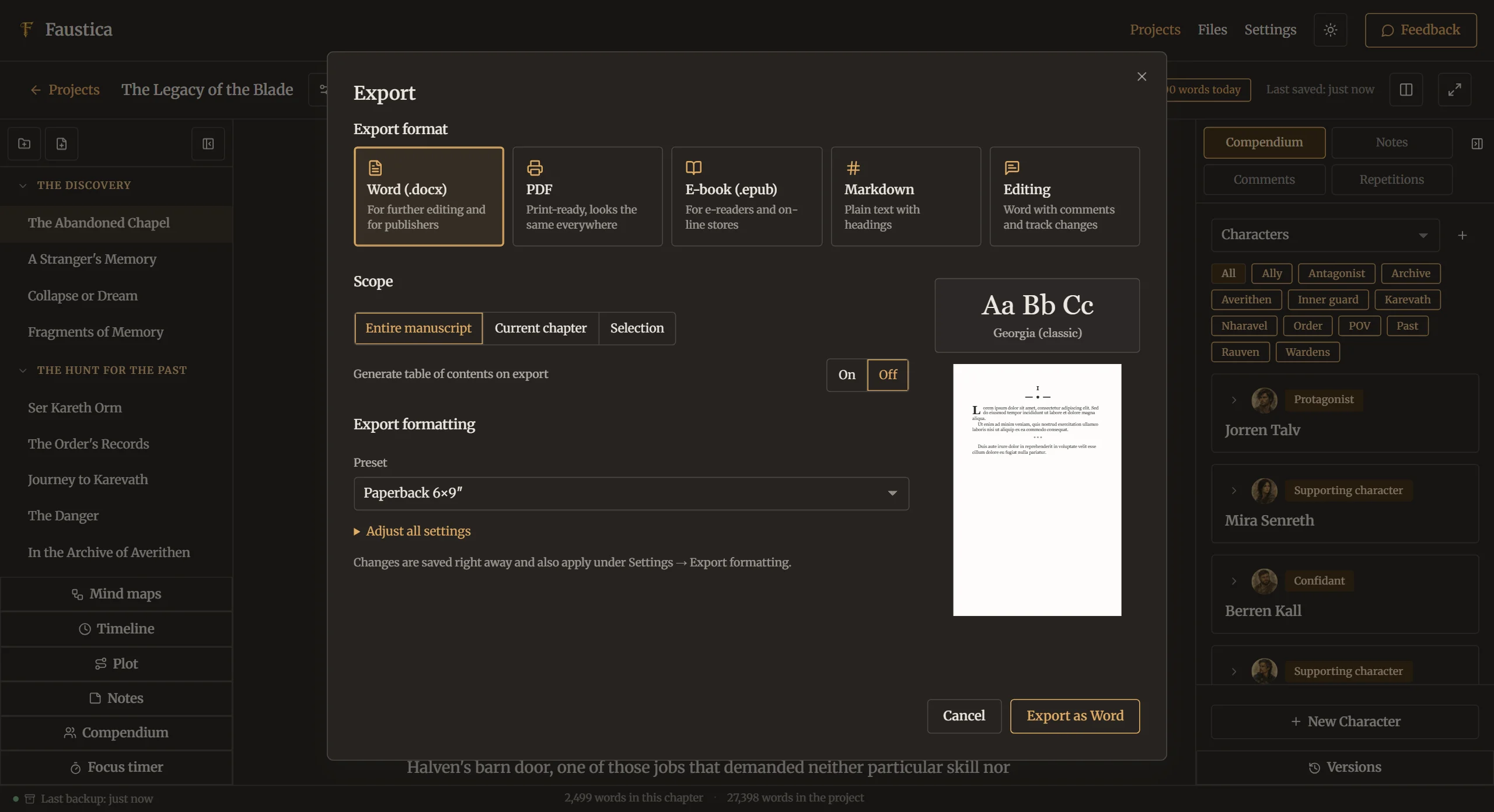
For proofreading in Faustica, the Export and working with notes are the most useful: you export the whole manuscript as a PDF or EPUB and read it in an unfamiliar format, or you pass it on as a Word file, for example to a proofreader or to a word processor with its own checks.
Whatever you notice while reading, you record in the editor with comments right at the passage and work through afterward. The editor uses your system’s spell checker in your project’s language; names from the compendium and words in your own dictionary are not flagged. The repetition analysis in the editor also shows frequently used words that you can check in the same pass.
Frequently asked questions
How many mistakes can a manuscript have when I query agents?
There is no fixed limit, and a single typo will hardly decide a submission. Many mistakes, however, look careless and distract from the content. A thorough proofread of your own before you send it out is always worth it.
Do grammar rules apply in dialogue?
Punctuation rules apply in dialogue too. Grammar is different: characters may speak informally, in dialect or ungrammatically, and that is a stylistic choice, not a mistake. Record such deviations in your style sheet so that they are not accidentally “corrected” during proofreading.
Should I use the serial comma?
The serial comma (also called the Oxford comma) is the comma before “and” in a list of three or more: “Rain, a burning fortress, and a king.” Chicago style recommends it; other style guides leave it out. What matters is that you handle it the same way throughout the manuscript.
Which style guide and dictionary should I follow?
For fiction in the US, The Chicago Manual of Style is a common reference, and it recommends Merriam-Webster as its dictionary. If you write in British English, follow a British dictionary and stick to British spellings throughout. For your manuscript, what matters most is that you decide once wherever variants exist and then stay consistent.