
Interior monologue renders a character’s thoughts the way the character thinks them: in the first person, usually in the present tense, without quotation marks and, in the strict sense, without a tag like “she thought.” It is the most direct of several ways to tell what goes on in a character’s head. Alongside it there is narrated thought, in which the narrator sums up what a character thinks, and free indirect style, which stays in the third person and the narrative past tense but takes on the character’s words and tone. Using interior monologue well means choosing the form that matches the closeness you want and using it sparingly, in the places where the character’s inner life carries the scene.
Below you will find the three forms in one example, conventions for tense and formatting, examples from a novel, common mistakes and practical tips.
Three ways to tell thoughts
Narrative theory distinguishes ways of rendering thought much as it distinguishes ways of rendering speech. The literary scholar Dorrit Cohn described three basic techniques in her study Transparent Minds (1978); the breakdown below is simplified for everyday writing, and the boundaries are fluid. The example sentences are invented.
- Narrated thought. The narrator summarizes what is going on inside the character: “She wondered whether he had read the letter yet.” The distance is greatest, but you can compress a long stretch of brooding into a single sentence.
- Free indirect style. The text stays in the third person and the narrative tense, usually the past, but the sentence structure, questions and exclamations belong to the character: “Had he read the letter yet? It was no longer on the table.” There is no verb of thinking. The narrator’s voice and the character’s voice merge. It is also called free indirect discourse.
- Interior monologue. The character thinks in their own person and their own present: “Has he read the letter yet? It’s not on the table anymore.” The narrator steps back entirely.
Strictly speaking, when a tag like “he thought” is attached, narrative theory calls this quoted thought or direct thought; interior monologue in the narrow sense is defined precisely by the absence of a tag. Craft books often lump both together, though. For writing, the effect is what counts: the less narrator, the more closeness, and the more the context has to keep readers oriented.
A special case is stream of consciousness: a long interior monologue that renders associations, sentence fragments and leaps without tidying them up. The best-known example is the final chapter of James Joyce’s Ulysses, Molly Bloom’s long, almost unpunctuated monologue. In most novels, however, interior monologue appears in short bursts, in the middle of scenes told in close third person or first person.
Which form fits when
| Form | Person and tense | Closeness to the character | Good for |
|---|---|---|---|
| Narrated thought | third person, narrative tense | low | summarizing, transitions, long periods of time |
| Free indirect style | third person, narrative tense | high | most thoughts in close third person scenes |
| Interior monologue | first person, usually present | very high | short, intense moments: shock, realization, decision |
In close third person, free indirect style is often the most important tool, because it shows the character’s thoughts without interrupting the flow of the narration. The guide to point of view explains how point of view and access to thoughts are connected: a character’s thoughts belong in the text only if the chosen point of view has access to that character’s head.
Writing thoughts in five steps
- Decide whose thoughts carry the scene. Only the point-of-view character thinks on the page. If you want to show another character’s thoughts, you need a change of point of view or an omniscient narrator.
- Choose your default. For most scenes, free indirect style works well as the base tone. Use narrated thought and interior monologue where you need distance or particular closeness.
- Give the thoughts the character’s language. Thoughts are not a report. Characters think in their own words, in half sentences and with their favorite curses, not in neatly organized paragraphs.
- Mark the transition. A switch into the present tense and the first person, a “she thought” the first time, or italics show that the character is now thinking directly. What matters is that readers never have to hunt for the line between narration and thought.
- Come back in time. Interior monologue stops the outer action. After a few sentences something should happen again, or the scene stands still.
Tense and formatting
There are fewer fixed rules for thoughts than for spoken dialogue. The following conventions are common in English-language fiction:
- Direct thought is in the character’s own tense, usually the present, even if the novel is told in the past tense. A tag, on the other hand, follows the narrative tense: I’m late, she thought. The thought is in the present, “thought” in the past.
- Free indirect style stays in the narrative tense and shifts its time words accordingly: “Tomorrow she would tell him” instead of “Tomorrow I will tell him.”
- Quotation marks are rarely used for thoughts today, because readers easily mistake them for speech. Many publishers set direct thoughts in italics; others leave them unmarked, especially when a tag makes the thought clear. Both are acceptable. Pick one approach and use it throughout the manuscript.
- With a tag, punctuation follows the rules for dialogue, just without the quotation marks: He knows, she thought. You will find those rules in the guide on writing dialogue.
Examples: Rika’s thoughts before the call
In this invented suspense novel, ferrywoman Rika is threatened by her childhood friend Hauke after discovering his drug cargo. She intends to fake an engine failure so he moves the load himself and send an anonymous tip. These teaching passages show her thoughts before the call reporting the supposed fault.
Quoted thought
He mustn’t hear my voice, Rika thought. Not like this.
First person and present tense provide her immediate concern. “Thought” attributes it.
Thought report
Rika feared that Hauke would hear the deception in her voice.
The narrator summarizes her concern. This concise form can carry a transition.
Free indirect thought
She should call him. Now. And what if he wanted to inspect the engine himself?
Third person and past tense remain in the narrative frame; question and rhythm belong to Rika’s thinking. The thought tests a specific risk in her plan.
The three forms serve different purposes. A long internal passage delays the call if it only repeats the same fear. A new objection can prepare a decision.
Before and after
A possible revision of the same teaching scene:
Before:
Rika thought about having to call Hauke. She was afraid because he had become aggressive. She considered what would happen if he did not believe her.
After:
Hauke’s number filled the screen. One press, and he would answer. She knew what to say. But what if he came over?
The first version names mental work. The second gives it an object, rhythm and a specific question. This does not replace every summary; here the thought prepares the next action.
Common mistakes
- Thoughts that explain. The character thinks things they have long known, just so readers learn them: “As I know all too well, Hauke advanced my repair costs.” It is the same mistake as in dialogue, only inside a head.
- Thoughts that repeat what has been shown. The character trembles, can hardly breathe, and then thinks: I’m afraid. If the action already shows the feeling, the thought is redundant.
- Monologues that run too long. Pages of brooding slow the scene down. Break them up, interrupt them with action or summarize parts in narrated thought.
- Blurry boundaries. Readers cannot tell whether a sentence is narration, thought or something said under the breath. Especially if you leave thoughts unmarked, the context has to make it clear.
- Thoughts of the wrong character. In a scene told in close third person, another character suddenly thinks. That is a point-of-view slip, often called head-hopping.
- Italics everywhere. If whole paragraphs are italicized, the emphasis wears off and the page becomes hard to read. Keep italics for short direct thoughts.
Practical tips
- In a finished scene, underline every thought of the character. If almost every sentence is underlined, outer action is missing; if none is, the character may stay too distant.
- Let thought and speech drift apart. What a character thinks while saying something else creates tension and is closely related to subtext in dialogue.
- Give each point-of-view character their own thinking voice: one thinks in short commands, another in questions, a third in images from their trade.
- Try deleting a questionable thought. If the scene is still clear, it was probably one too many (see also show, don’t tell).
Using Faustica
In the Editor in Faustica you write thoughts like any other text, and you can set direct thoughts in italics. When you revise, the repetition analysis and the offline synonyms help when phrases like “he thought” or “she wondered” start piling up.
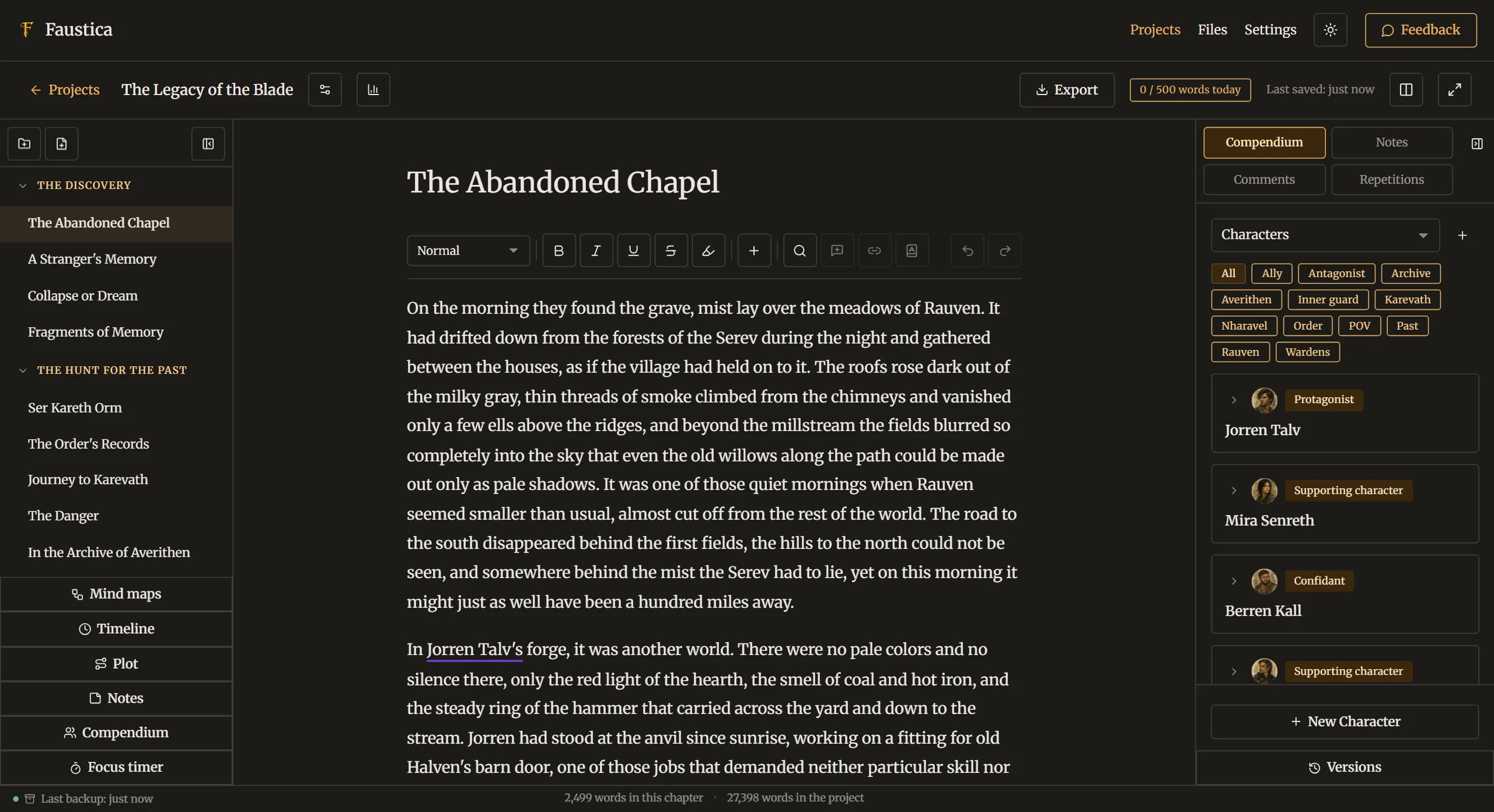
In the Compendium you can add your own sections to each point-of-view character and record their thinking voice there, such as typical words, curses or the images they think in. With comments you mark passages during revision where a thought runs too long or the line between narration and thought stays unclear, and return to them later.
Frequently asked questions
What is the difference between interior monologue and free indirect style?
Interior monologue is in the first person and usually the present tense, as if the character were talking to themselves. Free indirect style stays in the third person and the narrative tense but takes on the character’s word choice and tone. That makes it less conspicuous and easier to weave into the flow of the narration.
Do thoughts have to be in italics?
No, there is no fixed rule. Italics are a common convention for direct thoughts, especially without a tag like “she thought.” Free indirect style is not italicized, because it is part of the narration. What matters is that you choose one approach and use it consistently.
Can a first-person narrator have an interior monologue?
Yes. In first person, narration and thought blur anyway, because the narrating character is the one speaking. If they narrate in the past tense, a thought in the present still stands out and feels more immediate: “I looked at the clock. Late. Far too late.”
Can I show the thoughts of several characters in one scene?
With an omniscient narrator that is possible; in a scene told in close third person it usually leads to head-hopping. If you need a second character’s thoughts, a change of point of view at a scene break is usually the clearer solution.