
In English-language publishing, the length of a manuscript is stated as a word count, not a page count. Agents and publishers ask for it because pages say little: depending on font, margins and spacing, the same text can fill a hundred pages or three hundred. The word count is a shared measure. You take it from your writing software or word processor, round it, usually to the nearest thousand for a novel, and state it in your query letter, for example “complete at about 92,000 words.”
On this page you’ll learn why the word count matters, how it is counted, how page counts relate to it and what to watch out for. An example shows the figures for a real sample text, including how a few individual words are counted.
Why agents ask for the word count
The word count tells an agent or editor a lot before they read a single line:
- Whether the book fits the market. Readers of a genre have expectations about length, and publishers plan with them. A manuscript far longer or shorter than comparable books is harder to sell, especially from a debut author.
- Whether the book is finished. A word count in the query signals a complete manuscript. For debut fiction, agents generally expect the manuscript to be finished before you query.
- What the book will cost. Length affects printing costs, the price of the book and how long editing and translation take.
Word counts also come up outside the query. Many freelance editors and proofreaders quote their fees per word or per thousand words, and magazines and contests usually set word limits. If you are asked for a word count, give a word count, not a page count converted from it.
How words are counted
Today, you simply take the count your software shows. Most programs essentially count anything between two spaces as a word. In practice, this means:
- Contractions such as “don’t” are one word.
- Hyphenated compounds such as “well-kept” are one word.
- Numbers written as digits count as one word each.
- Dashes set without spaces can join two words into one in some programs.
Different programs may arrive at slightly different figures for the same text, and it makes a small difference whether you include chapter titles or front matter. That is one reason a rounded figure is enough. Nobody expects an exact count in a query; they expect an honest one.
An older method, still mentioned in some guides, estimated the word count from the number of pages in typewritten manuscript format, assuming a fixed number of words per page. It was useful when there was no software to count words. If you have an actual count, use it.
Rounding and stating the word count
For a novel, it is common to round to the nearest thousand: 91,640 words becomes “about 92,000 words.” Short stories are often given more precisely. In the query letter, the word count often appears in the same sentence as title and genre, for example (with an invented title): “THE LAST FERRY is a standalone crime novel, complete at 85,000 words.” In standard manuscript format, the rounded word count also goes at the top right of the first page; how that page looks is explained in How to format a manuscript.
Some definitions of length are explicit. The Science Fiction and Fantasy Writers Association, for example, defines the categories of its Nebula Awards by word count: under its Nebula rules, a novel has 40,000 words or more, a novella at least 17,500 but fewer than 40,000, a novelette at least 7,500 but fewer than 17,500, and a short story fewer than 7,500. These are award categories, not market expectations. What length agents expect for a novel in your genre is usually far above the lower limit and depends on the genre; many agents say on their websites what they are looking for.
Pages and word count
Pages are still useful in two places, but neither replaces the word count:
- Manuscript pages depend on your formatting. In standard manuscript format, with a 12-point font, double spacing and one-inch margins, a page holds far fewer words than a printed book page, and pages with lots of dialogue hold fewer still. A sample request such as “the first 50 pages” refers to pages in that format.
- Printed pages depend on trim size, font and layout. A manuscript of 300 pages doesn’t become a 300-page book. If you self-publish, you only know the final page count once the interior layout is done; you need it for the cover spine.
An example: an assumed word count for Rika’s novel
For this calculation, suppose we have an invented suspense novel about ferrywoman Rika, who is drawn into drug transport by a childhood friend and threatened when she tries to quit. Assume it contains 80,000 words. This is an illustrative length, not a measured count of an existing manuscript.
At 250 words per page, the arithmetic gives 80,000 ÷ 250 = 320 pages. At 300 words per page, it gives about 267 pages. Neither figure establishes the finished print length.
Dialogue between Rika and Hauke, short scene endings, chapter openings, type size and page dimensions affect the actual layout. A manuscript page count and a typeset book page count can therefore differ while the word count remains unchanged.
There is no actual total for this teaching story: it consists of sample scenes and a plot outline. Use your own manuscript’s measured word count for submissions and the requested counting convention when discussing page-based work.
Common mistakes
- Stating pages instead of words. “320 pages” says nothing without the formatting. Agents ask for words.
- Overly precise figures. “91,643 words” in a query letter isn’t wrong, but a rounded figure is the convention for novels.
- Rounding generously. A manuscript of 128,000 words isn’t “about 100,000 words.” An agent who requests the full manuscript will see the real length.
- Ignoring the expected length. If your manuscript is much longer or shorter than comparable books, check whether revision could bring it closer before you query.
- Counting an unfinished manuscript. A word count in a query implies a finished book. Don’t state a target figure for a manuscript you haven’t completed.
Practical tips
- Look up the word count only once the manuscript is revised; revision can change it considerably.
- When asking for quotes from editors or proofreaders, check whether the price refers to words, pages or hours. The page Editing vs. proofreading explains the difference between the services.
- To find out what length is usual in your genre, read the guidelines of agents and publishers who handle such books and compare with recently published books similar to yours.
- Keep an eye on the length of your chapters, too. Very uneven chapters are not a mistake in themselves, but it is worth knowing why they differ.
Using Faustica
Project Statistics count the words of your manuscript and show your progress toward a word goal, the number of chapters and an estimated reading time. The text statistics count characters, sentences and paragraphs and compare the lengths of your chapters, so you can see at a glance where a chapter is unusually long or short. Faustica counts words separated by spaces, so a hyphenated compound counts as one word, as described above.
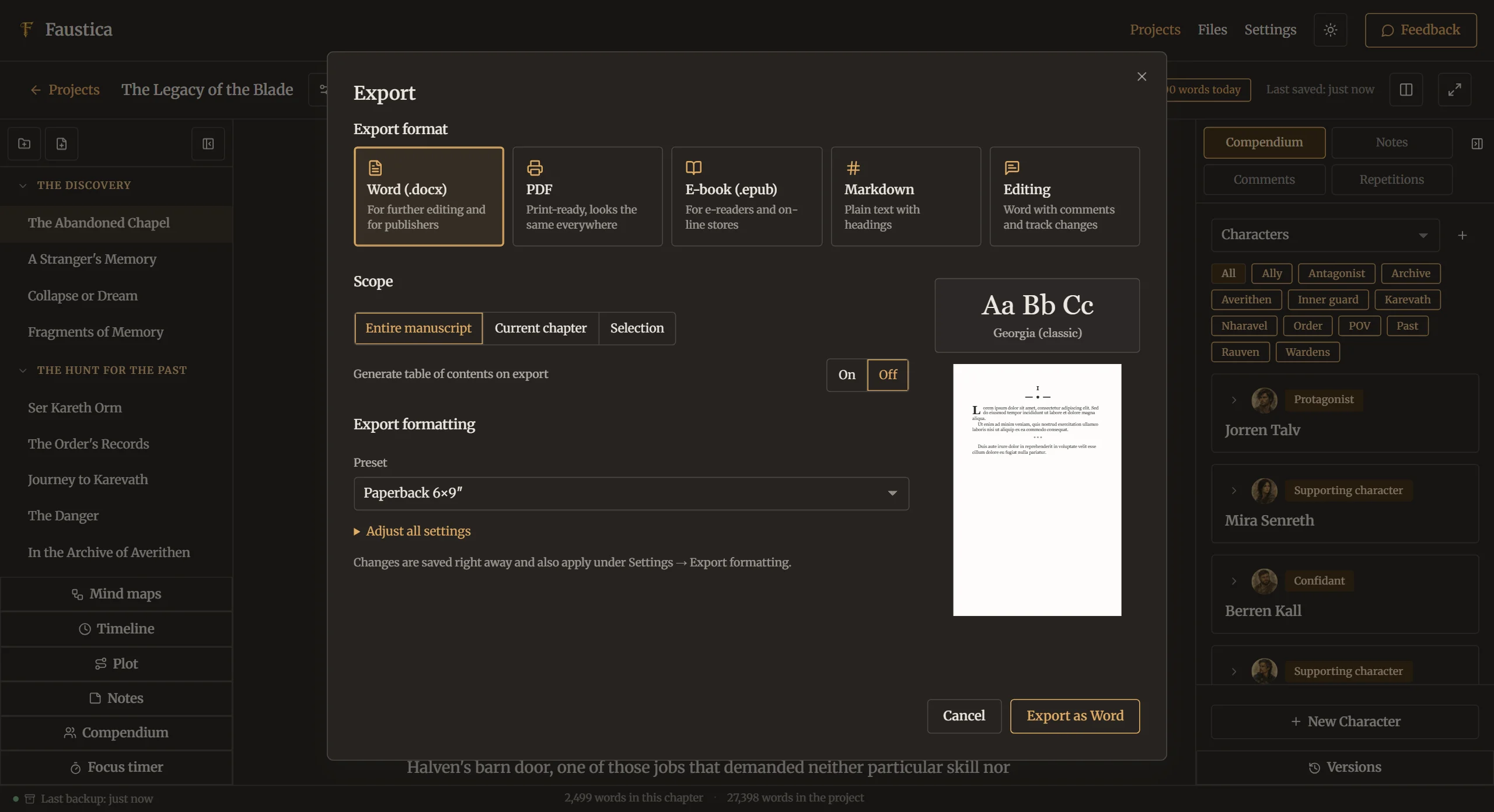
For the sample pages, Export has a standard manuscript template. You write in whatever view you like and output the whole manuscript or individual chapters as a Word file or PDF in manuscript format. Page format, margins, font and line spacing can be adjusted if an agent has their own requirements; the preview shows font and page in advance.
Frequently asked questions
How many words should a novel have?
There is no fixed number. The Nebula Awards define a novel as 40,000 words or more, but what agents and publishers expect depends heavily on genre and readership. Their submission guidelines and comparable recent books are the best guide.
Do chapter titles count toward the word count?
Strictly speaking, everything in the manuscript counts, but chapter titles barely change the figure of a novel. Since you round the number anyway, it doesn’t matter whether you include them.
Should I state the word count of the whole manuscript or the sample?
In a query letter, always the whole manuscript. The sample pages are whatever the agent asks for, for example the first three chapters or a set number of pages.
How many words are on a manuscript page?
That depends on the font, the formatting and the text itself; pages with lots of dialogue hold fewer words than dense description. For a reliable figure, count the words rather than estimating them from pages.