
A novel synopsis is a short, factual summary of your whole story, written for literary agents and editors. It tells the plot from beginning to end in the present tense, including every major turning point and the ending, and it shows who the main characters are and how they change. It is usually only a page or two long. After reading it, an agent should know what happens, whether the story holds together and whether the book is one they could sell.
On this page you’ll learn what belongs in a synopsis, how it differs from the query letter, how to build one step by step and what a finished synopsis can look like. One thing first: agents and publishers have their own submission guidelines. Whatever they ask for on their website takes priority over any general advice, including this page.
What a synopsis is, and what it isn’t
When you submit a novel to a literary agent in the US or the UK, you usually send a small package of documents. Each one has its own job:
- The query letter (in the UK often simply called a cover letter) is a short pitch: what your book is, a few paragraphs about the story that make an agent want to read it, a line or two about you, and why you are approaching this particular agent. It doesn’t give away the ending.
- The sample pages show how you write. Almost always these are the opening pages or chapters, not a selection of your best scenes from the middle. How much is requested varies widely.
- The synopsis shows whether the story works as a whole: structure, conflict, character arcs and resolution.
Not every agent asks for all three. Many US agents ask only for the query letter and the first pages at first and request a synopsis later or not at all; many UK agents ask for a synopsis with the first submission. Read each agent’s guidelines carefully.
Also keep the synopsis apart from the back-cover copy (the blurb). The blurb is written for readers in a bookshop; it wants to make them curious and deliberately hides the ending. A synopsis that sounds like a blurb (“Will he uncover the truth before it’s too late?”) misses its purpose. The agent wants to know whether he uncovers the truth, and how.
What goes into a synopsis
There is no binding standard. The following elements are widely recommended and cover what agents and editors typically want to see:
- A heading line: title, genre and, if the guidelines ask for it, the word count. Many writers put this information in the query letter instead; the synopsis itself can start straight with the story.
- A pitch line: one or two sentences that capture the core of the story: who wants what, what stands in the way, what is at stake?
- The plot: the whole story from beginning to end, in the third person and the present tense, with all the major turns and the resolution. This is the heart of the synopsis and by far the longest part.
- The main characters, woven in: in a short synopsis, characters are introduced where they first matter, with their goal and conflict in a phrase. A common convention is to put each character’s name in capitals the first time it appears, so the reader can find it again quickly. Some agents prefer a separate short character list; follow their guidelines.
- The ending and what it means: how the central conflict is resolved and how the protagonist has changed.
On length: go by the submission guidelines. DHH Literary Agency in London, for example, writes that it prefers a single-page synopsis and asks for the first three chapters or about 10,000 words of the manuscript. Other agents name different lengths or none at all. A commonly stated range is one to two pages; without a stated requirement, a single, readable page is a safe place to start, as long as the main plot stays fully understandable.
How to write a synopsis in seven steps
- Read the guidelines. Check on the agent’s or publisher’s website what they want: length, format, single or double spacing, attachment or pasted into the email.
- Write the pitch line first. One or two sentences force you to decide what your novel is really about. If that doesn’t work yet, look at the premise of your plot.
- List the turning points. Note the starting situation, the inciting incident, the major turning points, the climax and the resolution. That is the skeleton of your synopsis.
- Tell the story along that skeleton. Connect the turning points through cause and effect: because this happens, she decides to do that. Include subplots only where the main line depends on them.
- Reveal the ending. Without the resolution, nobody can judge whether the story holds. That goes for mysteries and thrillers, too: the synopsis says who did it.
- Show the characters through their choices. In a page or two, you don’t have room for backstory. A phrase for each main character is enough: who they are, what they want, what stops them and how they change by the end.
- Cut and test. Strike names that appear only once, minor settings and description. Then give the synopsis to someone who doesn’t know your book. If they can retell the plot afterward, your synopsis is clear.
A template with all the parts of a synopsis, a query letter checklist and these seven steps is also available as a printable PDF · Download Word file.
An example: a synopsis for “The Last Ferry”
This sample introduces an invented suspense novel about ferrywoman Rika: her childhood friend Hauke uses her for drug shipments without her knowledge and threatens her after discovery. The synopsis below explains her counterplan and reveals the outcome. Length and draft status are placeholders to replace with verified details in your own submission.
- Working title: The Last Ferry
- Genre: Suspense novel
- Length: [actual word count or requested measure]
- Draft status: [actual status]
- Series status: planned as a standalone
Pitch: A ferrywoman discovers that her childhood friend has been using her for drug shipments. When she tries to quit, he becomes aggressive and threatens her, forcing her to find a way to expose him without warning him of her plan.
Synopsis: After the daily ferry service is withdrawn, Rika maintains additional island supply runs with her own small boat. The service provides her income. An engine failure stops the crossings, and she cannot afford repairs.
Her childhood friend Hauke, a boat mechanic, offers an advance. In return, she must carry his supposedly harmless cargo on the return crossings. Trusting him, she accepts. The crossings resume, but her business now depends on his help.
When Rika discovers drugs in the cargo, she refuses further shipments. Hauke responds aggressively and threatens her. Their familiar relationship no longer protects her. Afraid he may hurt her or destroy her service, she seeks a way out that does not require another open confrontation.
She fakes a further engine failure so Hauke transports the cargo himself. She also sends an anonymous tip. That information leads to him being checked and arrested with the smuggled goods. Rika’s deception and anonymous information lead to exposure here.
Characters: Rika is practically experienced and wants to earn her living from the crossings. Financial trouble and trust in her childhood friend make her vulnerable. After his threats, she develops a counterstrategy despite fear. Hauke gains access to her trips through the repair. Following discovery, he uses aggression and blackmail to retain control.
The sample reveals the ending and explains the turns. A complete synopsis for a developed novel would also need specific consequences for Rika’s safety, debt and service after the arrest. Those consequences remain to be developed in the teaching story and must not be left open in an actual submission synopsis.
Common synopsis mistakes
- Hiding the ending. The most common mistake of all. An open ending in a synopsis suggests that you don’t yet know how your book ends.
- Blurb instead of summary. Sales language, superlatives and questions to the reader don’t belong in it.
- Too many names. Every name is something to remember. Minor characters can often be replaced by their function (“the detective from the mainland”).
- Retelling scene by scene. A synopsis isn’t a shortened manuscript. Whatever isn’t part of the main line goes.
- Ignoring the guidelines. Five pages where one is asked for looks careless, however good the novel is.
Practical tips
- Write the synopsis before you revise your manuscript for the last time. Gaps in the plot often show up more clearly when you summarize than when you read.
- Keep a master version, plus shorter and longer variants, and adapt them to each agent’s guidelines. Keep track of which version you sent where.
- Format the synopsis plainly: a readable font, page numbers and your name and title in the header. The agent’s guidelines decide whether it should be single- or double-spaced; the manuscript format for your sample pages isn’t automatically the right layout for the synopsis.
- How the synopsis fits into the whole submission, with query letter and sample pages, is explained in Finding a publisher or agent.
Using Faustica
In the Plot Planner, your storylines and scenes sit with their summary, goal, conflict and outcome; that is the skeleton of your synopsis. In the Compendium, your characters are recorded with their goals and development, which you can boil down to the short phrases a synopsis needs.
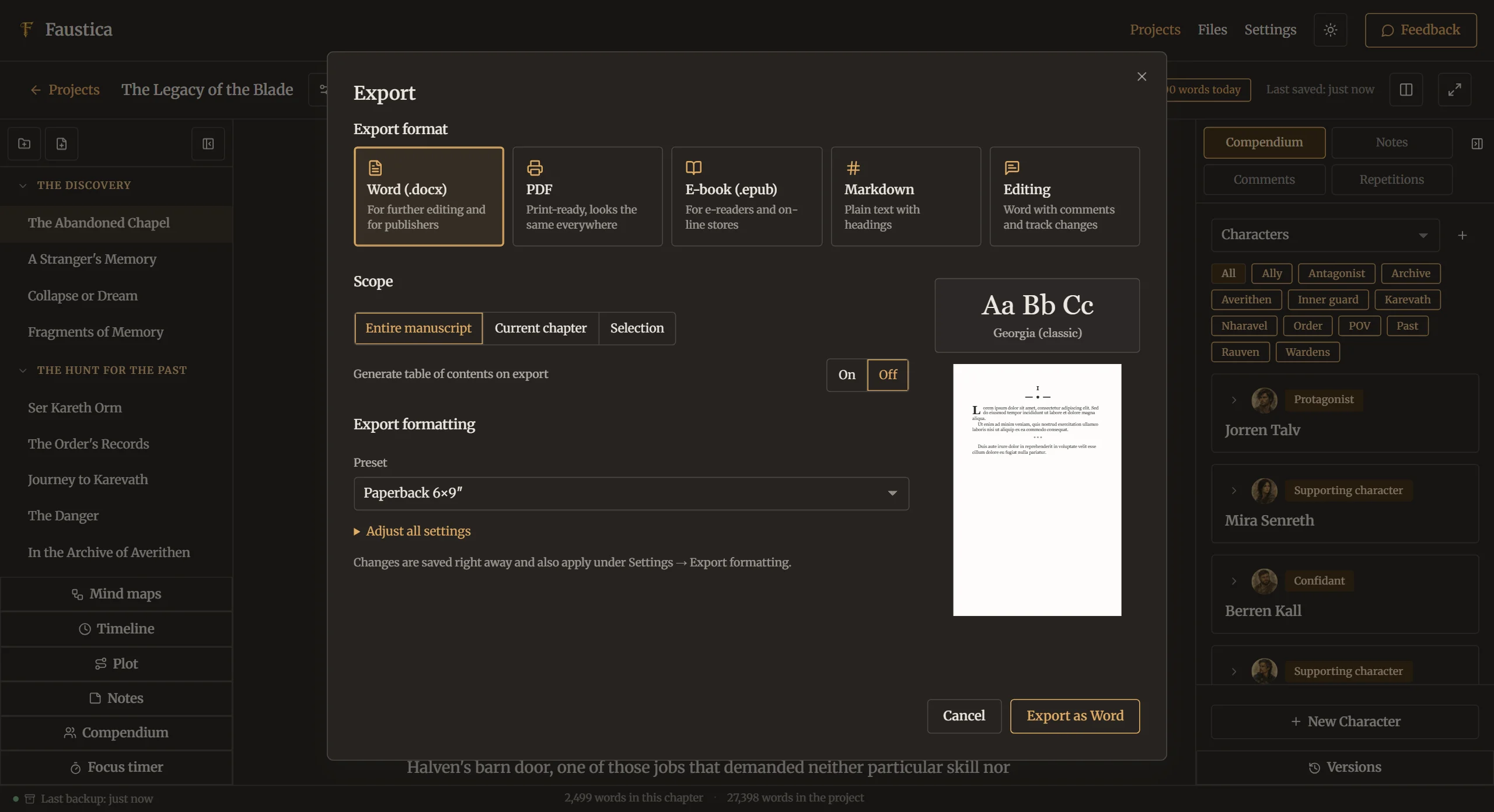
You can write the synopsis itself as a separate chapter or note. For the manuscript and the sample pages, Export offers Word, PDF, e-book and Markdown, for the whole manuscript or individual chapters. One of the templates is a standard manuscript layout; you can also set page format, margins, font and line spacing yourself, as well as title page and page numbers.
Frequently asked questions
How long should a novel synopsis be?
There is no fixed rule. A commonly stated range is one to two pages, and some agencies, such as DHH Literary Agency, say they prefer a single page. What counts is always the current guidelines of the agent or publisher you are submitting to.
Do I really have to reveal the ending?
Yes. A synopsis is a working document for professionals, not advertising. Only with the ending can an agent judge whether the conflict and the character arcs pay off.
What’s the difference between a synopsis and a query letter?
The query letter is a short pitch that makes an agent want to read your pages; it introduces the story but doesn’t give away the ending. The synopsis summarizes the whole plot, ending included. Many agents ask for the query letter first and the synopsis only with a submission or later.
Should I write the synopsis in first person if my novel is in first person?
Usually not. A synopsis is conventionally written in the third person and the present tense, whatever point of view the novel uses.