
To find a literary agent or publisher for your novel, look specifically for agents who represent books like yours and presses that publish them, read their submission guidelines closely and send each one a careful submission: a query letter, sample pages and, where asked, a synopsis. Fit is what matters most. A good manuscript sent to the wrong agent gets rejected just as surely as an unfinished one sent to the right agent. Expect long waits and rejections; both are normal and no verdict on your talent.
On this page you’ll learn whether to approach agents or publishers first, how to research suitable names, how to prepare your submission step by step and what happens after you hit send. An example shows a short query letter. What goes into the synopsis is covered on its own page, How to write a synopsis.
Agent or straight to a publisher?
In the English-language market there are two ways to a traditional publishing contract: through a literary agent, who then submits your manuscript to publishers, or directly to a publisher. Which one makes sense depends mainly on the publishers you are aiming for:
- Large trade publishers and their imprints receive a great many manuscripts. Many of them accept submissions only through agents. Their websites usually say so.
- Small and independent presses often accept unagented submissions, sometimes only during set reading periods or for particular lists.
- Literary agents assess submissions, often work with you on the text and later negotiate the contract. Reputable agents are paid by commission on what they earn for you and don’t charge reading fees up front.
A common path is to query agents first and, if that doesn’t work out, submit to presses that accept unagented work. Once your manuscript has already been offered to many publishers, it becomes harder for an agent to sell it. An overview of all the routes, including self-publishing, is on the page How to publish a book.
Researching agents and publishers
For German-language manuscripts, the directory of German publishers and literary agencies provides links to official websites and submission guidelines.
The best research starts with books that resemble yours:
- On the shelf: Pick up recent novels in your genre and for a similar readership. The copyright page names the publisher and imprint, and the acknowledgments often thank the agent and the editor.
- On agency websites: Agencies list which genres each agent represents and which they don’t, often also their clients and what they are currently looking for.
- On publisher websites: Look at the current list, not just single titles. Does the press have an imprint for your genre? Does it publish debuts? Does it accept unagented submissions?
- In databases and wish lists: Sites such as QueryTracker or the Manuscript Wish List collect agents’ interests and submission details. Always check the information against the agent’s own website, which is the one that counts.
For each name, write down why it fits. If you can’t think of a concrete reason, it probably doesn’t.
How to prepare your submission in seven steps
- Finish the manuscript. For a debut novel, agents generally expect a complete manuscript. Submit only when the novel is finished and revised. If an agent requests the full manuscript, it should be ready to send.
- Build a list. Collect ten to twenty suitable agents or presses with the agent’s name, how they want to be contacted, what they ask for and anything special.
- Read each agent’s guidelines. What materials, how many pages, pasted into the email or attached, by email or through an online form? Some ask for exclusive submissions, most don’t mind simultaneous ones.
- Write the query letter. Short and to the point, a single page: title, genre, word count, a few paragraphs about the story, why you are approaching this agent, a few sentences about you. Address the agent by name.
- Write the synopsis if it is requested, following the agent’s guidelines. It tells the plot including the ending.
- Prepare the sample pages. Almost always the opening pages or chapters, not the strongest ones from the middle. Formatted as requested; see How to format a manuscript.
- Query in batches. Start with part of your list. If you get only rejections and no requests for more pages, you still have a chance to improve your query letter or opening before you approach the next batch.
An example: a query letter for a crime novel
The sample queries an invented suspense novel with the working title “The Last Ferry”: ferrywoman Rika is unknowingly used for drug shipments by her childhood friend Hauke. When she tries to quit, he threatens her; she tries to expose him through deception. Replace placeholders with verified details about your own manuscript when writing a query.
Dear [Name],
Your submission guidelines indicate that you represent [relevant category]. I am therefore querying “The Last Ferry,” a standalone suspense novel, [actual status and word count].
A ferrywoman discovers that her childhood friend has been using her for drug shipments. When she tries to quit, he threatens her. Afraid of him, she devises a trap intended to make him transport the cargo himself.
[Brief relevant author details.]
I have included [the materials actually requested].
Kind regards,> [Name and contact]
The query establishes conflict without recounting every event. The anonymous tip and arrest belong in the full synopsis, which reveals the ending. Genre, length and draft status must match the actual manuscript offered.
After you hit send: waiting, rejections, offers
Waiting: Replies often take weeks or months. Many agents state in their guidelines that they respond only if interested and that no answer after a certain time means no. Only follow up once the stated period has passed, and then briefly and politely.
Rejections: Most rejections are form letters without reasons. Don’t read too much into them; often the book simply doesn’t fit the agent’s list or they have something similar already. A personal note or a request for the full manuscript, on the other hand, is a good sign, even if a rejection follows.
Offers: If an agent offers representation or a publisher wants your book, read the agreement carefully. Make sure you understand which rights you grant, for how long, how commission, advance and royalties work and how the agreement ends. Let other agents who still have your manuscript know that you have an offer. Reputable agents and publishers don’t ask you for money; how to spot dubious offers is explained on How to publish a book.
Common mistakes
- Mass emails. The same email to many agents in CC looks careless and usually breaks the guidelines.
- The wrong names. A fantasy novel sent to an agent who doesn’t represent fantasy has no chance, however good it is.
- An unfinished manuscript. Querying a debut novel that is only half written usually leads nowhere.
- Too much self-praise. “The next bestseller” and comparisons with the classics convince nobody. Let the writing speak.
- Following up after a week. Impatience looks unprofessional. Stick to the stated response times.
Practical tips
- Keep a table: agent, date, materials sent, response, next steps. That way you never send anything twice.
- Save a separate version of the query letter and synopsis for each submission, adapted to that agent’s guidelines.
- Keep writing while you wait, ideally something new. It makes the waiting easier and gives you something to mention if an agent asks what’s next.
- If a whole round brings only form rejections, look first at your opening pages and query letter. They are the parts most certain to be read.
Using Faustica
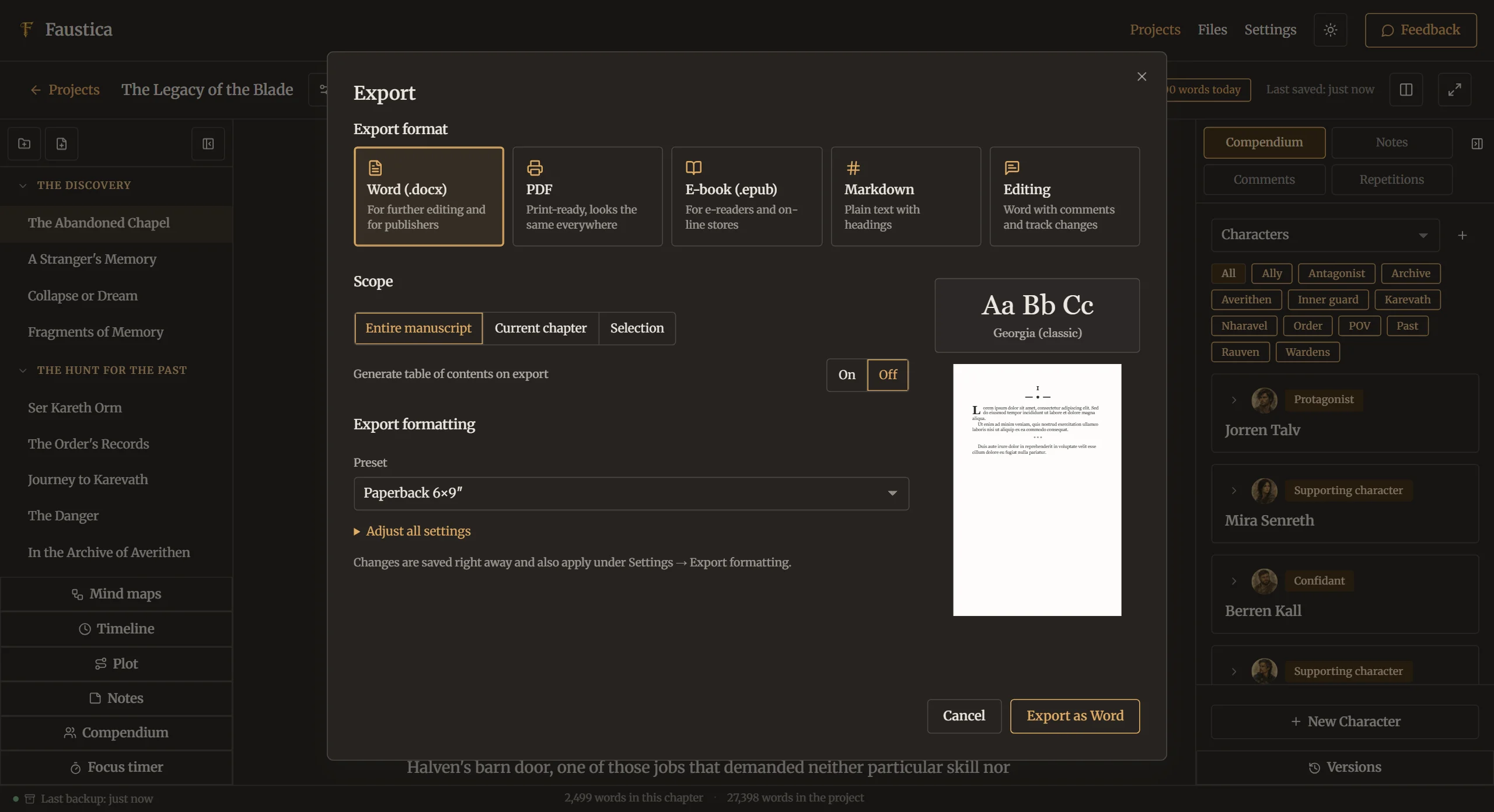
You create the sample pages with Export: choose individual chapters or a selection and output them as a Word file or PDF, if you like with the standard manuscript template. Font, line spacing, margins and page numbers can be adjusted to an agent’s requirements. If an agent requests the full manuscript, you export the whole thing.
For your research, you can set up a separate board in Notes: one note per agent or press, with a link to their guidelines, keywords such as “queried” or “rejected,” and the versions of your query letter attached as PDFs.
Frequently asked questions
Can I query several agents at the same time?
In most cases, yes. Some guidelines ask for exclusive submissions or want to be told if your manuscript is with other agents. If one agent shows interest or makes an offer, let the others know.
How long do literary agents take to respond?
It varies widely, from a few weeks to several months. Many agents state an approximate response time on their website, and many say that no reply after that time means no. If no time is stated, wait several months before following up politely.
Should my query letter be pasted into the email or attached?
Exactly as the guidelines say. Many agents ask for everything pasted into the body of the email because they don’t open attachments from unknown senders; others use an online submission form. Postal submissions have become rare; send them only if they are explicitly requested.
What do I do if every agent says no?
Check whether your choice of agents was right and whether your opening, query letter and synopsis are convincing; feedback from beta readers can help. Then you can start a new round, submit to small presses that accept unagented work, offer a different project or go into self-publishing.