
There are three basic ways to publish a book: you query literary agents, who then submit your manuscript to publishers; you submit directly to publishers that accept unagented submissions, usually small and independent presses; or you publish it yourself. In traditional publishing, the publisher pays for editing, production and distribution, carries the financial risk and pays you an advance and royalties; in return, it has a say in title, cover, editing and publication date. In self-publishing, every decision is yours, but so are all the costs and all the work. In between are mixed models, some legitimate, some not.
On this page you’ll find how each route works, how they differ in money, rights and effort, and six questions to help you decide. A separate section explains how to recognize offers that ask you to pay for something a real publisher would pay for itself.
What “publishing” actually involves
A book is published when it is publicly available, in print, as an e-book or both. But for readers to find it, more is needed than a file or a print run:
- Editing and proofreading: work on the content and language of the text, then the correction of errors. The difference is explained on the page Editing vs. proofreading.
- Production: interior layout for the print edition, a clean e-book, a cover, back-cover copy.
- Metadata and identifiers: title, author name, genre, description and usually an ISBN, so the book can be found and ordered by retailers and libraries.
- Distribution: getting the book into online stores, bookshops and libraries.
- Marketing: making sure people hear about the book.
With a traditional publisher, the publisher takes care of most of this. In self-publishing, you do it yourself or hire freelancers. Choosing a route is therefore also a question of who does what, and who pays for it.
Route 1: Literary agent and traditional publisher
In the US and the UK, the usual way into a large trade publisher goes through a literary agent. Many of the big publishing houses and their imprints accept submissions only from agents. An agent isn’t a publisher but an intermediary: they choose manuscripts, often work with you on the text, submit it to editors at suitable publishers and negotiate the contract.
Reputable agents are paid by commission, a share of the money they earn for you, so they only get paid when you do. The Association of American Literary Agents, for example, states in its Canon of Ethics that its members may not charge reading fees for evaluating work for possible representation.
Once a publisher buys your book, a publishing contract sets out which rights you license, typically the right to publish the book in certain formats and territories, often also e-book and audio rights. In return, the publisher pays for editing, production, distribution and marketing and pays you an advance against royalties: money up front that is set off against your future royalties. Amounts and terms are negotiated and vary enormously.
Pros: You carry no financial risk, you get professional editing and production, and your book has a better chance of being stocked in bookshops and noticed by reviewers. Cons: The route is long and uncertain, and rejections are the norm. You license rights and don’t decide alone on title, cover and date. It can take a long time from contract to publication.
For your submission you need a query letter, sample pages and often a synopsis. How to find suitable agents is explained in Finding a publisher or agent.
Route 2: Small and independent presses
Not every publisher works only with agents. Many small and independent presses accept submissions directly from authors, sometimes all year, sometimes only during set reading periods or for certain lists. They often have a clearly defined program and work closely with their authors, usually with smaller print runs and budgets and sometimes smaller advances or none.
Pros: You don’t need an agent, the press is often open to debut authors and niche books, and you get the same basic deal as with any traditional publisher: they invest, you don’t pay. Cons: Distribution and marketing reach vary a lot from press to press. Without an agent, you have to read and negotiate the contract yourself or get advice.
A real small press, however small, doesn’t charge you for publishing your book. That is the line between a small press and a vanity press (see below).
Route 3: Self-publishing
In self-publishing, you are the publisher. You get the book edited, design or commission the cover and interior layout, upload the e-book and print files to a platform or distributor and take care of marketing. Print editions are often produced print-on-demand: a copy is printed only when it has been ordered, so you don’t have to pay for a print run up front.
Pros: You decide everything, the book can come out as soon as it is ready, and you keep your rights. Depending on the platform and terms, you can earn more per copy sold than with a publisher. Cons: You pay for editing, proofreading and the cover yourself. Without marketing, a book hardly finds readers, and self-published books are less often stocked in bookshops.
How self-publishing works step by step, with ISBNs, formats and covers, is covered on the page Self-publishing your book.
Hybrid publishers, vanity presses and red flags
Between traditional publishing and self-publishing are offers where you pay money and get services in return. That isn’t automatically dishonest. A freelancer who edits your book, designs a cover or lays out the interior for an agreed fee does transparent business: you know what you are buying, and the rights stay with you. Some self-publishing services also combine free basic features with paid extras.
It becomes a problem when an offer looks like a publishing contract but the costs fall on you. Such companies are usually called vanity presses; some call themselves “hybrid publishers” or “partnership publishers.” A traditional publisher invests in a book and carries the risk because it wants to earn money by selling it. If a company earns its money mainly from authors’ payments, it has little incentive to actually sell the book.
Red flags to look out for:
- You are asked to pay a “contribution,” a “publishing fee,” for marketing packages, or to buy a set number of your own copies before the book will appear.
- The acceptance comes very quickly and very enthusiastically, with no sign that anyone has worked on the text.
- The company advertises for manuscripts (“Publisher seeking new authors”).
- The contract claims broad rights for a long time even though you carry the costs.
- It is unclear how the book will reach stores and what marketing will actually happen.
If you are unsure, read the contract in peace, ask for sample titles and check whether you can find them in bookshops. Writer Beware, sponsored by the Science Fiction and Fantasy Writers Association (SFWA), documents scams and questionable practices in publishing and is a good place to check a company’s name.
Which route suits your book? Six questions
- What matters more to you, control or support? If you want to make every decision yourself, self-publishing suits you better. If you want to put editing, design and distribution in experienced hands, look for an agent or publisher.
- How much time do you have? Finding an agent or publisher often takes many months, and publication after signing takes longer still. Self-publishing can be much faster.
- What can you invest? Professional editing, proofreading and a cover cost money in self-publishing. With a traditional publisher, they cost you nothing.
- What genre do you write? In some genres, such as parts of genre fiction, self-publishing is widespread and e-book readers are used to it. In others, bookshops, review pages and literary prizes play a bigger role; there, a traditional publisher is often the more obvious route.
- Do you want to do marketing? In self-publishing, success depends heavily on whether you reach readers. Publishers increasingly expect authors to take part too, but the main load lies with the publisher.
- What is your plan for the next books? A series meant to come out in quick succession is easier to control in self-publishing. If you want a long-term working relationship with an editor, you are more likely to find it with a publisher.
The routes don’t exclude each other. Some authors self-publish one title and publish another traditionally, or switch over time. You can also query agents first and decide on self-publishing afterward. The reverse is harder: a book that has already been self-published is often less interesting to agents and publishers unless it has demonstrably sold well.
An example: two publication routes for Rika’s story
The example is an invented suspense novel with the working title “The Last Ferry”: ferrywoman Rika discovers that her childhood friend Hauke uses her for drug shipments. When she tries to quit, he threatens her; she devises a fake engine failure and anonymous tip. Suppose this story has become a completed, revised standalone: what publication tasks follow?
Agent or publisher: The writer researches suitable lists and submission instructions. The synopsis reveals discovery, Hauke’s aggressive threat, Rika’s fear and the anonymous tip with its outcome. Sample chapters must establish the shift from trusted childhood friend to threatening antagonist.
Self-publishing: Planning includes text revision, cover, description and publication files. Cover and blurb should promise suspense, not a cozy island story or a police investigation with Rika as an officer.
The publication route changes work around the text, not automatically its plot. A single story need not become a series merely because a marketing strategy favors one.
Common mistakes
- Publishing too early. Submitting or uploading a manuscript straight after the first draft is the most common mistake. Revise first, then publish.
- Submitting at random. A fantasy novel sent to an agent who doesn’t represent fantasy wastes everyone’s time.
- Paying to be published. If you are asked to pay for a “publishing contract,” look very closely at what you would be paying for.
- Self-publishing without editing and proofreading. Readers notice errors and weaknesses at once, and they end up in the reviews.
- Not reading contracts. Rights, term, termination and payment should be clear before you sign.
Practical tips
- Don’t decide under time pressure. A finished manuscript can wait a few weeks while you compare the routes.
- Look at the copyright pages and acknowledgments of books similar to yours. They tell you which publisher or imprint released them, often who the agent was, or whether the book was self-published.
- Ask published authors in your genre about their experience. Writers’ organizations in your country often offer advice or contract reviews to members.
- Don’t let rejections discourage you. They often say more about an agent’s list and workload than about the quality of your writing.
Using Faustica
Whichever route you take, you need a clean file in the end. With Export, you output the whole manuscript or individual chapters as a Word file, PDF, e-book (EPUB) or Markdown. There are templates for paperback, standard manuscript and e-book; page format, margins, font, line spacing, title page, table of contents and page numbers can be set as you like. From the same text you get the sample pages for an agent and, if you publish yourself, the basis for your e-book and print edition.
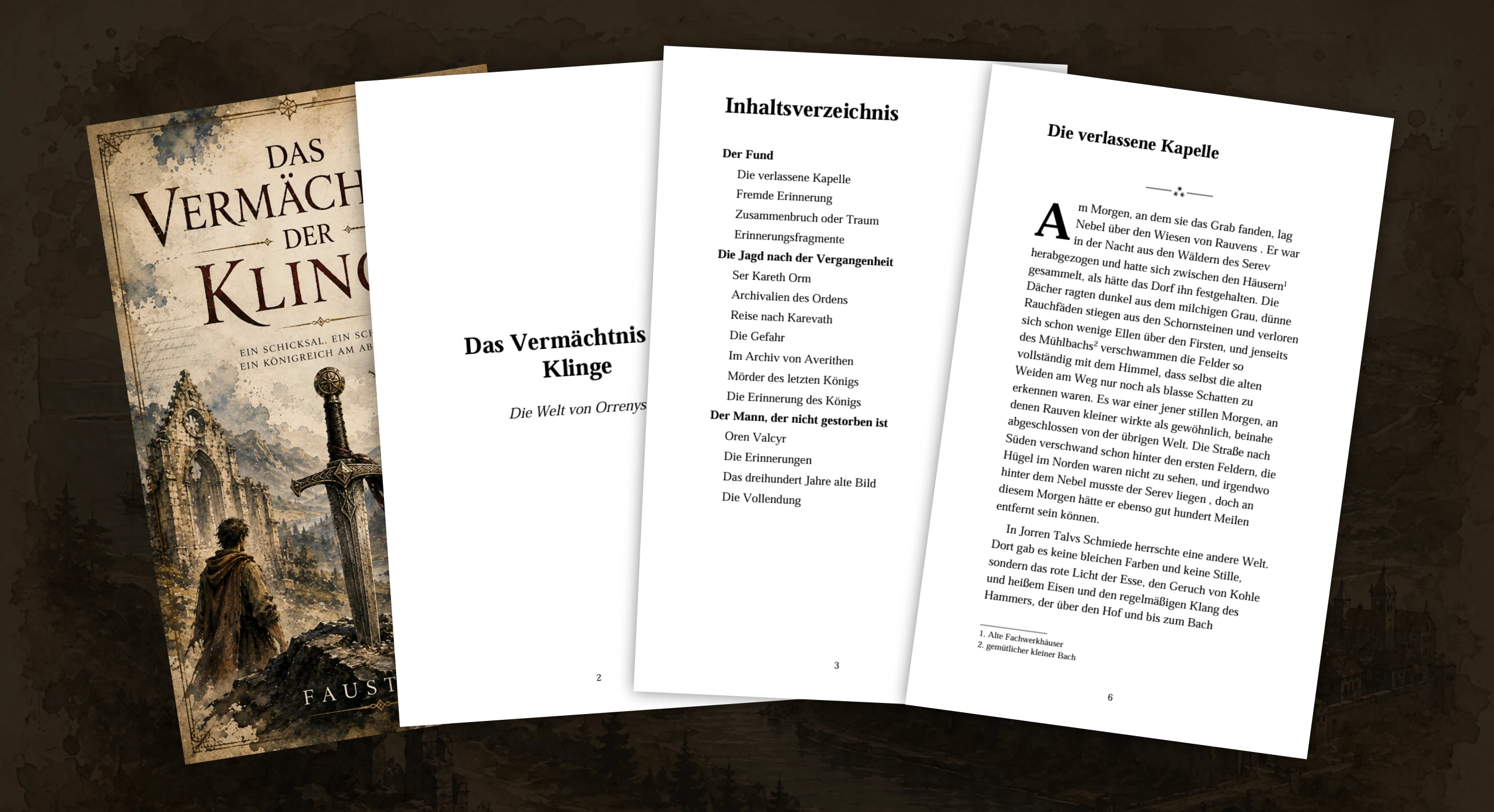
Project Statistics show the length of your manuscript in words, the figure agents and publishers ask for. To work with an editor, you export individual chapters as a Word file with comments and tracked changes and bring the changes back in afterward.
Frequently asked questions
How much does it cost to publish a book?
With a traditional publisher, nothing: the publisher pays for editing, production and distribution and pays you. In self-publishing, the costs depend on which services you buy, above all editing, proofreading, the cover and, if needed, ISBNs. Uploading to many platforms is free in itself; the terms are on their help pages.
Do I need a literary agent to get published?
Not necessarily. Many small and independent presses accept submissions directly from authors. Many large publishers, however, accept submissions only through agents. Each publisher’s website says which applies.
Can I submit my book to several agents at the same time?
In most cases, yes, unless the guidelines say otherwise. Some agents ask for exclusive submissions or want to be told if you receive an offer of representation elsewhere. Keep a record of whom you contacted and when.
Can I sell a self-published book to a publisher later?
In principle, yes, if you still hold the rights. But a book that is already published is usually only interesting to publishers if it has demonstrably sold well. Also check your self-publishing platform’s terms, for example on exclusivity and how to unpublish.